
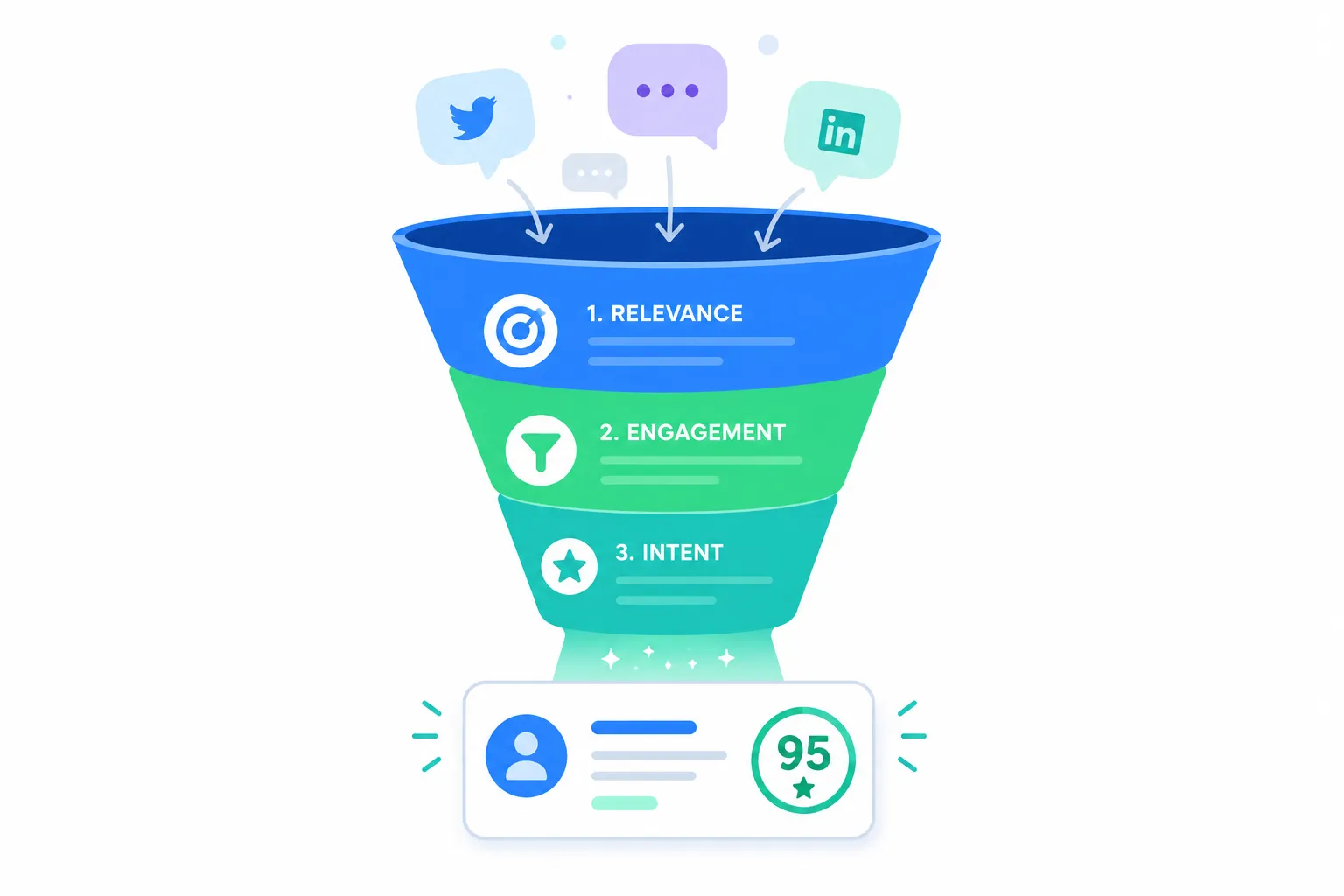
Most social lead generation breaks because every conversation starts to look important.
A founder mentions a problem on Reddit. A user complains about a competitor on X. Someone asks for tool recommendations in a niche subreddit. Your team sees all of it, opens ten tabs, and still ends the day unsure which threads deserved a reply.
That gets expensive fast.
Not because each missed comment costs money directly. Because the best public conversations have a short window. If you reply late, reply badly, or spend your energy on weak signals, you lose the moment where the buyer was actually open to help.
The fix is not “monitor more keywords.”
The fix is scoring conversations simply enough that your team knows what to do next.
In this article, you will learn a practical lead scoring model for public social conversations. You will see what to score, what to ignore, how to separate real buyer intent from noise, and how to turn Reddit and X monitoring into a cleaner daily workflow.
#The Real Problem Is Not Lead Volume
Most teams think they have a lead discovery problem.
They say:
“We need more alerts.”
“We need more keywords.”
“We need to monitor more subreddits.”
Sometimes that is true. But often, the real problem is that they already have enough signals. They just do not have a way to rank them.
A public social conversation is messy by nature. One comment can be a serious buying signal. Another can be a random opinion. Another can be a competitor rant that looks exciting but has no real purchase intent behind it.
Without scoring, your team treats all of them the same.
That creates three problems:
-
Strong conversations get buried under weak alerts.
-
Replies happen too late because nobody knows what is urgent.
-
The team writes generic responses because they do not understand the context.
Lead scoring solves this by giving each conversation a simple priority level before anyone spends time replying.
Not perfect. Just useful.
That is the goal.
#Why Public Social Conversations Need a Different Scoring Model
Traditional lead scoring was built for forms, demos, emails, and website behavior.
That world is cleaner.
Someone visits pricing. Someone downloads a guide. Someone books a demo. You score the action.
Public social conversations are different.
The buyer is not always raising their hand directly. They might be complaining, comparing, asking, researching, venting, or explaining a workflow problem. The signal is in the language, timing, and context.
Imagine these two posts:
“What are some good tools for tracking Reddit mentions?”
And:
“I hate how much time I waste manually searching Reddit for people talking about problems our product solves.”
Both could matter.
The first is obvious. The second is more valuable if your product solves that workflow pain. But if your scoring model only looks for exact tool-request keywords, you may miss the better opportunity.
So your model needs to score intent, context, fit, urgency, and reply opportunity.
Not just keywords.
#The Simple 5-Part Social Lead Score
A good scoring model should be easy enough to use every day.
If your team needs a long spreadsheet, nobody will follow it. If the model is too vague, every lead becomes “maybe worth replying to.”
Use five factors.
Score each from 0 to 20.
That gives every conversation a total score out of 100.
Scoring FactorWhat It MeasuresHigh Score Looks LikeProblem FitDoes the conversation match the problem your product solves?The person describes a pain your product directly helps withBuying IntentIs the person looking for help, tools, vendors, or a better way?They ask for recommendations, alternatives, or solutionsTimingIs the conversation fresh enough to reply while attention is still active?The thread is recent and still getting engagementContext QualityIs there enough detail to write a useful reply?The post explains the situation, constraints, or current workflowTrust-Safe Reply OpportunityCan you reply naturally without sounding promotional?You can help first, then mention your product only if relevantThis is simple, but it works because it forces the right question:
“Is this a real opportunity, or just a mention?”
That difference matters.
#Factor 1: Problem Fit
Problem fit asks one thing:
Does this conversation describe a problem your product actually solves?
Not a nearby problem. Not a broad category. The real pain.
For Leadmatically, strong problem fit might look like:
-
Someone says they miss Reddit conversations because they cannot monitor consistently.
-
A founder asks how to find people discussing a pain their SaaS solves.
-
An agency complains that manual Reddit prospecting is too slow.
-
A team wants to track competitor mentions before buyers choose another tool.
Weak problem fit might be:
-
Someone casually mentions Reddit.
-
Someone talks about social media in general.
-
Someone asks for marketing advice with no clear pain.
-
Someone complains, but the problem has nothing to do with discovery, timing, or replies.
Here is the mental model:
A keyword match means the conversation is related.
Problem fit means the conversation is relevant.
Those are not the same.
#How to score problem fit
Use this quick scale:
-
0–5: Not really related.
-
6–10: Broadly related, but vague.
-
11–15: Clear pain, but not perfectly aligned.
-
16–20: Direct match to the problem your product solves.
Do not over-score vague mentions. That is how noisy pipelines happen.
#Factor 2: Buying Intent
Buying intent is where many teams fool themselves.
A person can describe a problem without being ready to act. That still might be useful for research, but it should not be treated like a hot lead.
High buying intent shows movement.
The person is looking for:
-
a tool
-
a workflow
-
a replacement
-
an alternative
-
a vendor
-
a way to stop doing something manually
-
a comparison between options
For example:
“I’m tired of checking Reddit manually. Is there a tool that alerts me when people mention certain problems?”
That is strong intent.
Now compare it with:
“Reddit is such a weird place for marketing.”
That might be true, but it is not a serious lead.
Buying intent is the difference between someone talking about a topic and someone trying to solve a problem.
#How to score buying intent
Use this scale:
-
0–5: General discussion or opinion.
-
6–10: Pain exists, but no clear action.
-
11–15: Looking for advice or better workflow.
-
16–20: Actively asking for tools, alternatives, or help.
The best social leads often sound like frustration plus motion.
They are not just annoyed. They are trying to change something.
#Factor 3: Timing
Public conversations decay quickly.
A perfect Reddit thread from three weeks ago may still be useful for research, but it is usually not the best place to reply now. The person may have already chosen a tool, lost interest, or stopped checking replies.
Timing does not mean you only reply to brand-new posts. It means you should score freshness honestly.
A good reply has the best chance when:
-
the thread is recent
-
the author is still active
-
comments are still coming in
-
the discussion has not already been answered well
-
competitors have not already dominated the thread
This is why manual social lead generation feels hard. By the time someone finds the thread, the best window is often gone.
That is also where a workflow tool becomes useful. Leadmatically helps by monitoring Reddit and X continuously, so relevant conversations can be found closer to the moment they happen instead of days later. A useful next step is to build a monitoring workflow around high-intent keywords, like the one explained in this guide on finding warm Reddit leads before they go cold.
#How to score timing
Use this scale:
-
0–5: Old conversation with little chance of response.
-
6–10: Somewhat old, but still relevant.
-
11–15: Recent enough to reply.
-
16–20: Fresh, active, and still moving.
Timing should change your priority, not your entire strategy.
Old conversations can still teach you messaging. Fresh conversations deserve action.
#Factor 4: Context Quality
Some leads look promising until you try to write a reply.
Then you realize there is not enough context.
A post that says “Any good marketing tools?” is broad. You could reply, but you will probably sound generic.
A post that says “We sell B2B SaaS to developers and want to monitor Reddit threads where people complain about slow QA workflows. Any tools for that?” is much stronger.
Why?
Because the context helps you write a better response.
You can speak to the situation. You can answer the real problem. You can avoid sounding like a drive-by promotion.
Context quality matters because public replies are not cold emails. Everyone can see them. If your answer feels lazy, promotional, or off-topic, it can damage trust.
#How to score context quality
Use this scale:
-
0–5: Too vague to reply well.
-
6–10: Some context, but still broad.
-
11–15: Enough detail to write a useful response.
-
16–20: Clear situation, pain, audience, and need.
A high-context conversation is usually easier to convert because the reply can be specific.
Specific replies build trust.
Generic replies create resistance.
#Factor 5: Trust-Safe Reply Opportunity
This is the factor most teams ignore.
Just because a conversation is relevant does not mean you should pitch.
Public social platforms punish bad timing and bad tone. Not always through formal rules, but through human reaction. If your reply feels like a sales script, people ignore it or push back.
A trust-safe reply opportunity means you can enter the conversation naturally.
You can:
-
answer the question directly
-
share a useful framework
-
mention a tradeoff
-
give a short example
-
recommend your product only if it fits
-
be transparent about your connection if needed
Bad looks like this:
“Use our tool. It is the best platform for this.”
Better looks like this:
“The tricky part is usually not tracking mentions. It is separating random mentions from buying intent. I would score threads by pain fit, urgency, and whether the person is asking for a tool. Tools like Leadmatically can help with the monitoring side, but I would still keep the reply helpful and specific to the thread.”
The second reply teaches first.
That is why it works better.
#How to score reply opportunity
Use this scale:
-
0–5: Reply would feel forced or promotional.
-
6–10: Possible reply, but risky or awkward.
-
11–15: Clear way to help first.
-
16–20: Natural, helpful, high-trust reply opportunity.
This factor protects your reputation.
That matters because social selling is public.
#What the Final Score Means
Once you score the five factors, you need a simple action rule.
Do not let the score become decoration.
Use it to decide what happens next.
Total ScorePriorityWhat To Do80–100Hot conversationReply quickly with a specific, helpful answer60–79Strong opportunityReview and reply if the context supports it40–59Research or nurtureSave for learning, messaging ideas, or later monitoringBelow 40NoiseIgnore unless it reveals a useful patternThe goal is not to chase every mention.
The goal is to protect your team’s attention.
A 90-score conversation should not sit behind twenty vague alerts. A 35-score mention should not interrupt your day just because it includes a keyword.
#A Practical Example
Let’s score a realistic Reddit post.
“We’re a small SaaS team trying to find people talking about problems our product solves. Right now we manually search Reddit a few times a week, but we always find threads too late. Is there a better way to monitor this without spamming people?”
Here is how the score might look:
FactorScoreWhyProblem Fit20The pain directly matches social lead discoveryBuying Intent18They are asking for a better wayTiming16Assuming the thread is recentContext Quality19Clear team type, workflow, and problemTrust-Safe Reply Opportunity18Easy to answer helpfully without forcing a pitchTotal****91High-priority conversationThis is exactly the type of conversation worth acting on.
Now compare it with:
“Reddit marketing is underrated.”
That might score:
FactorScoreProblem Fit8Buying Intent2Timing12Context Quality4Trust-Safe Reply Opportunity6Total****32Related, yes.
A lead, no.
This is how scoring saves time.
#Build a Workflow Around the Score
A scoring model only works when it becomes part of your daily process.
Here is a simple workflow you can use.
#Step 1: Monitor focused keywords
Start with keywords tied to pain, not just category names.
Instead of only tracking:
-
“Reddit marketing”
-
“lead generation”
-
“social listening”
Track phrases closer to intent:
-
“how do I find customers on Reddit”
-
“tool to monitor Reddit”
-
“Reddit keyword alerts”
-
“alternatives to [competitor]”
-
“tired of manually searching Reddit”
-
“how to find people talking about [pain]”
Pain-based keywords usually produce fewer alerts, but better ones.
That is a good trade.
#Step 2: Score before replying
Do not open every alert and start typing.
Score first.
Even a quick 20-second score gives you discipline. It stops you from reacting emotionally to anything that looks relevant.
Ask:
-
Is the problem real?
-
Is the person looking for help?
-
Is the thread still active?
-
Is there enough context?
-
Can we reply without sounding spammy?
If the answer is weak, move on.
#Step 3: Match reply depth to score
Not every conversation deserves the same effort.
Use this rule:
-
80–100: Write a custom, high-quality reply.
-
60–79: Reply if you can add useful context quickly.
-
40–59: Save for research or future content ideas.
-
Below 40: Ignore.
This keeps your best thinking for the best opportunities.
#Step 4: Track what happens after the reply
Scoring should improve over time.
Track whether the lead was:
-
read
-
replied to
-
ignored
-
converted into a conversation
-
moved into pipeline
-
clearly not a fit
This helps you spot patterns.
Maybe “competitor alternative” threads convert better than “tool recommendation” threads. Maybe posts with lower urgency but higher context lead to better replies. Maybe some subreddits create lots of noise but very little pipeline.
That learning is valuable.
Leadmatically supports this kind of workflow by giving teams a lead queue, AI scoring, status tracking, reply management, and dashboard analytics. The point is not just to find more conversations. It is to make better decisions about which conversations deserve action.
#A Simple Checklist for Scoring Social Leads
Use this before replying to any public conversation.
#Social Lead Scoring Checklist
-
Does the person describe a problem we directly solve?
-
Are they asking for help, tools, alternatives, or a better workflow?
-
Is the conversation still fresh enough for a reply to matter?
-
Is there enough context to write something specific?
-
Can we help first without sounding like we only came to promote?
-
Would this reply build trust even if the person does not buy today?
-
Is this worth a custom response, or should we save it for research?
That last question is important.
Not every useful conversation is a sales opportunity. Some are better used for messaging, content ideas, objection research, or product positioning.
A good workflow knows the difference.
#Common Mistakes to Avoid
#Mistake 1: Scoring keyword matches too high
A keyword is not intent.
If someone mentions your category but does not show pain, urgency, or interest in solving anything, do not treat it like a hot lead.
Keywords help you find conversations.
Scoring helps you choose the right ones.
#Mistake 2: Ignoring reply quality
A high-intent conversation can still be wasted by a bad reply.
If your response sounds automated, desperate, or unrelated to the thread, the score does not matter. The conversation will not move forward.
The reply should feel like it belongs there.
#Mistake 3: Treating every platform the same
Reddit and X behave differently.
Reddit usually rewards deeper, more contextual answers. X often rewards speed, clarity, and brevity. The scoring model can stay the same, but the reply style should change by platform.
Same signal.
Different delivery.
#Mistake 4: Chasing volume instead of learning
More alerts can make the workflow worse if you do not know which ones matter.
A smaller number of high-quality conversations is better than a giant queue full of weak mentions.
The goal is pipeline, not activity.
#FAQ
#What is social lead scoring?
Social lead scoring is a simple way to rank public conversations based on how likely they are to become useful sales opportunities. For Reddit and X, that usually means scoring problem fit, buying intent, timing, context, and whether you can reply in a trustworthy way.
#What is a good score for a Reddit or X lead?
A score above 80 is usually worth a fast, thoughtful reply. A score between 60 and 79 is worth reviewing. Anything below 60 may still be useful for research, but it should not distract your team from stronger opportunities.
#Should every social mention become a lead?
No. Most mentions are not leads. Some are noise. Some are useful market research. Some are content ideas. A lead is a conversation where the person shows a relevant problem, enough intent, and a clear opportunity for a helpful reply.
#Can AI score public conversations accurately?
AI can help score and organize conversations much faster than manual review, especially when it evaluates context instead of just keywords. But the best workflow still uses human judgment for final replies, tone, and trust-sensitive situations.
#How does Leadmatically fit into this workflow?
Leadmatically helps businesses monitor Reddit and X, find relevant conversations, score opportunities, manage replies, and track lead status. It is useful when manual searching becomes too slow and your team needs a repeatable way to find and respond to high-intent conversations.
#Build a Scoring System Before You Scale Alerts
Public social conversations can become a strong acquisition channel, but only if you stop treating every mention like an equal opportunity.
The real advantage comes from knowing which conversations deserve attention.
Find the right conversations. Score them clearly. Reply while the window is still open. Say something useful before asking for anything.
That is how social lead generation becomes a workflow instead of a guessing game.
Leadmatically fits naturally into that workflow for teams that want to monitor Reddit and X, prioritize better conversations, and turn public buyer intent into real pipeline without sounding like spam.