
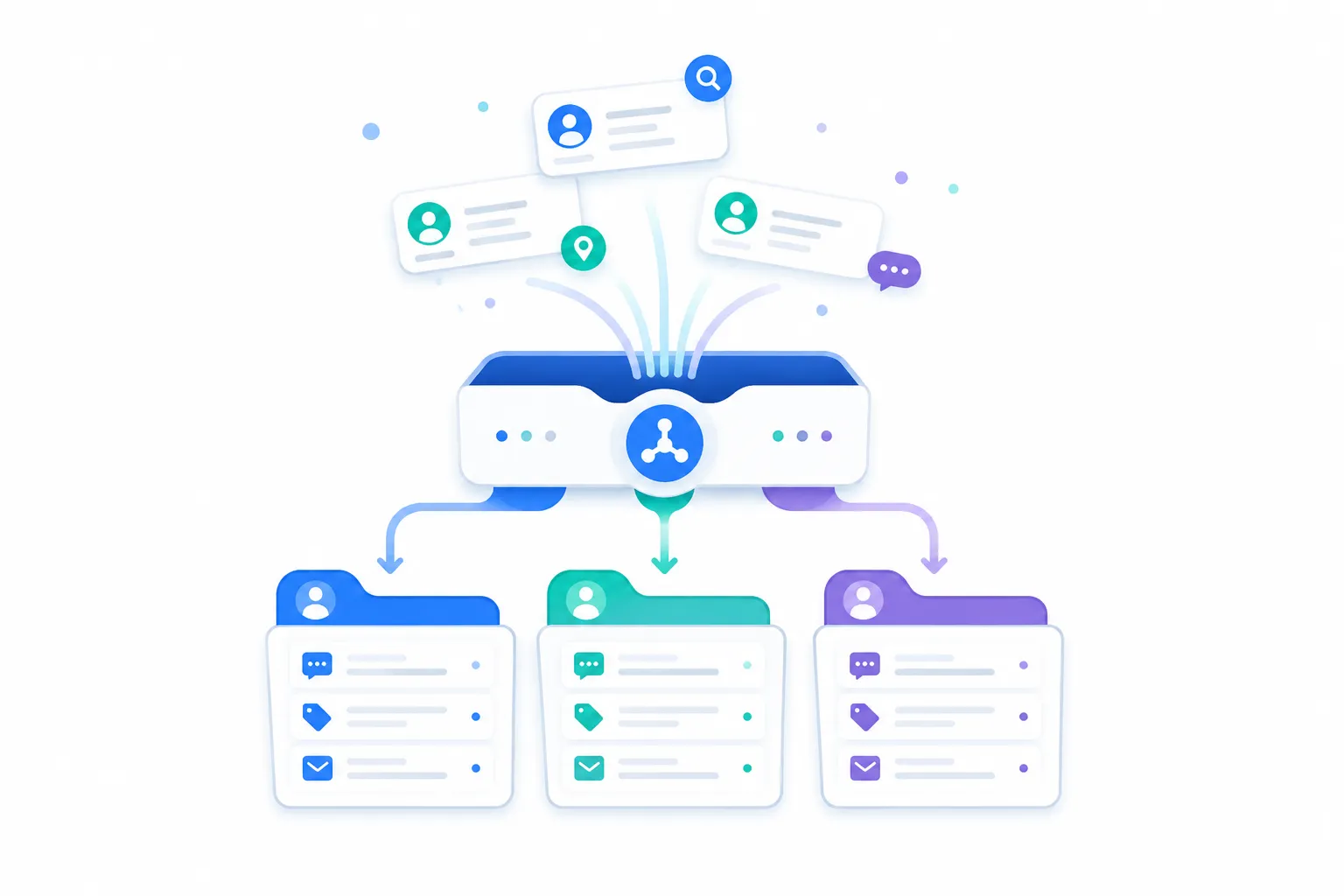
Agency lead generation gets messy fast when every client’s alerts, keywords, replies, and opportunities live in the same pile.
At first, it feels manageable. You have two clients. Then five. Then ten. Someone on your team spots a Reddit thread that looks useful, but nobody remembers which client it belongs to. Another lead gets marked as “handled,” but the reply was actually meant for a different offer. A founder asks why a good conversation was missed, and the only honest answer is: “It got buried.”
That is expensive.
Not because one thread disappeared. Because the system is now leaking trust, timing, and pipeline across every account you manage.
The fix is not simply “use more folders” or “make a better spreadsheet.” Agencies need a lead separation workflow that keeps each client’s pipeline clean while still preserving the full context behind every conversation.
In this guide, you’ll learn how to separate client leads properly, what context you must keep attached, how to avoid mixing signals between clients, and how a tool like Leadmatically fits into the workflow when your agency is managing Reddit and social lead discovery for multiple businesses.
#The Real Problem Is Not Lead Volume
Most agencies think the issue is volume.
Too many alerts. Too many keywords. Too many conversations. Too many clients.
But volume is only the visible problem.
The deeper problem is mixed context.
A lead is not just a message. A lead has a business behind it, an audience, a product, a positioning angle, a pain point, a reply style, and a next step. When that context gets separated from the lead, your team starts making bad decisions.
Imagine this.
You manage two SaaS clients:
-
One sells a Reddit monitoring tool for founders.
-
One sells customer support software for ecommerce stores.
A Reddit user writes:
“We keep missing customer complaints until they blow up.”
That could be relevant to both clients, but the reply should not be the same.
For the monitoring tool, the angle might be:
“You probably need earlier mention tracking before the thread gains traction.”
For the support software, the angle might be:
“You may need a better escalation workflow once those complaints come in.”
Same conversation. Different client. Different context. Different reply.
If your system only captures the thread and not the client-specific reason it matters, your agency will either reply too broadly or assign it to the wrong account.
That is how social lead generation starts to feel chaotic.
#Why Separating Client Leads Matters So Much
When agencies handle social lead discovery manually, they often create one shared workflow:
-
one Slack channel for alerts
-
one spreadsheet for leads
-
one inbox for Reddit threads
-
one list of “interesting conversations”
-
one person deciding what matters
That works for a tiny operation.
It breaks when clients have different offers, different markets, different reply rules, and different risk levels.
The cost shows up in quiet ways.
#You Reply Late
Social conversations have a short window.
If someone asks for recommendations on Reddit, the best time to reply is usually while the thread is still active. If your team spends hours figuring out which client the lead belongs to, the useful window may already be gone.
Late replies often feel like afterthoughts.
The person already got advice. A competitor already jumped in. The thread already went cold. The buyer already moved on.
Agencies do not usually lose social leads in one dramatic moment. They lose them through delay.
#You Reply With the Wrong Angle
A lead may look relevant at the surface level, but the real value depends on why it is relevant.
If your team only sees the keyword match, they may write a generic reply. That reply might mention the product, but it will not feel connected to the person’s actual problem.
That is where trust drops.
Bad reply:
“You should check out this tool. It helps with monitoring.”
Better reply:
“The hard part here is not just monitoring mentions. It is knowing which mentions are worth acting on before the thread gets crowded. I would start by separating customer complaints, competitor mentions, and buying-intent questions into different queues.”
The second reply understands the problem first. The product can come later if it fits.
#You Mix Client Positioning
Agencies often serve clients in similar categories.
That creates overlap.
If two clients target SaaS founders, indie hackers, ecommerce teams, or agencies, the same thread might appear useful for more than one client. Without clear separation, your team may reuse the wrong language, recommend the wrong feature, or confuse the client’s positioning.
That makes the agency look careless.
It is even worse when the clients are close competitors or adjacent solutions. A weak system can put your agency in an awkward position where the same thread is being considered for multiple clients without any clear rules.
You need separation before this happens.
#You Cannot Report Clearly
Clients do not only want to know how many leads you found.
They want to know:
-
which conversations mattered
-
why those conversations were relevant
-
what was replied to
-
what was skipped
-
what turned into pipeline
-
what patterns are showing up
If your leads are mixed together, reporting becomes painful. You end up explaining activity instead of showing progress.
Activity sounds like this:
“We tracked 400 mentions this month.”
Progress sounds like this:
“We found 37 relevant buyer conversations, replied to 16, skipped 9 because they were poor-fit, and found that competitor comparison threads are producing the strongest reply opportunities.”
Clients pay for the second one.
#Separate The Lead, But Keep The Story
Here is the mental model.
A lead should not be stored like a random URL.
It should be stored like a small case file.
That case file should answer:
-
Who is this lead for?
-
What business or client does it belong to?
-
What triggered the match?
-
What pain or buying signal is visible?
-
What is the best reply angle?
-
Has anyone read it?
-
Has anyone replied?
-
What happened after the reply?
This matters because agencies do not just need lead discovery. They need repeatable lead handling.
A clean workflow separates every client’s leads while keeping the full story attached to each opportunity.
That is the difference between a pile of alerts and an actual acquisition system.
#What Bad Client Lead Separation Looks Like
Before building the better version, it helps to see what the broken version looks like.
A bad agency workflow usually has these signs:
Broken WorkflowWhat Goes WrongAll client alerts go into one channelLeads get mixed, duplicated, or assigned lateKeywords are tracked without client ownershipThe team forgets why a thread was capturedReplies are written from memoryMessaging becomes generic or inaccurateStatus is tracked manuallyLeads get marked wrong or forgottenReporting is based on screenshotsClients cannot see a clean pipeline storyTeam members rely on “I think this is for Client A”Mistakes increase as account count growsEvery lead is treated with the same priorityStrong opportunities get buried under weak alertsReply instructions live in someone’s headNew team members cannot respond consistentlyClients share one review queueApproval becomes slow and confusingSkipped leads are not loggedYou cannot learn from false positivesThe biggest warning sign is this:
Your team has to ask, “Which client is this for?” after the lead has already been found.
That question should already be answered by the system.
#The Core Concepts Agencies Need To Get Right
Separating client leads without losing context comes down to a few simple ideas.
#1. Every Lead Must Belong To One Business First
The business or client should be the root of the workflow.
Not the keyword. Not the platform. Not the team member. Not the thread.
The client comes first.
That means every discovered lead should be attached to a specific business profile. This makes reporting easier, reduces confusion, and keeps your team from treating all conversations as interchangeable.
In Leadmatically, this is why businesses act as the root entity for the workflow. Each business has its own targeting layer, leads, and dashboard context, instead of forcing everything into one shared bucket. The uploaded Leadmatically brief describes the admin panel around business management, keyword targeting, Reddit lead queues, dashboard analytics, AI reply prompts, and token/API management, which supports this kind of separated workflow.
#2. Keywords Should Be Client-Specific
A keyword without client context is dangerous.
For example, the keyword “social listening” could apply to:
-
a SaaS monitoring product
-
a marketing agency
-
a reputation management consultant
-
a customer research tool
-
a Reddit lead generation service
The keyword alone does not explain the angle.
A better setup is:
Client A → keywords related to founder-led Reddit lead discovery Client B → keywords related to ecommerce customer complaints Client C → keywords related to agency lead sourcing
Now the keyword is not floating in space. It belongs to a client strategy.
That gives your team a cleaner reason for why the conversation matters.
#3. Lead Status Should Be Separate Per Client
A common agency mistake is tracking status too loosely.
Someone reads a thread and marks it as reviewed. Another person assumes it was handled. Later, the client asks what happened, and nobody knows whether a reply was written.
You need clear statuses like:
-
Pending
-
Read
-
Replied
Simple is fine. In fact, simple is better.
The point is not to create a complicated CRM. The point is to stop losing the operational state of each lead.
A lead that has not been read is different from a lead that has been read and intentionally skipped.
A lead that has been replied to is different from a lead waiting for approval.
A lead that needs a founder-level reply is different from a lead a junior team member can handle.
When those states are clear, your team can move faster without guessing.
#4. Context Should Travel With The Lead
A good lead record should keep the useful details close:
-
source content
-
subreddit or platform
-
business/client
-
score or priority
-
creation date
-
read/reply status
-
original post or comment context
This helps the person writing the reply understand the situation quickly.
Without that context, they are forced to reopen the thread, reread everything, guess the client angle, and rebuild the lead logic from scratch.
That slows the team down.
It also creates inconsistent replies.
One person may see the thread as a buying signal. Another may see it as a support complaint. Another may think it is too early to mention the product. The more context you preserve, the easier it becomes to make the right call.
#The Agency Version Of “Context” Is Bigger Than A Normal Lead
For a solo founder, context might mean:
“This Reddit post looks relevant to my product.”
For an agency, context has more layers.
You need to understand the thread, the client, the campaign, the offer, the rules, and the reporting expectation.
That means every good agency lead needs four types of context.
#1. Conversation Context
This is the original social discussion.
You need to know:
-
What did the person ask?
-
What pain are they showing?
-
Are they complaining, researching, comparing, or ready to buy?
-
Is the thread active?
-
Are other people already recommending tools?
-
Is the tone casual, frustrated, technical, or skeptical?
This decides whether you should reply at all.
#2. Client Context
This is the business behind the lead.
You need to know:
-
What does the client sell?
-
Who do they serve?
-
What problems do they solve best?
-
What should the reply avoid?
-
What claims are approved?
-
What product category should be emphasized?
This decides whether the lead belongs to that client.
#3. Reply Context
This is the angle your team should use.
You need to know:
-
Should the reply be educational?
-
Should it mention the product?
-
Should it ask a follow-up question?
-
Should it compare approaches?
-
Should it stay completely non-promotional?
-
Should it be handled by the client instead of your agency?
This decides how to respond without sounding forced.
#4. Pipeline Context
This is what happens after discovery.
You need to know:
-
Was the lead read?
-
Was it replied to?
-
Did the person respond?
-
Should it be followed up?
-
Should it be included in the client report?
-
Did it reveal a useful market pattern?
This decides how the opportunity affects reporting and learning.
A weak workflow only captures conversation context.
A strong agency workflow captures all four.
#How Agencies Should Think About Lead Ownership
Lead ownership sounds simple until your team grows.
Who owns a lead?
The person who found it? The strategist? The copywriter? The client manager? The client? The person replying?
For agencies, ownership should be split into roles.
#The System Owns Assignment
The system should identify which business or client the lead belongs to.
This should not depend on memory.
If the lead was discovered through Client A’s keywords or monitoring setup, it should enter Client A’s lead queue automatically.
#The Strategist Owns Fit
Someone should decide whether the lead is actually worth pursuing.
Not every mention deserves a reply.
The strategist should look at the thread and decide:
-
Is this relevant?
-
Is the buyer close enough?
-
Is the timing good?
-
Is the reply opportunity natural?
-
Is there risk in replying?
#The Writer Owns The Reply
The person writing the reply should not have to rediscover the whole strategy.
They need the lead context, client context, and reply direction in front of them.
This makes replies faster and more consistent.
#The Account Manager Owns Reporting
The account manager should be able to explain what happened to the client.
That requires clean status tracking, separated lead queues, and useful notes.
If reporting depends on digging through Slack messages and screenshots, the workflow is not ready to scale.
#A Practical Lead Separation Workflow For Agencies
Here is a simple workflow your agency can use.
#Step 1: Create One Workspace Per Client Or Business
Do not start with alerts.
Start with the client.
For each client, define:
-
business name
-
website or product URL
-
target customer
-
core pain points
-
offer category
-
reply boundaries
-
keywords or conversation themes
-
competitor names
-
common objections
-
approved product language
-
topics to avoid
This gives your team a clear container.
A lead should never enter your workflow without knowing which container it belongs to.
#Step 2: Build Targeting Around Each Client’s Actual Buyer
Most bad social lead workflows are too broad.
They track obvious keywords and collect noisy conversations.
For example, if your client sells a tool for SaaS founders, tracking “SaaS” alone will create a lot of noise. You may find funding posts, hiring posts, product launch posts, and random founder updates.
A better targeting setup would include buyer-intent patterns like:
-
“how do I find leads on Reddit”
-
“competitor recommendations”
-
“tool for monitoring Reddit”
-
“where are people talking about my product”
-
“how do I track customer pain points”
-
“best way to find customer complaints”
-
“how to monitor brand mentions”
-
“Reddit tool for lead generation”
The goal is not to capture every mention.
The goal is to capture conversations where the client can be genuinely useful.
For agencies working heavily with Reddit, this is also where a deeper workflow helps. A guide like /blog/reddit-lead-discovery-platform-for-agencies-how-to-turn-reddit-conversations-into-qualified-pipeline fits naturally if you want to turn Reddit conversations into a more organized client pipeline.
#Step 3: Score Leads By Client Fit, Not Just Keyword Match
Keyword matches are not enough.
A thread can contain the right word and still be a bad lead.
Agencies should evaluate each lead based on fit:
SignalWhat To Look ForWhy It MattersPain intensityIs the person clearly frustrated or blocked?Stronger pain usually means stronger intentTimingIs the thread active and recent?Early replies have a better chance of being seenBuyer typeDoes the person match the client’s ideal customer?Wrong audience wastes reply effortContextIs there enough detail to write a useful response?Thin posts lead to generic repliesRelevanceCan the client’s product naturally help?Forced replies damage trustCompetitionAre competitors already mentioned?This can create a strong comparison opportunityToneIs the thread open to suggestions?Some threads punish promotional repliesSpecificityIs the problem concrete or vague?Specific problems produce better repliesUrgencyDoes the person need help soon?Urgent pain often creates better response windowsThis is where agencies need discipline.
Do not reply just because the lead exists.
Reply when the conversation has enough fit, timing, and context to justify showing up.
#Step 4: Assign Replies With The Client Angle Included
A reply brief should not simply say:
“Reply to this.”
It should say:
“Reply as Client A. Focus on missed Reddit conversations. Do not pitch immediately. Mention the workflow problem first. Offer a practical suggestion before naming the product.”
That gives the writer direction.
The best replies usually follow this order:
-
Acknowledge the person’s problem.
-
Add one useful insight.
-
Explain what they can try.
-
Mention the product only if it fits naturally.
-
Keep the tone human.
This is especially important on Reddit, where people can smell lazy promotion quickly.
#Step 5: Keep Reporting Client-Specific
Your reporting should show each client their own pipeline view.
At minimum, track:
-
leads discovered
-
leads read
-
leads replied to
-
average quality
-
best-performing topics
-
missed opportunities
-
reply outcomes
-
next workflow improvements
This makes client conversations much easier.
Instead of saying:
“We found 300 Reddit leads this month.”
You can say:
“We found 43 relevant conversations for your product, replied to 18, skipped 12 because they were low fit, and noticed three recurring pain points around competitor comparison, monitoring fatigue, and late replies.”
That sounds like strategy.
#How To Separate Similar Clients Without Creating Conflict
This is one of the hardest parts for agencies.
You may serve clients that are not direct competitors but still overlap.
For example:
-
Client A sells social listening software.
-
Client B sells customer research software.
-
Client C sells founder-led sales consulting.
-
Client D sells a Reddit lead generation service.
A single Reddit thread about “finding customers from Reddit” could be relevant to all four.
So what do you do?
You need a simple conflict rule.
#Rule 1: Match The Lead To The Strongest Natural Fit
Ask:
“Which client can help this person most directly?”
Not which client pays more. Not which client has fewer leads this week. Not which client you want to impress.
The best fit should win.
If the person is asking for a tool, the software client may fit better.
If the person is asking for a strategy, the consulting client may fit better.
If the person is asking how to monitor conversations, the social listening client may fit better.
#Rule 2: Do Not Force Multiple Clients Into The Same Thread
Reddit users do not want a thread filled with obvious agency-driven replies.
If your agency tries to push multiple clients into the same conversation, it can damage trust.
Even if you use different accounts, the pattern can feel unnatural.
A better approach is to choose the strongest fit and skip the others.
#Rule 3: Keep A Record Of Why You Skipped A Lead
Skipped leads are still useful.
If Client B was not selected because Client A was a stronger fit, note that.
Over time, this helps you understand:
-
which clients overlap too much
-
which keyword sets need refinement
-
which offers are attracting similar conversations
-
where positioning needs to become sharper
Skipping is not failure.
Untracked skipping is the problem.
#The Reply Quality Problem Agencies Often Ignore
Lead separation is not only about organization.
It also affects reply quality.
When your team does not understand which client a lead belongs to, replies become generic. And generic replies are usually the fastest way to lose trust in public conversations.
Bad agency reply:
“This is a common problem. Our client helps with this. You should check them out.”
Better agency reply:
“The tricky part is that most teams only notice these conversations after they are already active. I would separate the workflow into three parts: monitoring the right keywords, filtering for real buying intent, and replying with something useful before mentioning the product. That keeps you from chasing every random mention.”
The better reply teaches first.
It gives the reader something useful.
Then, if the product naturally fits, the mention feels earned.
This is the core rule for social lead generation:
Do not enter the conversation like a salesperson. Enter like someone who understands the problem.
That only happens when the lead carries the right context.
#A Better Internal Review Process
Agencies should not let every discovered lead go straight to a reply.
A simple review process protects quality.
#Stage 1: Discovery
The system or team finds the lead.
The lead is attached to a specific client and source.
#Stage 2: Qualification
Someone reviews whether it is worth acting on.
They check:
-
relevance
-
timing
-
buyer fit
-
thread tone
-
risk
-
reply opportunity
#Stage 3: Reply Direction
The lead gets a short angle.
For example:
“Helpful educational reply. Mention that manual searching becomes unreliable once volume grows. Do not mention product in first sentence.”
#Stage 4: Reply Draft
The writer creates a reply based on the thread context.
The reply should be specific enough to feel human.
#Stage 5: Approval Or Send
Depending on the client agreement, either the agency replies or the client reviews and replies.
The Leadmatically positioning includes both paths: Leadmatically can support a done-for-you style where replies are handled for the customer, or a self-reply workflow where the user uses suggested replies.
#Stage 6: Status Update
The lead is marked as replied, skipped, read, or pending.
This is what keeps reporting clean later.
#What To Include In A Client Lead Record
A useful lead record does not need to be complicated.
But it should include enough information to avoid guessing.
Here is a practical structure:
FieldWhy It MattersClient / BusinessKeeps the lead attached to the right accountSourceShows whether it came from Reddit, X, or another channelOriginal URLLets the team inspect the live conversationContent PreviewHelps reviewers understand the thread quicklyKeyword TriggerShows why the lead was capturedAI Score / PriorityHelps sort urgent or high-fit leadsStatusKeeps the workflow movingReply AngleGuides the writerRead AtShows whether the lead was reviewedReplied AtShows whether action was takenNotesPreserves human judgmentWithout these fields, your team will keep rebuilding context manually.
That is slow, inconsistent, and hard to report.
#How Leadmatically Helps Agencies Keep Workflows Clean
Leadmatically is useful for agencies because it treats lead discovery as an organized client workflow, not just a stream of alerts.
Instead of throwing every Reddit opportunity into one messy inbox, Leadmatically lets you structure discovery around businesses, keywords, lead queues, statuses, AI scores, and reply workflows.
That matters when you manage multiple clients.
You can keep each business separate, track relevant Reddit leads, see status clearly, and use AI reply prompts to guide better responses. The goal is not to automate spam. The goal is to help your team find the right conversations earlier and respond with more context.
Leadmatically’s admin structure supports this kind of separation through business management, keyword management, Reddit lead tracking, AI reply prompts, and dashboard analytics with business and period filters.
That is the agency advantage.
Not “more alerts.”
Better separation. Better timing. Better replies. Better reporting.
#A Simple Checklist For Separating Client Leads
Use this checklist before your agency scales social lead discovery across more accounts.
#Client Setup Checklist
-
Each client has a separate business profile.
-
Each client has clear target customers.
-
Each client has its own keyword set.
-
Each client has approved reply angles.
-
Each client has topics you should avoid.
-
Each client has a defined lead quality standard.
-
Each client has clear reporting expectations.
-
Each client has a decision rule for overlapping leads.
#Lead Handling Checklist
-
Every lead is attached to one client.
-
Every lead has a clear source.
-
Every lead has enough context to understand the pain.
-
Every lead has a status.
-
Every reply has a client-specific angle.
-
Every skipped lead has a reason, even if simple.
-
Every high-priority lead is reviewed quickly.
-
Every reply is written for the thread, not copied from a template.
#Reporting Checklist
-
Leads are reported per client.
-
Replies are tracked separately.
-
High-quality examples are saved.
-
Low-quality patterns are reviewed.
-
Keyword targeting is improved regularly.
-
The client can understand what changed and why.
-
Reports include insight, not just activity.
-
Repeated pain points are turned into strategy recommendations.
This is not complicated.
But it does require consistency.
#A Weekly Review Workflow For Agencies
Separating leads is not a one-time setup. You need a weekly review rhythm.
This is where agencies get better over time.
#Review The Best Leads
Look at the highest-quality leads for each client.
Ask:
-
Why did this lead work?
-
Which keyword found it?
-
Was the reply angle clear?
-
Did the thread match the client’s ideal buyer?
-
Should we look for more conversations like this?
Good leads teach you what to track next.
#Review The Bad Leads
Bad leads are not useless.
They show you where your targeting is too broad.
Ask:
-
Which keywords created noise?
-
Which subreddits produced weak conversations?
-
Which leads looked relevant but were not?
-
Which client got too many false positives?
Then adjust.
#Review Missed Timing
Some leads are good but discovered too late.
That means your monitoring or review process needs improvement.
Ask:
-
Did the lead sit pending too long?
-
Was the thread already cold?
-
Did approval slow things down?
-
Did the team know who should reply?
Timing problems usually point to process problems.
#Review Reply Quality
Pull a few replies and read them like a normal Reddit user.
Ask:
-
Does this feel useful?
-
Does it sound too promotional?
-
Does it match the thread?
-
Does it mention the product too early?
-
Would someone trust this reply?
This is uncomfortable but valuable.
Agencies that review replies honestly improve much faster than agencies that only count replies.
#Common Mistakes Agencies Should Avoid
#Mistake 1: Using One Generic Keyword List For Every Client
This creates noise.
Even if clients are in similar markets, their buyers are not always looking for the same thing. Build keyword sets around the client’s actual offer, not your agency’s general idea of the industry.
#Mistake 2: Treating Reddit Like A Cold Outreach Channel
Reddit is not a place where people want random pitches.
A good reply should feel like it belongs in the thread. It should be useful even if the person never clicks anything.
That is how trust starts.
#Mistake 3: Replying Before Understanding The Thread
Speed matters, but speed without context creates bad replies.
Read the post. Check the comments. Understand what the person is actually asking. Then decide whether the client fits.
#Mistake 4: Reporting Activity Instead Of Insight
Clients do not need a giant list of links.
They need to understand what the market is saying and what your agency is doing about it.
Show patterns. Show decisions. Show next steps.
#Mistake 5: Letting Team Members Remember Context Manually
Memory does not scale.
Your system should carry the context. Your team should not have to remember which client, keyword, reply angle, and status belongs to every lead.
#Mistake 6: Using The Same Reply Style For Every Client
Some clients should sound technical. Some should sound casual. Some should be direct. Some should avoid product mentions unless asked.
If every reply sounds the same, your agency is not really representing the client.
#Mistake 7: Overvaluing Lead Count
More leads are not always better.
A client would rather get 20 strong conversations than 200 weak mentions.
Lead quality, timing, and reply fit matter more than raw volume.
#A Better Before And After
Before:
Your team monitors Reddit manually. Leads go into a shared sheet. Some are assigned in Slack. Some are replied to. Some are forgotten. Reporting takes hours because nobody knows which conversations were actually useful.
After:
Each client has a separate business workflow. Keywords are tied to that client. Leads appear in the correct queue. Scores and statuses help the team prioritize. Replies are written with the right context. Reporting shows what happened for each client.
That is the difference between chasing conversations and managing a real lead system.
#FAQ
#How should an agency separate leads for multiple clients?
Start by making the client or business the root of the workflow. Every keyword, lead, reply, and report should connect back to that client. Do not manage all alerts in one shared pile.
#Should two clients ever share the same lead?
Sometimes, but be careful. If a conversation genuinely fits two clients, treat it as two separate decisions. Each client needs a different angle, and you should avoid replying in a way that creates conflict or looks unnatural.
#How many keywords should each client track?
Start small. A few strong keywords or pain-based phrases are better than a huge list of broad terms. Expand after you see which conversations are actually useful.
#What is the biggest risk when managing client leads manually?
The biggest risk is losing context. Once your team forgets why a lead matters, who it belongs to, or what reply angle fits, the quality of the workflow drops quickly.
#How do you stop client lead queues from becoming noisy?
Review false positives every week. Remove broad keywords, refine phrases around buyer pain, and separate informational conversations from real intent. Noise usually means the targeting is too loose.
#Should agencies reply from their own accounts or client accounts?
It depends on the client’s strategy and risk tolerance. Some clients want to reply themselves using suggested replies. Others want a more managed workflow. The important thing is that replies should feel human, useful, and relevant to the thread.
#What should be included in a client lead report?
A useful report should include leads found, leads reviewed, replies sent, high-quality examples, skipped lead reasons, common pain points, and recommended targeting changes. Do not only send a list of links.
#Can Leadmatically help agencies manage multiple client lead workflows?
Yes. Leadmatically is designed around business-specific lead discovery, keyword targeting, Reddit lead queues, statuses, scoring, and reply workflows. That makes it easier to keep client pipelines separate without losing the context needed to reply well.
#Final Thought
Agencies do not lose good social leads only because they are not looking hard enough.
They lose them because the workflow is too messy.
When client leads are mixed together, context disappears. When context disappears, replies get weaker. When replies get weaker, trust drops. And when trust drops, even good opportunities stop turning into pipeline.
The better approach is simple.
Separate every client’s leads clearly. Keep the full context attached. Prioritize conversations based on fit and timing. Reply like a helpful person, not a campaign. Then report what actually matters.
That is how social lead generation becomes repeatable.
And that is where Leadmatically fits: helping agencies find the right Reddit and social conversations, keep them organized by business, and turn them into better replies without losing the context that makes those replies work.