
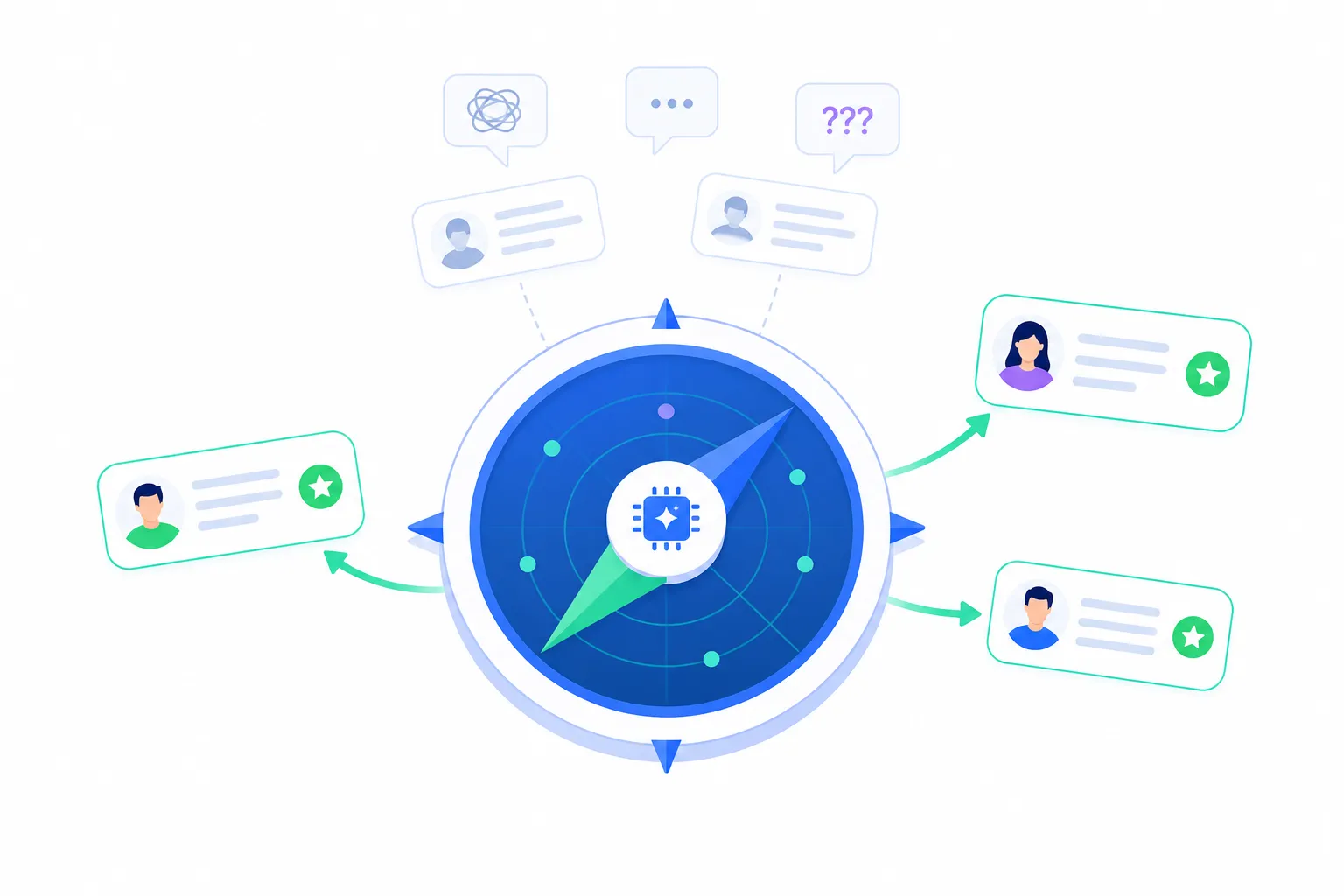
Most AI startups do not struggle because nobody needs what they built.
They struggle because the right people never see it at the right moment.
That is expensive. You can spend weeks polishing a landing page, launching on Product Hunt, posting feature updates, and sending cold DMs, while real buyers are already asking for help inside Reddit threads, X conversations, niche Slack groups, Discord servers, forums, and comment sections. The demand is there. The problem is that it is scattered, messy, and easy to miss.
The better approach is not to “promote harder.”
It is to find the public conversations where your future users are already describing the problem in their own words. Then you show up with something useful before the thread goes cold.
This article will show you how AI startups can find early users in public communities without sounding desperate, spammy, or robotic. You will learn what to look for, where to search, how to reply, and how to turn scattered conversations into a repeatable early-user workflow.
#Early Users Are Usually Already Talking Somewhere
Early-stage founders often assume they need to create demand from scratch.
That is rarely true.
For most AI products, the pain already exists. People are already complaining about manual work, broken workflows, expensive tools, slow processes, messy spreadsheets, bad handoffs, or time-consuming tasks. They may not be using your exact words, but they are describing the problem your product solves.
Imagine you built an AI tool that summarizes sales calls.
A weak founder searches for:
“sales call summary software”
A smarter founder searches for conversations like:
“How do you keep track of customer calls?” “I keep forgetting action items after demos” “Best way to write CRM notes faster?” “Our sales reps hate updating HubSpot”
The second group is closer to real demand.
They are not browsing software categories. They are living inside the pain.
That is where early users come from.
#Why Public Communities Matter More for AI Startups
AI startups have a trust problem.
People have seen too many vague AI tools that promise to “save time,” “automate workflows,” or “10x productivity.” Most buyers are skeptical now. They do not want another generic pitch. They want to know if your product understands their exact situation.
Public communities help because they show you the real language of the market.
You can see:
-
what people complain about repeatedly
-
what alternatives they already tried
-
what they hate about current tools
-
what they are willing to pay for
-
what words they use when describing the pain
-
what objections appear before they even reach your website
That information is more useful than a polished buyer persona.
A persona says:
“Marketing manager, 28–40, wants productivity.”
A Reddit thread says:
“I spend 3 hours every Friday copying campaign data into a client report and I hate it.”
That second sentence can shape your landing page, your demo, your reply, your onboarding, and your product roadmap.
#The Goal Is Not Traffic. The Goal Is Signal.
A lot of founders chase public communities the wrong way.
They look for places with the most users. Big subreddits. Viral X threads. Huge communities. High-traffic forums.
But early users usually come from signal, not size.
A small niche community with 20 serious buyers is more valuable than a huge community full of casual browsers.
You are looking for signs of intent.
High-intent signals include:
SignalWhat it usually meansExampleSomeone asks for tool recommendationsThey are actively comparing options“What tool can automate this?”Someone complains about a recurring workflowThe pain is frequent, not random“I do this manually every week”Someone mentions switching toolsThey may be open to alternatives“We are leaving Tool X”Someone asks how others solve a problemThey are looking for a better process“How do you handle this at your company?”Someone mentions budget, time, or team impactThe problem has business weight“This costs us hours every month”Someone compares competitorsThey are already in buying mode“Is Tool A better than Tool B?”This is the mental model:
Low-intent conversation is attention. High-intent conversation is opportunity.
Your job is to find the second one.
#Where AI Startups Should Look First
You do not need to monitor the whole internet.
Start with places where people openly describe problems and ask for help.
Reddit is one of the strongest places for early-user discovery because people are blunt. They complain clearly. They ask for recommendations. They compare tools. They explain what broke.
For AI startups, Reddit is especially useful because many users are still trying to understand which AI tools are actually useful and which ones are just wrappers.
Good subreddit types to watch:
-
niche professional communities
-
SaaS founder communities
-
productivity communities
-
role-specific communities
-
software recommendation communities
-
industry-specific communities
-
competitor-related discussions
The trick is not to search only for your product category.
Search for the pain.
For example, if your AI product helps agencies write client reports, do not only monitor:
“AI reporting tool”
Also monitor:
“client reporting takes too long” “weekly reports agency” “how do you report results to clients” “automate client updates” “spreadsheet reporting nightmare”
That is how you find users before they know the name of the solution.
#X
X is useful for fast-moving conversations, especially around builders, indie hackers, AI tools, product teams, marketing teams, and startup operators.
The problem is that X moves quickly.
A good opportunity can appear and disappear in a few hours. If you reply two days later, it can feel random or forced.
Use X for:
-
people asking for recommendations
-
founders complaining about workflows
-
creators sharing tool stacks
-
public competitor feedback
-
product comparison threads
-
niche AI use-case discussions
The best replies on X are short, specific, and useful. Do not write a long sales message. Add context, share a practical suggestion, then mention your product only if it fits naturally.
#Niche Forums and Communities
Some markets still have strong forums, private communities, Slack groups, Discord servers, Facebook groups, and industry boards.
These are harder to monitor, but often higher trust.
The rule is simple:
Do not enter a community only to extract leads.
Learn the language first. Understand the norms. See what people reward and what they ignore. If every reply you post sounds like a landing page, people will notice.
#How to Search for Early Users Without Wasting Hours
Manual searching works for a few days.
Then it becomes messy.
You search Reddit in the morning. You check X at night. You bookmark a few threads. You forget to follow up. You reply late. You lose track of what worked.
That is why you need a simple workflow.
Start with four buckets.
#1. Pain Keywords
These are words people use when they are frustrated.
Examples:
-
“takes too long”
-
“manual”
-
“wasting time”
-
“annoying”
-
“hate doing”
-
“too expensive”
-
“hard to manage”
-
“looking for a better way”
-
“any tool for”
-
“how do you automate”
Pain keywords help you find raw demand.
#2. Category Keywords
These are direct solution terms.
Examples:
-
“AI note taker”
-
“AI customer support tool”
-
“AI reporting software”
-
“AI sales assistant”
-
“AI writing workflow”
-
“AI data extraction”
Category keywords help you find people who already know what kind of solution they want.
#3. Competitor Keywords
These are names of tools your audience already uses.
Monitor:
-
competitor complaints
-
cancellation discussions
-
alternative requests
-
pricing complaints
-
feature gaps
-
migration questions
Be careful here.
Do not jump into every competitor thread with “try my tool instead.” That looks weak.
A better reply is:
“The issue you are running into is usually caused by X. One workaround is Y. If you want a lighter option, I’m building something focused specifically on Z.”
That feels helpful. Not desperate.
#4. Outcome Keywords
These are tied to what the user wants, not what your product is.
Examples:
-
“save time on reports”
-
“reply faster to customers”
-
“reduce support tickets”
-
“find leads”
-
“write proposals faster”
-
“clean messy data”
-
“summarize meetings”
-
“track customer feedback”
Outcome keywords often reveal buyers who are not searching for AI yet, but are ready for a better workflow.
#How to Know If a Conversation Is Worth Replying To
Not every mention deserves a reply.
Some threads are too broad. Some users are not buyers. Some questions are just curiosity. Some communities hate promotion of any kind.
Before replying, ask five questions:
-
Is the person describing a real problem?
-
Is the problem repeated, expensive, or urgent?
-
Can your product genuinely help?
-
Can you add value without pitching immediately?
-
Is the thread still active enough for a reply to matter?
If the answer is no, skip it.
This is where many founders go wrong. They reply to everything because they want visibility. But bad-fit replies can damage trust faster than silence.
Better to reply to 10 strong conversations well than 100 weak conversations poorly.
#The Right Way to Reply Without Sounding Like Spam
A good community reply does three things:
-
It proves you understood the context.
-
It gives something useful immediately.
-
It introduces your product only when relevant.
Bad reply:
“We built an AI tool for this. Check us out.”
Better reply:
“This usually gets painful when the workflow depends on copying notes between three different tools. One thing that helps is separating capture, summary, and follow-up into separate steps. I’m building an AI tool for this exact problem, but even without a tool, I’d start by standardizing the summary format first.”
The better reply works because it does not ask for trust immediately.
It earns a little trust first.
#Simple Reply Framework
Use this structure:
StepWhat to doExampleAcknowledgeShow you understood the situation“Yeah, this gets messy fast when…”DiagnoseExplain the root problem simply“The real issue is not the notes, it is the handoff after the call.”HelpGive one practical suggestion“Try using a fixed format: summary, objections, next step, owner.”BridgeMention your product only if useful“I’m building a tool around this, happy to share if helpful.”Notice the soft bridge.
You are not forcing the pitch. You are opening the door.
That matters.
#Turn Conversations Into a Learning Loop
Finding early users is not just a sales activity.
It is product research.
Every public conversation can teach you something.
Track:
-
the exact words people use
-
the problem they describe
-
what they already tried
-
what they dislike about existing tools
-
whether they mention budget or urgency
-
what reply style gets engagement
-
what objections appear repeatedly
After 30 to 50 strong conversations, patterns will appear.
You may realize your homepage uses the wrong language. You may find a smaller but more painful niche. You may discover that people do not want “AI automation,” they want “less manual cleanup before Monday meetings.”
That is a better message.
Early users do not just give you signups.
They give you market language.
#A Practical Weekly Workflow for Finding Early Users
Here is a simple workflow an AI startup can use without turning community monitoring into a full-time job.
#Monday: Choose the Problem Theme
Pick one problem area for the week.
Example:
“Founders wasting time turning customer calls into product insights.”
Do not monitor everything. Focus creates better results.
#Tuesday: Search Pain and Outcome Keywords
Look for fresh conversations on Reddit and X.
Save the best threads. Ignore weak ones.
Prioritize people asking for help, comparing tools, or describing repeated pain.
#Wednesday: Reply With Useful Advice
Reply to the strongest opportunities.
Do not copy-paste.
Match the tone of the community. A Reddit reply should sound different from an X reply. A technical founder reply should sound different from a small business owner reply.
#Thursday: Follow Up and Learn
Check which replies got engagement.
Did anyone ask for the product? Did anyone disagree? Did people ignore the reply? Did the thread reveal a better angle?
This feedback matters.
#Friday: Update Your Messaging
Use what you learned to improve:
-
landing page headline
-
onboarding questions
-
demo script
-
product positioning
-
FAQ
-
cold outreach angle
-
keyword monitoring list
This is how public community work compounds.
You are not just chasing random users. You are building a sharper understanding of the market every week.
#When to Use a Tool Instead of Doing It Manually
Manual monitoring is useful at the beginning because it forces you to read the market yourself.
But once you know the kinds of conversations that matter, manual searching becomes a bottleneck.
You miss threads. You reply late. You forget keywords. You spend too much time searching and not enough time talking to users.
That is where Leadmatically fits naturally.
Leadmatically helps businesses monitor Reddit and X for relevant conversations, find qualified leads, and manage the reply workflow. Instead of manually checking communities every day, you can set up your business, track the right keywords, review discovered leads, and decide whether to reply yourself or let Leadmatically handle human-crafted replies.
For AI startups, that matters because timing is part of trust.
A helpful reply in the first hour feels useful. The same reply three days later can feel like outreach.
If Reddit is a key channel for your early-user strategy, this guide on finding high-intent Reddit conversations without spamming is a useful next step: /blog/how-to-find-leads-on-reddit-without-spamming-a-better-workflow-for-high-intent-social-selling
#Common Mistakes AI Startups Make in Public Communities
#Mistake 1: Pitching Before Helping
People do not owe you attention because you built something.
Lead with usefulness.
If your product mention is the first useful part of your reply, the reply is probably too promotional.
#Mistake 2: Searching Only for “AI” Keywords
Many great users are not searching for AI.
They are searching for outcomes.
They want fewer manual tasks, faster replies, cleaner reports, better notes, easier analysis, or less admin work.
Monitor the pain, not just the category.
#Mistake 3: Replying Too Late
Public conversations have a short window.
If someone asks for tool recommendations and gets 20 replies before you arrive, your chance is weaker. Speed is not everything, but it matters.
#Mistake 4: Using the Same Reply Everywhere
Copy-paste replies are easy to detect.
A good reply should feel like it belongs in that exact thread.
Use the person’s context. Mention their specific problem. Keep the tone natural.
#Mistake 5: Treating Communities Like Ad Channels
Communities are not ad inventory.
They are trust networks.
If you show up only when you want something, people can feel it. If you show up with useful answers, practical examples, and honest tradeoffs, your product mention becomes more acceptable.
#Early User Discovery Checklist
Before you start posting, use this checklist.
Positioning
-
Do you know the exact pain your AI product solves?
-
Can you describe it without using vague AI language?
-
Do you know who feels this pain most often?
Search
-
Do you have pain keywords?
-
Do you have outcome keywords?
-
Do you have competitor keywords?
-
Do you know which communities your buyers actually use?
Qualification
-
Is the conversation recent?
-
Is the user describing a real problem?
-
Is there business urgency?
-
Can your product genuinely help?
-
Can you reply without forcing a pitch?
Reply
-
Did you acknowledge the context?
-
Did you give practical advice?
-
Did you avoid sounding automated?
-
Did you mention your product only where it fits?
-
Did you invite a next step softly?
Learning
-
Did you save the thread?
-
Did you record the user’s exact language?
-
Did you note objections?
-
Did you update your messaging based on patterns?
This is the difference between random posting and a real acquisition workflow.
#FAQ
#How do AI startups get their first users?
AI startups can get their first users by finding people already discussing the problem in public communities, replying with useful advice, and offering the product only when it fits the context. Reddit, X, niche forums, and founder communities are often better starting points than broad paid ads because they reveal real pain in the user’s own words.
#Should I promote my AI product on Reddit?
You can mention your AI product on Reddit, but only when it is relevant and useful. Direct promotion usually performs badly. A better approach is to answer the question first, explain the problem clearly, share a practical suggestion, and then mention your product softly if it genuinely helps.
#What keywords should AI startups monitor?
Monitor a mix of pain keywords, outcome keywords, category keywords, and competitor keywords. For example, instead of only tracking “AI sales tool,” also track phrases like “manual CRM notes,” “sales follow-up takes too long,” “summarize customer calls,” and competitor alternatives.
#How quickly should I reply to public community conversations?
The sooner the better, especially when someone is actively asking for recommendations or help. Many high-intent threads lose momentum within hours. A useful early reply has a much better chance of earning attention than a late promotional comment.
#Is community monitoring better than cold outreach?
It depends on your market, but community monitoring often gives AI startups warmer context. Instead of interrupting someone who may not care, you join a conversation where the person has already shown interest, pain, or buying intent. That makes the reply more natural and often more trusted.
#Final Thought
Early users are not hiding.
They are complaining, asking, comparing, and searching in public.
The hard part is not whether demand exists. The hard part is seeing it early enough, understanding the context, and replying in a way that builds trust instead of burning it.
For AI startups, public communities can become one of the strongest early acquisition channels because they give you two things at once: users and market learning.
Start small. Track the right problems. Reply like a helpful operator, not a marketer. Save what you learn. Improve the workflow every week.
And when manual searching starts slowing you down, use a system like Leadmatically to help you find the right conversations earlier and turn them into a repeatable lead discovery process.