
Most client lead workflows break because they depend on someone remembering to check Reddit or X at the right time.
That sounds small until you see the cost.
A buyer asks for a tool recommendation. A founder complains about the exact problem your client solves. A competitor gets mentioned in a thread full of warm prospects. Nobody sees it until two days later. By then, the thread is cold, the buyer has already chosen something, and your reply looks late or forced.
That is not a content problem. It is a workflow problem.
Good Reddit/X lead generation is not about posting more, scraping random mentions, or dropping client links into every thread. It is about finding the right conversations early, understanding why they matter, and responding in a way that feels useful instead of promotional.
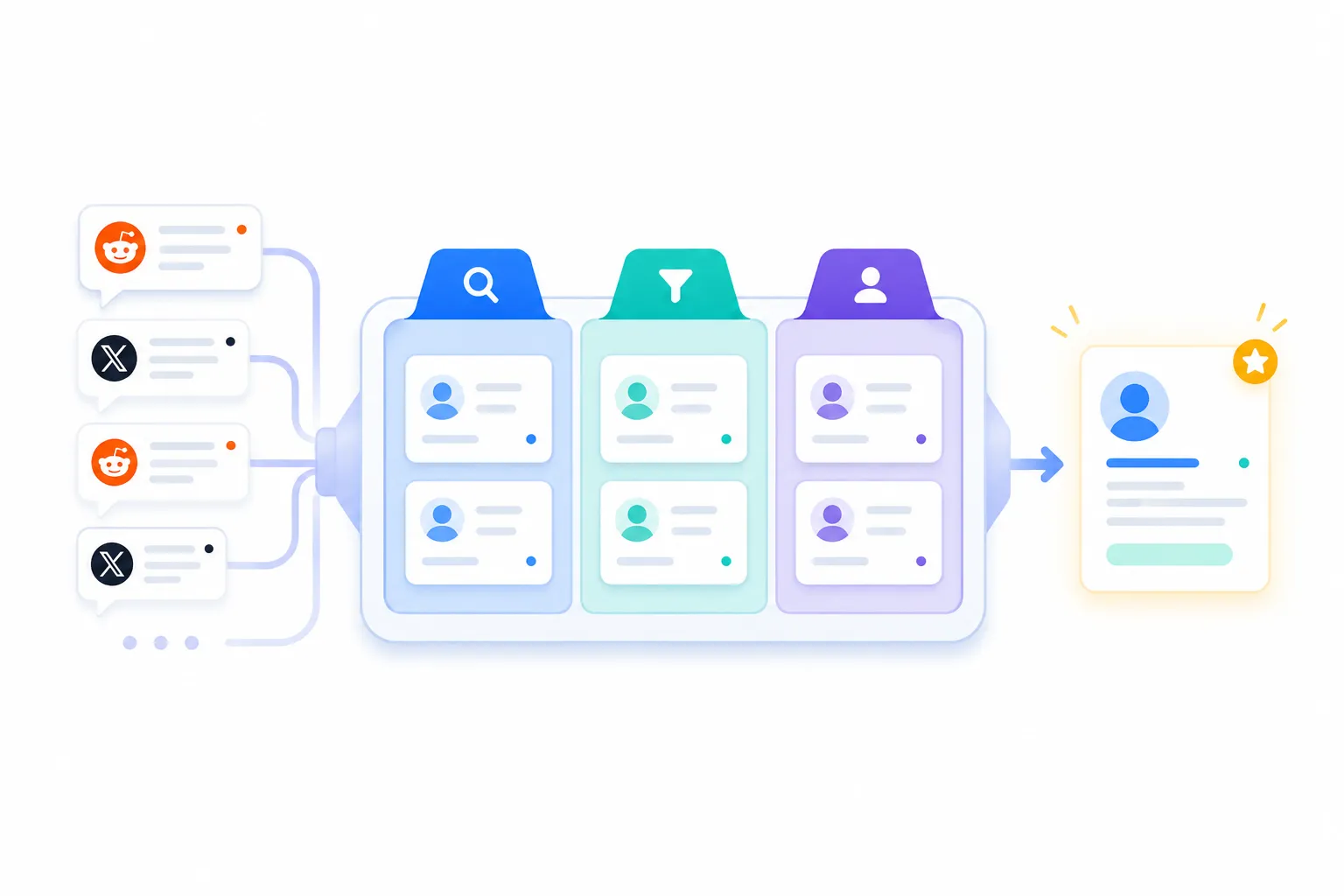
In this guide, you will learn how to build a repeatable Reddit/X lead workflow for clients that helps you discover better opportunities, separate noise from real buyer intent, reply faster, and report results without guessing.
#The Big Problem: Social Leads Are Easy to Miss and Hard to Organize
Reddit and X are messy by nature.
People do not usually write clean buying-intent phrases like:
“I am ready to purchase project management software today.”
They say things like:
“I am tired of using spreadsheets for this.”
“Has anyone found a decent tool for this?”
“We tried [competitor], but it feels too expensive.”
“What are you all using for this workflow?”
Those are valuable signals. But they are scattered across posts, comments, replies, subreddits, niche communities, and fast-moving X discussions.
Now add clients into the mix.
One client sells SaaS to agencies. Another sells ecommerce software. Another offers a service for startup founders. Each one has different keywords, competitors, pain points, tone, and ideal customers.
If your workflow is just “search Reddit sometimes and save links in a spreadsheet,” things will fall apart quickly.
You will miss good conversations. You will mix up leads between clients. You will waste time reading low-intent threads. Worse, you may reply in a way that damages trust because you are rushing to catch up.
#Why Repeatability Matters More Than Random Effort
A one-off search can find a few leads.
A repeatable workflow builds a channel.
That difference matters.
Random effort feels busy. Repeatable effort creates consistency. When your client asks where leads came from, what was replied to, what worked, and what should change next month, you need more than screenshots and memory.
You need a system.
A good Reddit/X workflow should answer five questions clearly:
Workflow QuestionWhy It MattersWhat are we monitoring?Keeps targeting focused instead of broad and noisyWhich conversations are worth acting on?Prevents wasted time on low-intent threadsWho should reply and how?Protects trust and avoids spammy responsesWhat happened after the reply?Helps connect social activity to pipelineWhat should improve next?Turns the workflow into a learning loopWithout this structure, Reddit and X become another messy “brand awareness” activity that is hard to explain to clients.
With it, social listening becomes a practical acquisition system.
#Start With Client Intent, Not Keywords
Most bad workflows start with keywords.
A better workflow starts with intent.
Keywords matter, but they are only useful when they map to real buyer situations. If you monitor broad terms, you will collect broad noise. If you monitor intent-rich phrases, pain points, and competitor mentions, you will find conversations that are much closer to action.
For example, imagine your client sells customer support software.
A weak keyword list might include:
-
customer support
-
helpdesk
-
support tool
-
live chat
That will catch too much general discussion.
A better list includes buying signals:
-
“looking for helpdesk software”
-
“alternative to Intercom”
-
“Zendesk too expensive”
-
“how do you handle support tickets”
-
“best support tool for SaaS”
-
“tired of managing support in Gmail”
The second list is closer to how real buyers talk when they are frustrated, comparing options, or asking for help.
That is where your workflow should begin.
#Build a Client Lead Map Before You Monitor Anything
Before setting up alerts or tracking conversations, create a simple lead map for each client.
This keeps the workflow clean.
A client lead map should include:
-
The main product or service
-
The ideal customer
-
The pain points that usually appear before someone buys
-
Competitors people compare against
-
Common “tool recommendation” phrases
-
Communities or topics where buyers hang out
-
Reply tone rules
-
What counts as a qualified lead
This step feels basic, but it prevents most problems later.
Without a lead map, every mention looks tempting. With a lead map, your team knows what deserves attention and what should be ignored.
#Example: Before and After
Before:
“Find Reddit posts about CRM software.”
After:
“Find Reddit and X conversations where small agency owners complain about managing leads in spreadsheets, ask for CRM recommendations, compare HubSpot alternatives, or mention missed follow-ups.”
The second version is much more useful. It gives your workflow direction.
#Separate Discovery, Qualification, and Replying
One reason client social workflows become chaotic is that everything gets treated as one task.
Someone finds a thread, decides whether it is relevant, writes a reply, sends it, and tries to remember to track it later.
That is too much for one messy moment.
A stronger workflow separates the process into three layers.
#1. Discovery
This is where you collect possible opportunities.
Discovery should be broad enough to catch useful conversations, but not so broad that your queue becomes useless. Monitor Reddit posts, Reddit comments, X posts, competitor mentions, pain phrases, and recommendation requests.
The goal is not to reply to everything.
The goal is to create a clean stream of possible leads.
#2. Qualification
This is where you decide whether the conversation is worth action.
Ask:
-
Is the person showing a real problem?
-
Is the timing still fresh?
-
Does the client’s offer fit naturally?
-
Is the thread active enough to matter?
-
Would a reply help the conversation?
-
Is this a buyer, researcher, competitor, or random commenter?
Qualification protects your client’s reputation. It stops you from replying just because a keyword matched.
#3. Replying
This is where the actual trust-building happens.
A good reply should feel like it belongs in the thread. It should answer the person’s question first, add useful context, and only mention the client when it genuinely fits.
Bad reply:
“We built the best tool for this. Check us out.”
Better reply:
“If your main issue is tracking replies across multiple clients, I would avoid using a plain spreadsheet because it gets messy fast. You probably want something that separates leads by client, tracks status, and lets you see which conversations still need replies. A few tools can help with this depending on how hands-on you want to be.”
That reply earns attention before asking for anything.
#Create a Simple Scoring System for Leads
You do not need a complex scoring model to start.
You just need a clear way to sort conversations.
A simple 1–5 score works well:
ScoreMeaningAction1Irrelevant or too broadIgnore2Mildly related but no clear intentSave only if useful for research3Relevant pain, weak timing or unclear fitMonitor or lightly engage4Strong problem and good fitPrepare a thoughtful reply5High-intent buyer asking for help nowReply quickly and track closelyThis helps your team avoid treating every mention equally.
A competitor mention from six months ago is not the same as a fresh post asking for recommendations today. A casual joke is not the same as someone saying they are about to switch tools.
Lead quality depends on context.
#Reply Timing Is Part of the Strategy
Speed matters on Reddit and X.
Not because you need to spam replies instantly, but because conversations have a natural window.
Early replies often get more visibility. They are more likely to shape the conversation. They are more likely to be seen by the original poster before they make a decision.
Late replies can still work, but they need to be much stronger. If you show up after ten other recommendations, your reply must add something new.
That is why manual searching is risky for client work.
If you only check once a week, you are mostly finding old conversations. You may still collect insights, but you are missing the best acquisition window.
A repeatable workflow should include daily monitoring at minimum. For high-value clients, it should be closer to real-time discovery with clear thresholds for what gets attention first.
This is where a tool like Leadmatically fits naturally. Instead of relying on manual searches, Leadmatically helps monitor relevant Reddit and X conversations, organize discovered leads by business, and support faster replies so good opportunities do not sit unnoticed until the thread is already cold.
#Match the Reply to the Conversation Type
Not every lead needs the same response.
A recommendation request needs one style. A complaint needs another. A competitor comparison needs another. A technical question needs another.
Here is a practical way to think about it:
Conversation TypeWhat the Person WantsBest Reply StyleTool recommendationOptions and tradeoffsHelpful comparison, light product mention if relevantPain complaintValidation and practical fixEmpathetic, specific, no hard pitchCompetitor mentionBetter alternative or explanationBalanced, not aggressiveWorkflow questionStep-by-step helpEducational reply with clear processBad experienceTrust and cautionHelpful guidance, avoid opportunistic sellingThe mistake is using one reply template for everything.
That is how brands sound automated.
A strong workflow should include reply guidelines for each client. Not rigid scripts, but useful rules.
For example:
-
Start with the person’s problem, not the product
-
Avoid sounding like a founder defending their tool
-
Mention the client only when the fit is obvious
-
Give one practical suggestion before any CTA
-
Keep replies natural for the platform
-
Do not overuse links
-
Do not reply to threads where the brand would feel intrusive
This protects trust.
#Build a Client-Friendly Tracking System
Clients do not just want “we monitored Reddit.”
They want to know what happened.
A useful tracking system should show:
-
Leads found
-
Lead source
-
Conversation link
-
Client/business
-
Keyword or trigger
-
AI or manual score
-
Status
-
Reply status
-
Date discovered
-
Date replied
-
Notes or next action
This turns scattered conversations into a manageable pipeline.
It also helps you improve the workflow over time.
If one keyword generates many low-quality leads, adjust it. If competitor mentions convert better than generic pain phrases, monitor more competitor terms. If replies work better in certain communities, prioritize those places.
Without tracking, you are guessing.
With tracking, you are building a repeatable client acquisition process.
#A Practical Reddit/X Lead Workflow You Can Use
Here is a simple workflow you can use for each client.
#Step 1: Define the Client Lead Map
Write down the client’s offer, audience, pain points, competitors, buying triggers, and bad-fit signals.
This keeps the workflow focused from day one.
#Step 2: Create Keyword and Intent Groups
Do not throw all keywords into one bucket.
Group them by purpose:
-
Pain keywords
-
Competitor keywords
-
Recommendation keywords
-
Industry keywords
-
Problem phrases
-
Brand mentions
This makes reporting and optimization easier later.
#Step 3: Monitor Reddit and X Consistently
Set up a daily or real-time discovery process.
The goal is to catch fresh conversations while the reply window is still open.
#Step 4: Score and Filter Leads
Use a simple score to separate real opportunities from noise.
Do not let your team reply to everything. That creates spam risk and wastes time.
#Step 5: Write Context-Aware Replies
Match the reply to the thread.
Teach first. Help first. Mention the client only when it makes sense.
#Step 6: Track Status
Mark each lead as new, read, replied, ignored, or follow-up needed.
This prevents leads from disappearing into Slack messages or spreadsheets.
#Step 7: Review Weekly
Look at which keywords, communities, reply styles, and client angles produced the best conversations.
Then improve the system.
That weekly review is where the channel gets smarter.
#What Bad Looks Like vs What Better Looks Like
Bad workflow:
-
Search Reddit manually when you remember
-
Use broad keywords
-
Save links in a messy spreadsheet
-
Reply with the same promotional angle
-
Forget which client each lead belongs to
-
Report vague activity at the end of the month
Better workflow:
-
Monitor Reddit and X consistently
-
Use intent-based keyword groups
-
Score leads before replying
-
Separate clients clearly
-
Write replies based on thread context
-
Track reply status and results
-
Improve targeting every week
The better workflow does not require more noise.
It requires more structure.
#Where Leadmatically Helps
Leadmatically is useful when the manual version starts slowing you down.
If you are handling one client casually, you can begin with a simple spreadsheet and daily searches. But once you manage multiple clients, multiple products, or multiple keyword groups, the workflow needs a real system.
Leadmatically helps by giving you a place to manage businesses, keywords, discovered Reddit leads, reply workflows, and analytics without mixing everything together.
That matters because client work depends on clarity.
You need to know which business a lead belongs to, why it was discovered, whether it has been read, whether someone replied, and whether the conversation is still worth action.
For teams trying to turn Reddit into a repeatable lead channel, this is the difference between “we found some mentions” and “we have a working lead workflow.”
For a deeper setup path, you can also read the Leadmatically setup guide from zero to first qualified lead: /blog/leadmatically-setup-guide-from-zero-to-first-qualified-lead
#A Simple Checklist Before You Scale the Workflow
Before adding more clients, more keywords, or more reply volume, check this:
-
Do you know each client’s best-fit buyer?
-
Do you know which pain phrases signal real intent?
-
Are competitor mentions tracked separately?
-
Can you tell which leads belong to which client?
-
Are leads scored before someone replies?
-
Are replies written for context, not copied from a generic template?
-
Can you see what has been replied to?
-
Can you report leads found, replies sent, and pipeline movement?
-
Do you review keyword quality weekly?
-
Are you protecting trust by ignoring bad-fit threads?
If the answer is no, do not scale yet.
Fix the workflow first.
More volume will only make a messy system messier.
#FAQ
#How often should I monitor Reddit and X for client leads?
For active client campaigns, daily monitoring is the minimum. For competitive niches or high-value services, faster monitoring is better because the best conversations often move quickly.
#Should every Reddit or X mention become a lead?
No. A keyword match is not the same as buyer intent. Treat mentions as possible leads, then qualify them based on fit, timing, context, and whether a reply would actually help.
#Is it okay to mention a client’s product in replies?
Yes, but only when it fits the conversation naturally. The reply should be useful even if the person never clicks the link. If the product mention feels forced, leave it out.
#What is the biggest mistake agencies make with Reddit/X lead generation?
The biggest mistake is treating it like outreach instead of conversation discovery. Reddit and X work better when you find people already discussing a problem and respond with context, not when you push a pitch into random threads.
#Can this workflow work for multiple clients?
Yes, but only if clients are separated clearly. Each client needs its own lead map, keywords, scoring rules, reply style, and tracking. Otherwise, leads get mixed together and reporting becomes unreliable.
#Turn Social Conversations Into a System
Reddit and X can be strong lead channels, but not when they are handled randomly.
The opportunity is not just “find mentions.”
The opportunity is to build a workflow that finds the right conversations early, filters them properly, replies with trust, and tracks what happens next.
That is what clients actually need.
They do not need more noise. They need a repeatable way to turn scattered buyer conversations into qualified pipeline.
Leadmatically exists for that exact workflow: finding relevant Reddit and X conversations, organizing them by business, and helping teams respond before good opportunities go cold.