
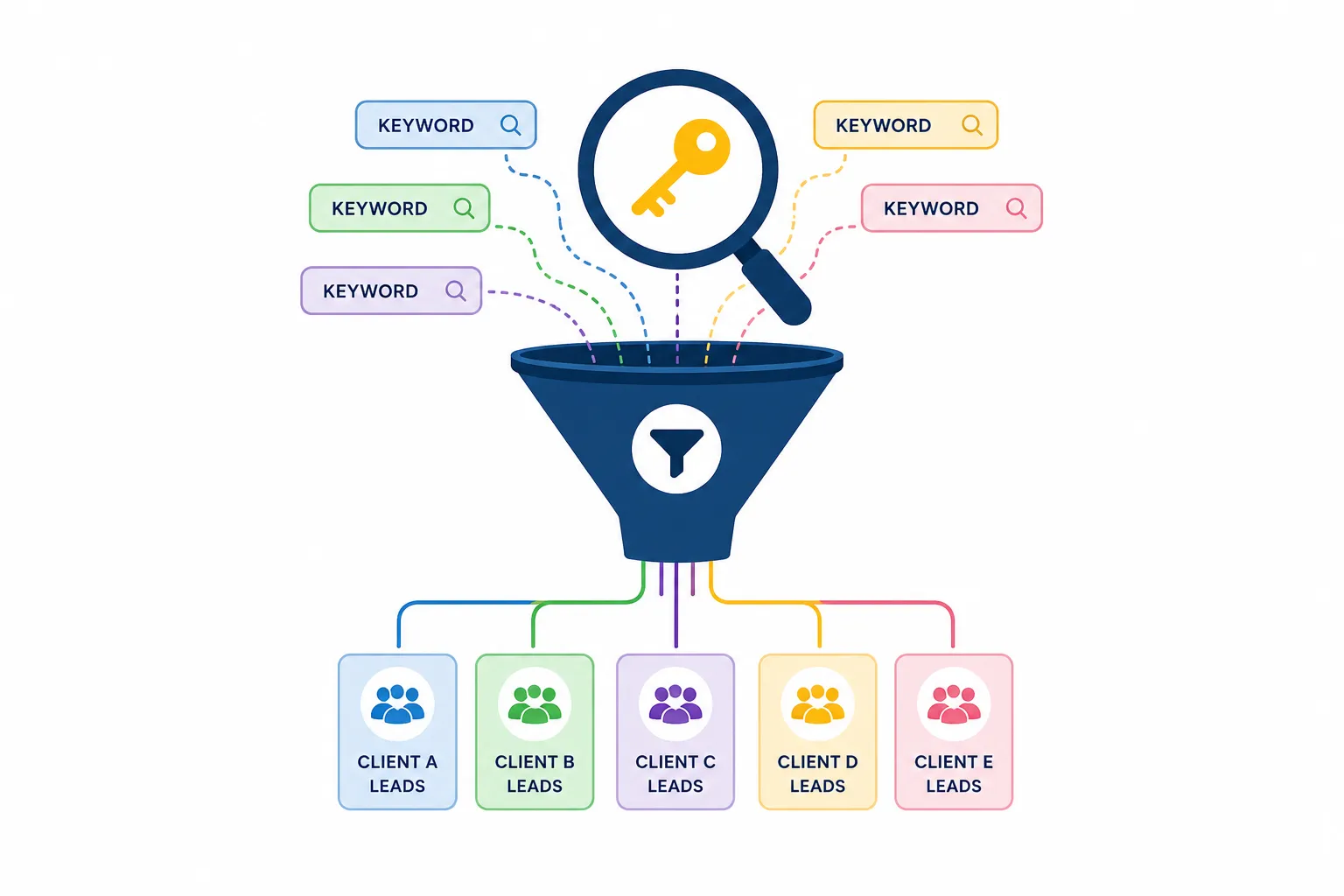
Running one social listening campaign is already messy.
Running five, ten, or thirty client campaigns without a clean keyword system can turn into a full-time cleanup job. Alerts pile up. Leads get mixed between clients. Your team starts replying to weak conversations because the real buying signals are buried under noise. And worst of all, clients begin wondering why “lead generation” feels so random.
The fix is not adding more keywords.
The fix is choosing keywords with intent, separation, and workflow in mind. A good keyword setup should help you find the right conversations early, understand which client they belong to, and decide whether the reply is worth your time before the thread goes cold.
In this guide, you’ll learn how to choose keywords for multiple client campaigns without creating a noisy social listening system. You’ll see how to separate broad research terms from buying-intent terms, how to avoid keyword overlap between clients, and how to build a repeatable process your team can actually manage.
#Why Keyword Choice Gets Harder With Multiple Clients
When you manage one campaign, keyword mistakes are annoying.
When you manage multiple campaigns, keyword mistakes multiply.
A vague keyword might create a few bad alerts for one client. But across several clients, that same kind of vague targeting can flood your dashboard with weak conversations, duplicate leads, and confusing reply decisions.
Imagine this.
You manage campaigns for:
-
a project management SaaS
-
a CRM consultant
-
an AI writing tool
-
a web design agency
-
a customer support platform
If you track broad keywords like “software,” “tool,” “agency,” “automation,” or “AI,” you will collect a lot of conversations. But most of them will not be useful. Your team will spend more time deciding what to ignore than deciding what to reply to.
That is not a lead generation system.
That is a noise collection system.
Good keyword planning for multiple clients has one job: reduce confusion before the leads arrive.
#The Real Goal: Separate Conversations by Buyer Intent
Most people choose keywords by asking:
“What words describe this client?”
That is the wrong starting point.
A better question is:
“What would someone say when they are close to needing this client’s product or service?”
That small shift changes everything.
For example, a client might sell Reddit monitoring software. You could track “Reddit” and “monitoring,” but those terms are too broad. You will catch people discussing moderation, social media trends, API changes, brand drama, and random subreddit issues.
Better keywords would sound closer to a problem:
-
“how do I monitor Reddit mentions”
-
“track Reddit keywords”
-
“find Reddit leads”
-
“Reddit alerts for brand mentions”
-
“tool to monitor subreddits”
-
“Reddit lead generation”
These phrases show a clearer job-to-be-done.
They tell you the person is not just talking about a topic. They may be trying to solve a problem.
That is the difference between a keyword and a buying signal.
#Start With the Client’s Actual Offer
Before choosing keywords, get painfully clear on what each client actually sells.
Not the category.
Not the tagline.
The actual offer.
A client might say they sell “AI automation for agencies.” That could mean anything. Are they helping agencies automate reporting? Lead scraping? Proposal writing? Client onboarding? Inbox replies? Social listening?
Each one needs different keywords.
A useful campaign brief should answer:
-
What does the client sell?
-
Who buys it?
-
What pain makes someone look for it?
-
What alternatives do buyers mention?
-
What words do buyers use when frustrated?
-
What communities do these buyers hang out in?
-
What would a high-intent conversation look like?
You do not need a 20-page strategy document.
You need enough clarity to avoid guessing.
#Bad Keyword Planning
Bad keyword planning starts with categories:
-
SaaS
-
marketing
-
growth
-
automation
-
leads
-
AI
These terms are too wide. They may describe the client, but they do not reveal enough intent.
#Better Keyword Planning
Better keyword planning starts with buyer language:
-
“where can I find leads”
-
“Reddit lead generation tool”
-
“how to monitor competitor mentions”
-
“alternative to cold email”
-
“customers talking about my brand”
-
“social listening for small business”
These terms are closer to real demand.
They are messier, but more useful.
That is the point.
Real buyers do not speak in perfect category pages. They complain, compare, ask, search, and describe problems in rough language.
#Build Keyword Buckets for Every Client
For multiple client campaigns, do not throw every keyword into one flat list.
Use buckets.
Buckets help you understand why a keyword exists and how aggressively your team should treat the leads it finds.
Here is a simple structure.
Keyword BucketWhat It CapturesExamplePriorityPain keywordsPeople describing the problem“manual Reddit search takes too long”HighSolution keywordsPeople looking for a tool or service“Reddit monitoring tool”HighCompetitor keywordsPeople mentioning alternatives“Brand24 alternative for Reddit”Medium to highCategory keywordsBroad industry terms“social listening”MediumUse-case keywordsSpecific workflow needs“track Reddit comments for leads”HighNegative/noisy keywordsTerms to avoid or treat carefully“free karma,” “Reddit drama”Filter outThis makes campaign management easier because each keyword has a purpose.
You are not just collecting phrases.
You are building a map of demand.
#Use Pain Keywords to Find Early Conversations
Pain keywords are often the most valuable because they catch people before they formally start shopping.
These are the conversations where someone says:
“I’m tired of manually checking Reddit for mentions.”
Or:
“Does anyone know how to find people asking for tools like ours?”
They may not be searching for a product yet, but the need is visible.
For client campaigns, pain keywords are useful because they create warmer reply opportunities. You are not jumping into a thread with a pitch. You are responding to a real frustration.
Bad reply:
“Use our software. It solves this.”
Better reply:
“Yeah, this gets messy fast if you’re checking manually. One way to handle it is to track specific pain phrases and separate them from broad category mentions. That way you only reply when the thread shows actual intent.”
That kind of reply builds trust first.
The product can come later if it fits.
#Use Solution Keywords to Catch Buyers Closer to Action
Solution keywords are more direct.
These are phrases people use when they already know they need something.
Examples:
-
“best Reddit monitoring tool”
-
“tool for tracking Reddit mentions”
-
“software for finding social leads”
-
“Reddit keyword alerts”
-
“social listening tool for agencies”
These are usually higher-intent than broad topics.
But they are also more competitive.
If someone asks for “best Reddit monitoring tool,” other vendors may reply too. Timing matters. Your team needs to see the conversation early and respond with something useful before the thread fills with generic recommendations.
This is where a tool like Leadmatically fits naturally. It helps you monitor Reddit conversations, organize lead queues by business, and act on qualified opportunities instead of manually searching across every client campaign.
For a deeper workflow on this idea, you can use this related guide as a bridge: how to find leads on Reddit without spamming.
#Use Competitor Keywords Carefully
Competitor keywords can be powerful, but they can also make your brand look desperate if handled badly.
If someone mentions a competitor, do not rush in with:
“We are better. Try us.”
That usually sounds weak.
Instead, look at the context.
Are they complaining? Are they comparing options? Are they asking for alternatives? Are they describing a missing feature? Are they unhappy with pricing? Are they trying to solve a workflow problem?
A competitor mention is only useful when it reveals a reason to respond.
For example:
Low-intent competitor mention:
“I saw this company launched a new feature.”
High-intent competitor mention:
“We tried this tool but it misses Reddit comments and the alerts are too broad. Any better options?”
The second one is worth attention.
For multiple clients, competitor keywords should be separated clearly. Otherwise, one client’s competitor research can pollute another client’s lead queue.
#Avoid Broad Keywords Unless You Have a Reason
Broad keywords are tempting because they create volume.
Volume feels good in a dashboard.
But volume is not pipeline.
A keyword like “marketing” might produce hundreds of results, but most of them will not be useful for a client selling a niche B2B tool. Your team will waste time reading posts that were never a fit.
Broad keywords can still be useful in two cases:
-
You are doing market research.
-
You combine them with tighter filters, scoring, or context rules.
For example, “social listening” alone is broad.
But “social listening for Reddit leads” is much sharper.
“AI” alone is almost useless for lead discovery.
But “AI tool to monitor Reddit for customer pain points” is much closer to intent.
The narrower phrase may produce fewer alerts, but the alerts will be easier to act on.
That is usually a better tradeoff.
#Watch for Keyword Overlap Between Clients
This is one of the biggest problems in agency-style social listening.
Different clients can appear to need similar keywords.
For example:
-
a lead generation agency
-
a cold email tool
-
a Reddit monitoring tool
-
a sales automation SaaS
All of them might care about “leads,” “prospecting,” “sales,” and “outreach.”
If you reuse the same keywords across all campaigns, you will create confusion. The same conversation may look relevant to multiple clients, but the reply angle should not be the same.
You need separation.
Ask:
-
Which client is the best fit for this conversation?
-
What specific pain makes it relevant to that client?
-
Is the keyword too generic to assign confidently?
-
Does this phrase create duplicate alerts across campaigns?
-
Would the reply be different for each client?
If the answer is unclear, the keyword is probably too broad.
#Create a Keyword Map Before Activating Campaigns
Do not activate keywords as soon as you think of them.
Map them first.
A simple keyword map can prevent weeks of messy alerts.
Use this structure:
ClientBuyer SegmentPain KeywordSolution KeywordCompetitor KeywordNotesClient ASaaS founders“missing Reddit mentions”“Reddit monitoring tool”“[competitor] alternative”Focus on founder-led salesClient BAgencies“too many client leads to track”“lead tracking for agencies”“[competitor] pricing”Avoid generic “leads”Client CEcommerce brands“customers complain on Reddit”“brand monitoring Reddit”“[competitor] reviews”Reputation-focusedThis gives you a working system before the alerts start.
It also helps your team understand what each client campaign is trying to catch.
#Score Keywords Before You Use Them
Not every keyword deserves to be active.
Some keywords sound useful in a planning doc but create weak alerts in practice.
Use a simple scoring system before adding them.
#Keyword Quality Checklist
Give each keyword a score from 1 to 5.
QuestionScoreDoes this keyword suggest a real problem or buying need?1–5Is it specific enough to separate this client from others?1–5Would a reply feel natural in the conversation?1–5Is the phrase likely to appear in real Reddit or X discussions?1–5Can the client actually help the person using this phrase?1–5If a keyword scores low on specificity or reply fit, do not activate it yet.
Rewrite it.
For example:
Weak keyword:
“automation”
Better keyword:
“automate Reddit lead tracking”
Weak keyword:
“customer feedback”
Better keyword:
“find customer complaints on Reddit”
Weak keyword:
“agency leads”
Better keyword:
“how agencies track leads for multiple clients”
Specificity is what turns a keyword from noise into a useful trigger.
#Use Negative Keywords and Exclusions
Choosing good keywords is only half the job.
You also need to remove bad matches.
Negative keywords help you avoid conversations that look relevant on the surface but are not useful.
For example, if a client sells B2B lead generation software, you may want to exclude:
-
job posts
-
free tool requests
-
student research
-
memes
-
unrelated crypto terms
-
hiring threads
-
support-only discussions
-
spammy promotion threads
The exact exclusions depend on the client.
The goal is not to block every imperfect match. That is impossible.
The goal is to reduce obvious noise so your team spends more time on real buyer conversations.
#Match Keywords to Reply Strategy
A keyword should not only decide what you monitor.
It should also shape how you reply.
Different keyword buckets need different reply styles.
#Pain Keyword Reply
When someone is describing frustration, lead with empathy and practical advice.
Example:
“Yeah, this gets hard once you’re tracking more than a few terms. The mistake is usually treating every mention as equal. I’d separate pain phrases from general category mentions first, then only reply when the post shows a real workflow problem.”
#Solution Keyword Reply
When someone asks for tools, be direct but still helpful.
Example:
“If you’re mainly trying to catch Reddit conversations early, look for something that separates keyword alerts by business/client and lets you score lead quality. Otherwise you’ll end up with a big feed and no clear priority.”
#Competitor Keyword Reply
When someone compares alternatives, avoid attacking.
Example:
“The main thing I’d check is whether the tool catches the specific communities you care about and whether the alerts are actionable. A lot of tools can track mentions, but not all of them help you decide which ones are worth replying to.”
The reply should match the intent behind the keyword.
That is how you avoid sounding automated.
#Review Keywords After Real Alerts Come In
Keyword planning is not a one-time setup.
The first version is a hypothesis.
The alerts tell you whether the hypothesis was right.
After the first week or two, review:
-
Which keywords created qualified leads?
-
Which keywords created noise?
-
Which clients had overlapping alerts?
-
Which phrases led to natural replies?
-
Which phrases created awkward or forced replies?
-
Which keywords produced conversations too late to matter?
-
Which keywords need to be split into more specific variations?
Do not judge keywords only by volume.
Judge them by usefulness.
A keyword that creates 10 strong conversations is better than one that creates 500 weak alerts.
#Build a Weekly Keyword Cleanup Process
For multiple client campaigns, keyword cleanup should be part of the workflow.
Not an emergency task.
A simple weekly process works well:
-
Review new leads by client.
-
Mark which keyword triggered each strong lead.
-
Identify noisy keywords.
-
Pause or rewrite weak keywords.
-
Add new phrases from real customer language.
-
Check for overlap between campaigns.
-
Update reply prompts based on the best conversations.
This is how your keyword system gets sharper over time.
The best keywords often come from the leads themselves. When you read real conversations, you start noticing the exact words buyers use before they are ready to buy.
That language is more valuable than anything you invent in a spreadsheet.
#How Leadmatically Helps With Multi-Client Keyword Campaigns
Leadmatically is useful here because multiple-client social listening gets messy fast when everything lives in manual searches, saved Reddit tabs, spreadsheets, and Slack messages.
Inside Leadmatically, each business can have its own targeting layer, lead queue, and workflow. Keywords help drive discovery, while the Reddit Leads view helps your team review opportunities with context, score, status, and source content.
That matters because the hard part is not only finding conversations.
The hard part is keeping them organized enough to act on them.
For agencies and teams, this means you can separate client campaigns, monitor relevant Reddit conversations, review leads by business, and avoid treating every alert like it deserves the same attention.
Good lead generation is not “more alerts.”
It is better selection.
#A Practical Keyword Workflow for Agencies
Here is a simple workflow you can use for every new client campaign.
#Step 1: Define the Client’s Buying Moment
Write one sentence:
“This campaign should find people who are trying to ____ but struggling with ____.”
Example:
“This campaign should find SaaS founders who are trying to get leads from Reddit but struggling with manual searching, late replies, and spammy outreach.”
That sentence becomes your filter.
#Step 2: Build Three Keyword Buckets
Start with:
-
pain keywords
-
solution keywords
-
competitor keywords
Do not add 100 phrases.
Start with 10 to 20 strong ones.
#Step 3: Remove Anything Too Broad
Look at each keyword and ask:
“Would this phrase clearly belong to this client?”
If not, narrow it.
#Step 4: Test Alerts Before Scaling
Let the campaign run long enough to see real conversations.
Then adjust.
Do not scale a bad keyword list.
#Step 5: Create Reply Guidance by Keyword Type
Your team should know how to respond when a lead comes from a pain keyword versus a solution keyword versus a competitor keyword.
This keeps replies natural.
#Step 6: Review Weekly
Pause weak keywords.
Add better ones from real conversations.
Keep the system clean.
#Common Mistakes to Avoid
#Mistake 1: Using the Same Keywords for Every Client
This creates overlap and confusion.
Even if clients are in similar markets, their buyer intent is not identical.
#Mistake 2: Chasing Volume Instead of Relevance
A huge alert feed looks impressive until nobody can use it.
Relevance wins.
#Mistake 3: Ignoring Reply Fit
Some keywords find conversations where replying would feel awkward.
If you cannot imagine a helpful reply, the keyword may not be worth tracking.
#Mistake 4: Never Reviewing Performance
Keyword lists get stale.
Markets change. Buyer language changes. Competitors change. Communities change.
Your keyword system should improve with real data.
#Mistake 5: Treating Keywords as SEO Terms
Social listening keywords are not the same as blog SEO keywords.
SEO keywords are often polished.
Social conversations are raw.
Track how people actually talk.
#FAQ
#How many keywords should each client campaign start with?
Start with 10 to 20 strong keywords. That is usually enough to test intent without creating a flood of weak alerts. You can expand after you see which phrases produce useful conversations.
#Should I use broad keywords for client campaigns?
Use broad keywords carefully. They can help with research, but they often create too much noise for lead generation. For active campaigns, specific pain and solution phrases usually work better.
#How do I stop different client campaigns from getting the same leads?
Avoid shared generic keywords. Build keyword maps for each client, review overlap before activating campaigns, and make sure each keyword clearly connects to one client’s offer.
#Are competitor keywords worth tracking?
Yes, but only when they reveal intent. A competitor mention is not automatically a lead. Look for complaints, comparison requests, pricing concerns, missing features, or alternative searches.
#How often should I update campaign keywords?
Review them weekly at first. Once the campaign is stable, you can review every few weeks. The important thing is to adjust based on lead quality, not just alert volume.
#Final Thought
Choosing keywords for multiple client campaigns is not about building the biggest list.
It is about building the clearest filter.
Every keyword should help you find a better conversation, separate one client’s opportunity from another, and reply in a way that feels useful instead of promotional.
When your keyword system is clean, your social lead workflow gets easier. Your team wastes less time. Clients see more relevant opportunities. Replies become sharper because the context is clearer from the start.
That is the real advantage.
Leadmatically helps turn that process into a repeatable workflow by connecting business-level targeting, Reddit lead discovery, reply management, and campaign organization in one place. So instead of chasing random alerts, you can focus on the conversations most likely to turn into trust, replies, and pipeline.