
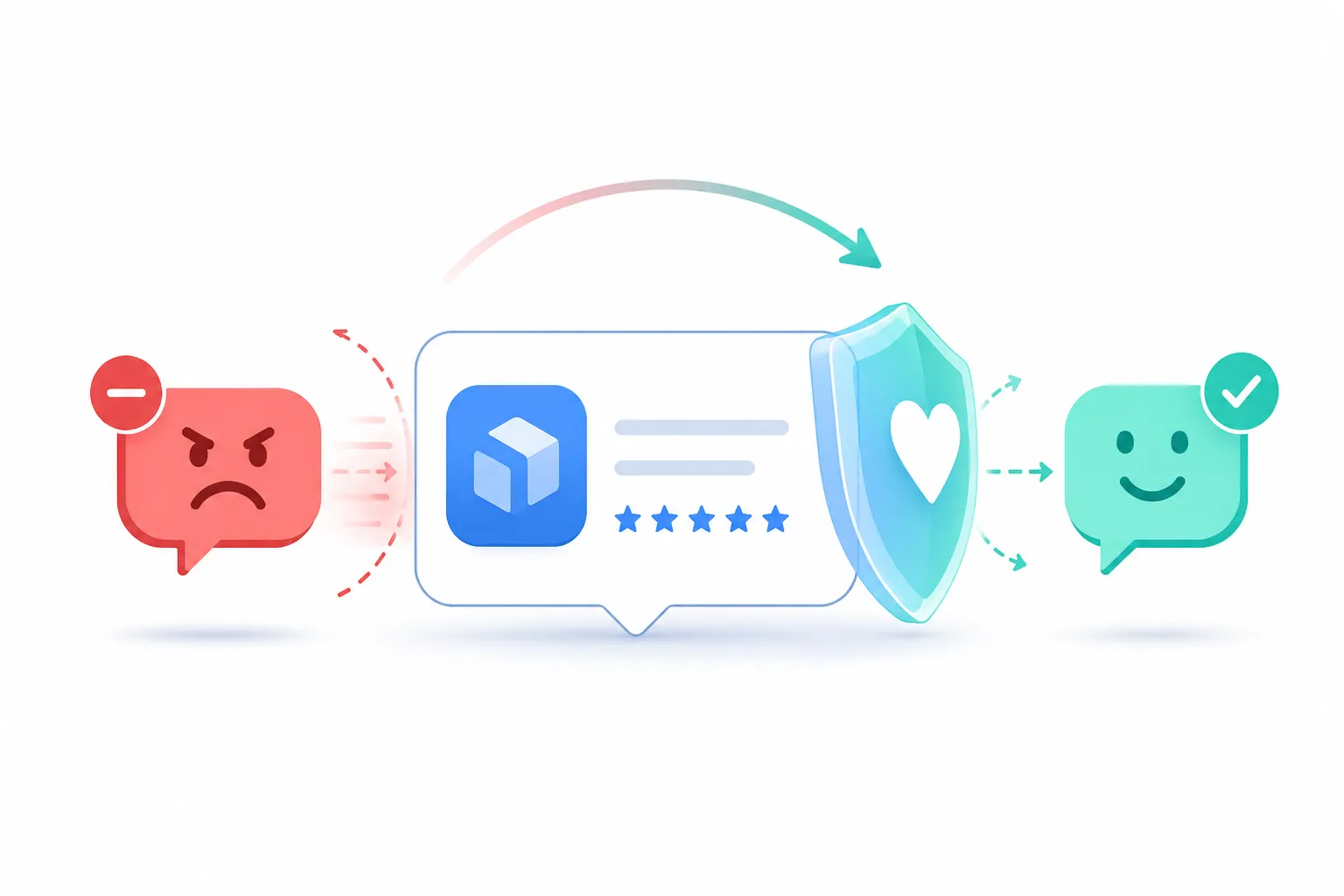
Negative replies can turn a good social lead opportunity into a public credibility problem in seconds.
You find a relevant Reddit thread. Someone is asking for help with a problem your product actually solves. You write a thoughtful answer, mention your tool carefully, and then someone replies with: “Nice ad.” Or, “You clearly work for them.” Or, “Stop spamming.”
That moment matters.
Not because one person disagreed with you. That happens. It matters because everyone else in the thread can now judge how you react. Your response can either make you look honest, useful, and calm, or it can confirm the worst fear people have about founders and marketers entering community spaces.
The mistake is thinking your job is to win the argument.
It is not.
Your job is to protect trust.
A negative reply is not always a disaster. Sometimes it is a warning sign that your original reply came across too promotional. Sometimes it is a chance to clarify your intent. Sometimes it is simply a person testing whether you are there to help or just trying to extract attention from the community.
In this guide, you will learn how to handle negative replies when recommending your product on Reddit, X, LinkedIn, or other social platforms without sounding defensive, fake, desperate, or overly polished.
You will also learn how to prevent many negative replies before they happen by improving the way you choose conversations, write replies, disclose your connection, and decide when your product should not be mentioned at all.
#Negative Replies Are Part of Social Selling
If you recommend your product in public conversations, some pushback is normal.
That does not mean your product is bad. It does not always mean your comment was wrong. It means you are entering spaces where people are cautious, tired of low-effort promotion, and quick to protect the quality of the discussion.
This is especially true on Reddit.
Reddit users are not only reading the words in your comment. They are reading the intent behind it. They are asking:
“Is this person actually helping?”
“Are they being honest about their connection?”
“Would they still give this advice if their product was not involved?”
“Are they here as a member of the discussion or as a salesperson?”
That is why a product recommendation can get a negative response even when the product is genuinely relevant.
The audience is not just evaluating fit. They are evaluating trust.
#Why Negative Replies Feel So Dangerous
A negative reply feels different from a private objection.
In a private sales call, if someone says, “This feels expensive,” you can ask questions, explain the value, and work through the concern. The conversation has context. It has space.
In a public Reddit thread, everything is compressed.
One short criticism can change how the whole thread feels. A useful product recommendation can suddenly look suspicious. Other users may start reading your original comment through the lens of that criticism.
That is why your next reply is so important.
You are not only answering the person who challenged you. You are also speaking to silent readers who may never comment but are deciding whether you are credible.
This is the part many founders miss.
They respond to the critic as if the critic is the only audience.
But on social platforms, the real audience is often the people watching quietly.
#The Real Risk Is Not the Negative Reply
The real risk is reacting badly.
A negative reply does not automatically damage your brand. A defensive response does.
Imagine this simple situation.
Someone posts:
“What is the best way to monitor Reddit for people talking about problems my SaaS solves?”
You reply:
“You can use saved searches manually, or use a tool like Leadmatically to monitor Reddit and find relevant conversations automatically.”
Someone responds:
“Of course you recommend your own tool. This is spam.”
Now you have two possible paths.
You can react defensively:
“It is not spam. The person asked for tools, and I recommended one. Not sure why people here are so negative.”
That response may feel justified, but it makes you look fragile. It also shifts the thread away from helping the original poster and turns it into a fight about your intent.
Or you can respond with trust:
“Fair callout. I’m connected to Leadmatically, so I should have said that clearly. The broader advice is that saved searches can work manually, but once you need consistent monitoring and lead filtering, a tool can save time. Leadmatically is one option, but the main thing is to avoid broad keyword tracking and focus on high-intent phrases.”
That reply is calmer. It discloses the connection. It gives a manual alternative. It turns the conversation back toward the problem.
That is the difference.
You do not need to make the critic love you. You need to show everyone else that you are not hiding, fighting, or forcing the pitch.
#Treat Negative Replies Like Trust Repair
Most people handle negative replies like sales objections.
They try to counter. They try to explain. They try to prove that the criticism is wrong.
That approach usually fails in public communities.
A better mental model is:
Negative replies are trust repair moments.
When someone reacts negatively, they are usually saying one of these things:
-
“I do not trust your intent.”
-
“This sounds too promotional.”
-
“You did not disclose enough.”
-
“This does not feel relevant to the thread.”
-
“I have seen too many comments like this before.”
-
“You are taking more value from the community than you are giving.”
Your response should repair that trust gap.
That means your reply should usually be calmer, shorter, and more useful than your instinct tells you.
Do not try to overpower the criticism. Do not reply like a landing page. Do not copy-paste a brand-safe statement. Do not act like the reader is stupid for being skeptical.
Instead, show that you understand why the concern exists.
That is how you lower resistance.
#The First Question: Was the Criticism Fair?
Before you respond, pause and ask the uncomfortable question.
Was the person right?
Not completely right. Not perfectly fair. Just partly right.
Maybe your comment did sound promotional. Maybe you mentioned the product too early. Maybe you did not disclose that you are the founder, marketer, employee, or affiliate. Maybe the subreddit rules are stricter than you realized. Maybe your answer helped, but the product mention was still heavier than it needed to be.
This matters because your response should match the truth.
If the criticism is fair, admit it.
If it is partly fair, acknowledge the part that is fair.
If it is unfair, still respond calmly.
You do not lose authority by being honest. You lose authority by pretending there is no issue when everyone can see there is one.
#A Simple Framework for Responding
When you receive a negative reply, use this structure:
-
Acknowledge the concern.
-
Clarify your connection or intent.
-
Add value that stands without the product.
-
Mention the product lightly only if it still fits.
-
Step back if the conversation is no longer useful.
That is it.
You do not need a long speech. You need a response that makes a neutral reader think:
“Okay, this person is being fair.”
That is the goal.
#Common Types of Negative Replies and What They Mean
Not every negative reply deserves the same response.
Some are fair criticism. Some are simple skepticism. Some are bad-faith attacks. Some are useful feedback hidden inside a harsh tone.
Here is a practical breakdown.
Negative ReplyWhat It Usually MeansBest ResponseWhat Not To Do“This is spam.”They think your intent is promotional.Acknowledge, disclose, and return to useful advice.Argue aggressively that it is not spam.“You work for them, right?”They want transparency.Be direct about your connection.Pretend you are just a random user.“Stop advertising.”The product mention felt too strong.Apologize if fair and reduce the pitch.Explain every feature again.“This tool is too expensive.”They are questioning value or fit.Explain who it is and is not for.Act like price concerns are irrational.“You can do this manually.”They want practical alternatives.Agree and explain the tradeoff.Claim manual work is useless.“I tried it and it was bad.”They had a poor experience.Ask what went wrong and respond calmly.Dismiss their experience.Sarcasm or insultsThey may not want a real discussion.Stay brief or disengage.Match their tone.“Mods should remove this.”They think you broke community norms.Respect the rules and step back.Fight the community publicly.This table is important because many founders over-respond.
They treat every comment like it must be converted.
It does not.
Some replies should be answered. Some should be acknowledged. Some should be left alone.
#Step 1: Pause Before Replying
Your first draft will usually be too defensive.
That is normal.
Negative replies feel personal because they question your integrity in public. Even if you know your intent was helpful, the accusation can sting.
Do not reply while you feel that sting.
Take a moment and ask:
-
What exactly is this person objecting to?
-
Did I disclose my connection clearly?
-
Did I lead with helpful advice?
-
Did the product mention actually fit the thread?
-
Would a neutral reader think their criticism is reasonable?
-
Will my reply improve the discussion?
-
Am I trying to help, or am I trying to protect my ego?
That last question is the big one.
A lot of bad brand replies are really ego replies wearing a business costume.
If your response is mainly about proving you are right, do not post it yet.
#Step 2: Acknowledge the Concern Clearly
Acknowledgment does not mean surrender.
It means you understand why someone reacted the way they did.
Bad response:
“No, this is not spam.”
Better response:
“Fair concern. Product mentions can definitely feel spammy when they are dropped without enough context.”
The better response works because it does not fight the reader’s experience. It validates the concern without accepting that you acted maliciously.
Here are a few useful acknowledgment lines:
-
“Fair callout.”
-
“I get why it came across that way.”
-
“That is a reasonable concern.”
-
“You are right that I should have disclosed my connection more clearly.”
-
“I can see how that sounded more promotional than intended.”
-
“That is fair. Product mentions in threads like this need to be handled carefully.”
Keep it human.
Do not sound like a customer support script.
#Step 3: Disclose Your Connection Without Dancing Around It
If you are connected to the product, say it.
Do not hide behind vague language.
Bad:
“I know of a tool that does this.”
Better:
“I’m connected to Leadmatically, so take this with that context.”
Bad:
“Some people use Leadmatically for this.”
Better:
“I work on Leadmatically, so I’m obviously biased, but the general workflow is what matters here.”
Bad:
“This tool might help.”
Better:
“This is my product, so I should disclose that. It is built for this specific workflow, but you can also do a lighter version manually.”
Transparency changes the entire feel of the reply.
It tells people you are not trying to sneak a recommendation into the conversation. You are giving them the context they need to judge your advice properly.
That does not hurt trust.
It builds it.
#Step 4: Give Useful Advice That Does Not Require Your Product
This is one of the strongest ways to handle negative replies.
After acknowledging the concern, say something useful that would still help the reader even if they never use your product.
For example:
“The manual version is to track narrow phrases like ‘looking for an alternative to X,’ ‘how do I solve Y,’ or ‘any tools for Z,’ then review those threads daily. The mistake is tracking broad keywords because they create noisy results and tempt you to reply where the fit is weak.”
That advice stands on its own.
Then, if appropriate, you can add:
“Leadmatically helps automate that monitoring and filtering, but the principle is the same either way.”
This style works because the product is not carrying the whole reply.
The insight is.
That is what makes the recommendation feel earned.
#Step 5: Explain Who the Product Is Not For
This is underrated.
When someone pushes back, do not act like your product is perfect for everyone.
That is exactly how spammy recommendations sound.
Instead, explain the boundary.
For example:
“If you only check Reddit once a week and get a few relevant threads per month, you probably do not need a paid tool. Saved searches and a simple spreadsheet may be enough. A tool starts making sense when missed conversations are costing you pipeline or when your team needs a repeatable workflow.”
That kind of answer builds trust because it has restraint.
It shows you understand fit.
It also makes the product more credible for the people who are actually a good match.
#Step 6: Apologize When You Should
Sometimes the right response is a plain apology.
Not a dramatic apology. Not a fake corporate one. Just a clear admission.
Example:
“You are right. I should have disclosed that I’m connected to the product. My mistake.”
Or:
“Fair. I led with the product too quickly there. The better answer is that you should first validate whether the thread actually has buying intent before mentioning any tool.”
Then stop.
Do not attach another pitch.
The mistake many people make is apologizing and then immediately selling again.
That weakens the apology.
If you made the thread worse, repair the trust first. You can always contribute value later in a better-fitting conversation.
#Step 7: Keep the Reply Short Enough to Feel Human
Long defensive replies are rarely persuasive.
They can make you look like you are trying to bury the criticism under explanation.
A good negative-reply response is often between 3 and 6 sentences.
Long enough to be useful. Short enough to feel calm.
Here is a simple structure:
“Fair callout. I’m connected to the product and should have said that clearly. The general point I was trying to make is that broad keyword alerts create noisy outreach, while narrow intent-based monitoring works better. You can do that manually with saved searches, or use tools if the manual process becomes too time-consuming.”
That is enough.
It acknowledges. It discloses. It teaches. It does not push.
#Step 8: Know When Not to Reply
Not every negative comment deserves engagement.
Some people are not asking a question. They are venting. Some are trying to bait you into looking bad. Some have already decided what they think.
A reply is worth posting when it can improve the thread.
It is not worth posting when it only protects your pride.
Do not reply if:
-
the person is only insulting you
-
the thread is already becoming hostile
-
the subreddit rules clearly discourage promotion
-
a moderator has already stepped in
-
your reply would repeat the same point again
-
you are only trying to get the last word
In public communities, restraint is a growth skill.
A founder who can step back looks more credible than one who needs to answer every criticism.
#Bad vs Better Examples
Let’s make this practical.
#Example 1: “This is clearly an ad.”
Bad:
“It is not an ad. The person asked for recommendations, and I gave one. People here complain about everything.”
Better:
“Fair concern. I’m connected to Leadmatically, so I should have disclosed that clearly. The broader advice is to monitor specific buying-intent phrases instead of broad keywords, then only reply when you can genuinely help. Leadmatically is one way to automate that, but the workflow can also be done manually.”
Why this works:
The better reply does not fight the accusation. It accepts the transparency issue and gives useful advice.
#Example 2: “You are just promoting your own tool.”
Bad:
“Obviously I recommend it because it solves the problem.”
Better:
“That is fair to point out. I do work on the product, so I’m biased. The reason I mentioned it is because the problem here is not just finding mentions, it is filtering for conversations where the timing and context are right. But yes, the same principle applies even without the tool.”
Why this works:
It does not pretend to be neutral. It explains the thinking behind the recommendation without over-selling.
#Example 3: “This is too expensive.”
Bad:
“It is not expensive if you understand the ROI.”
Better:
“Totally fair. It is probably not worth paying for if you only get a few relevant conversations each month. The value starts to make more sense when you are regularly missing high-intent threads or when your team spends too much time manually searching and filtering.”
Why this works:
It respects the price concern and explains fit.
#Example 4: “Just use Reddit search.”
Bad:
“Reddit search is terrible. That will not work.”
Better:
“You can start with Reddit search, saved searches, and a spreadsheet. That is the right first step for many teams. The tradeoff is consistency and filtering. Once you need daily monitoring, scoring, and a repeatable reply workflow, a dedicated tool can save time.”
Why this works:
It does not dismiss the manual option. It places the tool as a next step.
#Example 5: “Your product sounds like spam automation.”
Bad:
“You clearly do not understand what it does.”
Better:
“That is a valid concern. A bad workflow can absolutely turn into spam. The healthier version is to find relevant conversations, read the thread properly, and reply only when the answer is useful even without the product mention. Automation should help with discovery, not replace judgment.”
Why this works:
It agrees with the underlying fear and reframes the product around responsible use.
#Example 6: “I tried it and the leads were not good.”
Bad:
“That is unusual. Most users get good results.”
Better:
“Sorry to hear that. Lead quality usually depends heavily on the keywords and the kind of intent signals being tracked. If the targeting is too broad, the results can get noisy fast. What kind of conversations were you trying to find?”
Why this works:
It does not invalidate the user. It asks for context and points to a real cause.
#A Practical Reply Template You Can Adapt
Use this when someone reacts negatively to your product mention.
“Fair callout. I’m connected to [product], so I should disclose that clearly. The general advice is [useful principle that applies without the product]. You can do this manually by [manual method]. A tool like [product] mainly helps when [specific situation where the tool makes sense].”
Example for Leadmatically:
“Fair callout. I’m connected to Leadmatically, so I should disclose that clearly. The general advice is to track high-intent Reddit conversations instead of broad keywords. You can do that manually with saved searches and a spreadsheet. A tool like Leadmatically mainly helps when you want that monitoring and filtering running consistently without checking Reddit all day.”
This template works because it keeps the order right.
Disclosure first. Advice second. Manual option third. Product fit last.
#Build a Negative Reply Playbook for Your Team
If more than one person replies on behalf of your business, you need a simple playbook.
Do not leave this to instinct.
Different people have different tolerance for criticism. One teammate may over-apologize. Another may argue. Another may delete comments too quickly. Another may keep pitching after the thread has clearly rejected the mention.
A basic playbook protects the brand.
It should include:
-
when to disclose your connection
-
when to mention the product
-
when to avoid mentioning the product
-
how to respond to “this is spam”
-
how to respond to pricing criticism
-
how to respond to competitor comparisons
-
when to stop replying
-
when to escalate internally
-
when to delete or edit a comment
This does not need to be complicated.
A simple shared document is enough.
The goal is consistency. If your brand replies calmly one day and defensively the next, people notice.
#Negative Reply Response Checklist
Before replying, run through this checklist.
QuestionWhy It MattersDid we disclose our connection?Hidden affiliation creates distrust fast.Did we give value before pitching?Useful replies earn more tolerance.Is the criticism partly fair?Fair criticism should be acknowledged, not denied.Can we offer a manual alternative?Non-product advice builds credibility.Are we replying to help or to defend?Defensive replies usually make things worse.Would a neutral reader trust us more after this reply?Silent readers are often the real audience.Should we disengage instead?Some threads are not worth continuing.If the answer to the neutral reader question is no, rewrite the reply.
That one question will save you from many bad responses.
#How Better Lead Discovery Prevents Negative Replies
A lot of negative replies happen before the reply is even written.
The real problem is upstream.
You are replying to the wrong thread. The thread is too cold. The keyword match is too broad. The person is not actually asking for a solution. The subreddit culture does not welcome product mentions. The comment sounds relevant to you but not to the community.
This is why social lead generation cannot just be “find keyword, drop reply.”
That workflow creates bad timing and bad context.
A better workflow looks like this:
-
Find conversations with real intent.
-
Read the thread before replying.
-
Understand the person’s problem.
-
Decide whether a product mention is appropriate.
-
Give useful advice first.
-
Mention the product only when it naturally fits.
-
Handle pushback calmly if it happens.
Leadmatically fits into the first part of that workflow by helping businesses monitor Reddit and social conversations, find relevant leads, and manage the reply process without manually searching all day.
But the key point is not “use automation to reply more.”
The key point is “use better discovery so you reply better.”
That distinction matters.
Bad automation creates spam. Good workflow creates timely, relevant, human replies.
#When You Should Not Mention Your Product
This is one of the easiest ways to reduce negative replies.
Do not mention your product every time a topic is related.
Mention it only when the thread has enough fit.
You should usually avoid mentioning your product when:
-
the person is only asking for education, not tools
-
the subreddit has strict no-promotion rules
-
you cannot disclose your connection naturally
-
your product is only loosely related
-
the conversation is emotional or complaint-heavy
-
the user asked for free options only
-
another answer already covered your product category well
-
your reply would be mostly about the tool instead of the problem
This restraint is not lost opportunity.
It is reputation protection.
The more careful you are with product mentions, the more credible your mentions become when you do make them.
#How to Edit a Reply That Is Getting Pushback
Sometimes your original comment is the problem.
You may not need to delete it. You may need to edit it.
A good edit can fix missing disclosure or reduce promotional language.
Before:
“Leadmatically is perfect for this. It monitors Reddit and X, finds leads, and helps you convert them.”
After:
“Disclosure: I’m connected to Leadmatically. You can handle this manually with saved searches and a spreadsheet, but the hard part is staying consistent and filtering for intent. Leadmatically is one tool that helps with monitoring and lead discovery if the manual workflow becomes too time-consuming.”
The edited version is more trustworthy because it adds context, disclosure, and a manual alternative.
If the platform allows edit notes, add one:
“Edited to add disclosure.”
That small note matters.
It shows you are not trying to quietly rewrite history.
#How to Handle Moderator Pushback
Moderator pushback is different from normal user pushback.
If a moderator says your comment is too promotional, do not argue publicly.
Respect the rule.
A good response might be:
“Understood. I should have been more careful with the product mention. I’ll avoid that here.”
Then stop.
Do not debate the interpretation of the rules unless the moderator invites it.
Communities are not your distribution channel by default. They are spaces with their own norms. If you want to participate, you have to respect those norms even when they limit your marketing.
That is part of playing the long game.
#How to Handle Competitor Comparisons
Sometimes negative replies mention competitors.
Example:
“Why would anyone use this instead of just using Brand24, GummySearch, F5Bot, or Reddit search?”
Do not attack the competitor.
That almost always looks bad.
A better answer explains fit.
Example:
“Those can be good options depending on the workflow. The difference I’d look at is whether you only need mention alerts, or whether you need lead qualification and reply workflow too. If simple alerts are enough, a lighter tool may be fine. If the goal is turning conversations into a repeatable pipeline, then the filtering and reply process matter more.”
This keeps the conversation practical.
It also helps the reader choose based on use case instead of forcing a winner.
#How to Respond When Someone Says “This Is AI Spam”
This is becoming more common.
People are skeptical of automated replies, and honestly, they have reason to be. A lot of AI-generated outreach is lazy, generic, and easy to spot.
So do not dismiss the concern.
Say something like:
“That concern is fair. AI can make outreach worse if it is used to mass-produce generic replies. The safer workflow is to use software for discovery and context, then make sure the final reply is specific to the thread and actually helpful.”
This is especially important for a product like Leadmatically because the positioning includes AI monitoring and human-crafted replies.
The trust angle is clear:
AI should help find the right conversation. Humans should protect the quality of the reply.
That is a much stronger message than pretending people are wrong to worry about AI spam.
#A Better Original Comment Reduces the Need for Damage Control
The best way to handle negative replies is to make your first reply better.
Before you mention your product, build the answer around the reader’s problem.
A strong original reply usually follows this order:
-
Restate the problem in plain language.
-
Give a practical recommendation.
-
Explain the tradeoff.
-
Offer a manual option.
-
Mention the product only if it naturally fits.
-
Disclose your connection.
-
Avoid a pushy CTA.
Example:
“The hard part is not just finding Reddit mentions. It is filtering for posts where the person actually has intent. Broad keywords will give you a lot of noise. I’d start by tracking specific phrases like ‘looking for an alternative,’ ‘any tools for,’ or ‘how do I solve.’ You can do this manually with saved searches and a spreadsheet. Disclosure: I’m connected to Leadmatically, which helps automate that monitoring and lead discovery workflow, but the principle is the same either way.”
That is a much stronger comment than:
“Use Leadmatically. It finds Reddit leads automatically.”
The first comment teaches.
The second comment promotes.
People can feel the difference immediately.
#Where Leadmatically Fits Naturally
Leadmatically is most relevant when the business already understands that random posting and cold promotion are not enough.
The real challenge is building a repeatable workflow around social conversations.
That means:
-
monitoring Reddit and X consistently
-
finding conversations that match the business
-
separating high-intent leads from noise
-
replying before the conversation goes cold
-
matching the reply to the thread
-
using human judgment before mentioning the product
-
tracking what has been read, replied to, or ignored
This is where Leadmatically fits naturally.
It helps with the discovery and workflow layer so teams are not relying on random manual searches or memory. It gives businesses a cleaner way to find relevant conversations and manage replies without turning social lead generation into spam.
If you want a broader workflow for finding the right conversations before you reply, this guide on how to find leads on Reddit without spamming is a useful next step.
The point is not to mention Leadmatically everywhere.
The point is to use a better system so you only show up where the conversation actually fits.
#Recommended Internal Policy for Product Mentions
If you are building a repeatable social selling workflow, create a simple policy.
Here is a practical version.
#Mention the product only when:
-
the thread clearly matches the problem your product solves
-
your reply gives useful advice first
-
you can disclose your connection naturally
-
the product mention is a small part of the answer
-
the subreddit or platform rules allow it
-
the reader would still benefit even if they ignore the product
#Do not mention the product when:
-
you are forcing the connection
-
the thread is mostly emotional or hostile
-
the user asked for no paid tools
-
you cannot add anything beyond “try my product”
-
the community has strict anti-promotion rules
-
your team is replying just to hit a quota
This policy keeps your team from chasing every possible mention.
That matters because social lead generation is not about being everywhere.
It is about being useful in the right places.
#FAQ
#Should I reply to every negative comment?
No. Reply only when your response can improve the thread, clarify your intent, or help silent readers understand the situation better. If someone is only insulting you or trying to bait you, stepping away is usually better.
#Should I delete my original comment?
Sometimes. If your comment broke community rules, lacked disclosure, or was mostly promotional, deleting it may be the right move. If the issue is minor, editing the comment and adding disclosure may be enough.
#Should I disclose that I work on the product?
Yes. If you are connected to the product, disclose it clearly. Hidden affiliation creates more backlash than honest disclosure.
#What should I do if someone calls my product spam?
Do not argue. Acknowledge the concern, explain the intended workflow, and make it clear that useful replies should come before product mentions. If the criticism is fair, admit it.
#Can I still recommend my product after a negative reply?
Sometimes, but be careful. In most cases, the better move is to focus on the principle, manual workflow, or practical advice. Let the product mention become secondary.
#What if a competitor is mentioned?
Do not attack the competitor. Explain the difference in use case. Help the reader understand which option fits which workflow.
#What if the person is wrong about my product?
Correct the misunderstanding calmly and briefly. Do not turn it into a debate. Your goal is clarity, not victory.
#How can I prevent negative replies?
Choose better conversations, reply with context, disclose your connection, give manual alternatives, avoid broad promotional claims, and only mention your product when it genuinely fits the thread.
#Final Thought
Negative replies are not the end of the opportunity.
They are a test.
They test whether you understand the community. They test whether you can handle skepticism. They test whether your product recommendation is built on real relevance or just promotion.
The businesses that win on Reddit and social platforms are not the ones that force their product into the most threads.
They are the ones that find better conversations, show up earlier, respond with context, and stay calm when challenged.
That is how trust is built.
Not by avoiding every negative reply.
By handling the right ones well.