
Warm leads are easy to waste.
That sounds strange, because a warm lead already has some intent. They are asking a question, complaining about a problem, comparing tools, looking for recommendations, or describing a workflow that your product could improve. But if you treat every warm lead the same, you still end up replying late, chasing weak-fit people, and missing the conversations that could actually turn into revenue.
The real problem is not usually lead volume.
The real problem is lead order.
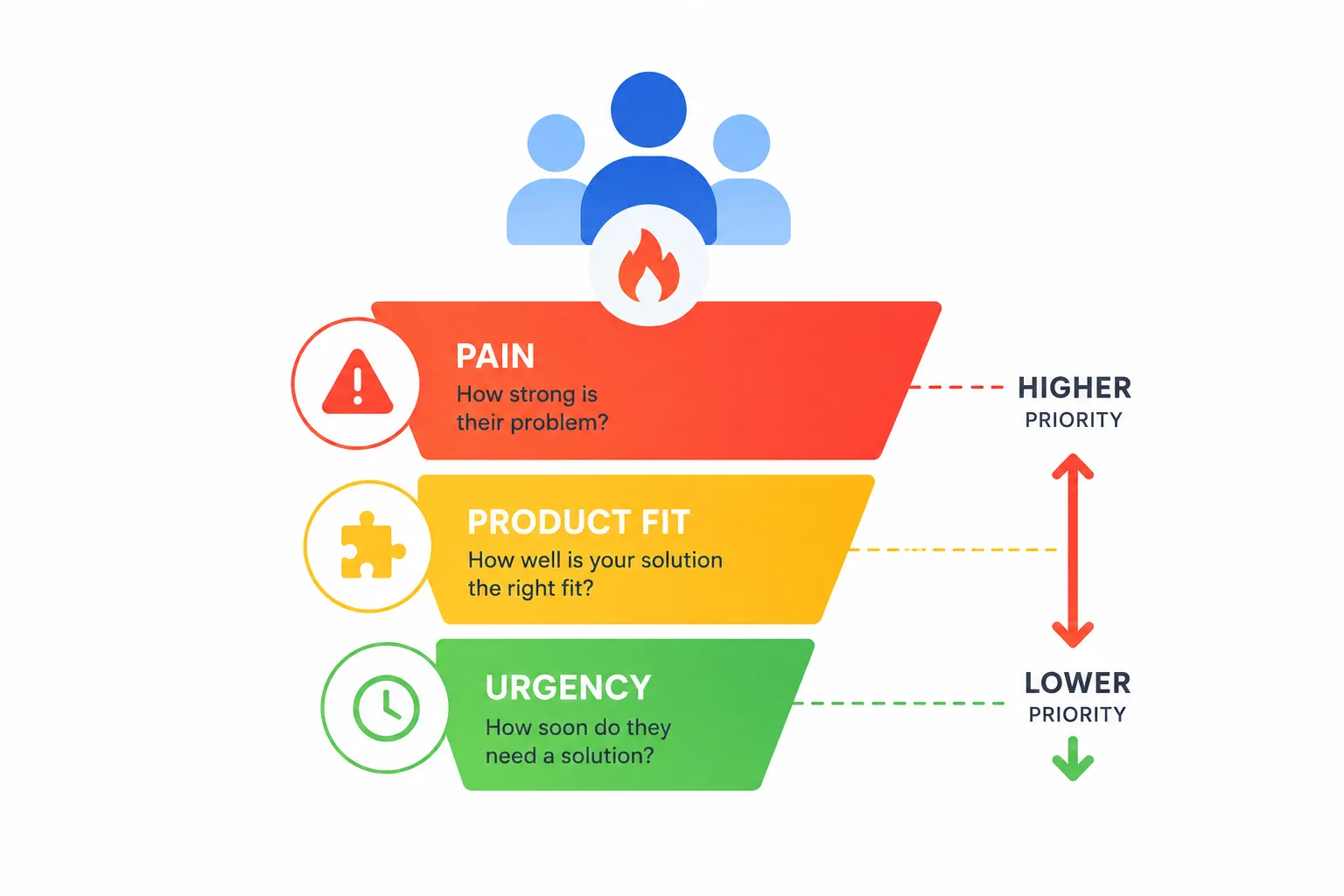
When you find conversations on Reddit, X, LinkedIn, communities, or forums, you need a way to decide which ones deserve your attention first. Not just who mentioned a keyword. Not just who seems active. Not just who sounds interested. You need to sort leads by three things: pain, product fit, and urgency.
This article will show you how to organize warm leads clearly, so you can stop reacting randomly and start building a repeatable social lead workflow.
#Why Warm Leads Become Messy Fast
Warm leads feel simple when you only have five of them.
You read each post, think about whether you can help, and reply manually. That works for a while.
Then your monitoring starts working better. You find 20, 50, or 100 possible conversations in a week. Some people are complaining about a pain you solve. Some are casually curious. Some are students. Some are competitors. Some are not ready to buy. Some are perfect-fit buyers, but the thread is already old by the time you see it.
Now everything gets blurry.
You start asking:
-
Which lead should I reply to first?
-
Is this person actually a buyer?
-
Should I mention the product or just help?
-
Is this urgent or just general research?
-
Is this worth a founder’s time?
-
Should this go into a follow-up list?
Without a system, you rely on instinct.
Instinct is useful, but it does not scale. It also makes your replies inconsistent. One day you chase every mention. The next day you ignore good leads because you are busy. Then a competitor shows up earlier in the thread and wins the trust you could have earned.
That is why lead organization matters.
#The Simple Mental Model: Pain, Fit, Urgency
A warm lead is valuable only when three things line up.
They have a real pain.
Your product fits that pain.
The timing is active enough to justify a response now.
Think of it like a traffic light system.
A lead with strong pain, strong fit, and high urgency is green. You should respond quickly and carefully.
A lead with clear pain but weak urgency might be yellow. It is worth saving, watching, or replying to with helpful context.
A lead with poor fit is red, even if it mentions your keyword. Replying there will usually feel forced.
The goal is not to collect the biggest list.
The goal is to know where your attention should go first.
#Pain: What Problem Is the Person Actually Feeling?
Pain is the reason the conversation exists.
A person may not say, “I am ready to buy software.” They usually say something more human:
“I’m tired of doing this manually.”
“Is there a better way to track this?”
“We keep missing these conversations.”
“Our current workflow is too slow.”
“Any tool recommendations?”
That is pain.
The mistake is treating every keyword mention as pain. A keyword is only a signal. It is not proof.
For example, someone saying “Reddit lead generation” in a generic marketing discussion is not the same as someone saying, “I spend two hours every morning searching Reddit and still miss good buyer threads.”
The second person has operational pain.
That matters more.
#Types of Pain Worth Tracking
You can organize pain into simple categories:
Pain TypeWhat It Sounds LikeWhy It MattersTime pain“This takes too long”They may value automation or workflow improvementMissed opportunity pain“We keep finding these too late”They may care about alerts and speedQuality pain“Most leads are irrelevant”They may need better filteringTrust pain“Our replies sound promotional”They may need better reply guidanceScale pain“This worked manually, but now it is messy”They may need a repeatable systemCompetitive pain“Competitors keep showing up first”They may care about monitoring and timingThis helps you stop looking at leads as one big pile.
A founder complaining about wasted time is not the same as an agency worrying about reply quality. Both may be good leads, but they need different replies.
#Product Fit: Can You Actually Help This Person?
Pain alone is not enough.
A lead can have a real problem and still be a bad fit for your product.
This is where many teams make a mistake. They see someone struggling and immediately try to recommend their tool. But if the tool does not match the situation, the reply feels like a pitch. Worse, it damages trust.
Product fit means the lead’s problem connects naturally to what your product does.
For Leadmatically, that usually means the person or business needs help with things like:
-
finding relevant Reddit or X conversations
-
spotting buyer intent earlier
-
reducing manual searching
-
improving reply context
-
organizing discovered leads
-
choosing between manual replies and done-for-you replies
-
turning scattered social conversations into a real acquisition workflow
That is fit.
A random person asking for general marketing advice may not be a fit yet. A founder asking how to find SaaS buyers on Reddit without spamming is much closer.
#Fit Is Not Just Industry
Do not qualify leads only by industry.
A SaaS founder can be a poor fit if they have no interest in social selling. A service business can be a great fit if they are actively trying to find customers in Reddit threads.
Better fit questions are:
-
Is this person trying to solve a problem your product directly addresses?
-
Would your workflow make their current process easier?
-
Are they already doing some version of the task manually?
-
Do they seem responsible for the outcome?
-
Can they understand the value without a long explanation?
The best warm leads usually already believe the problem matters.
You are not convincing them the pain exists. You are showing them a better way to handle it.
#Urgency: How Soon Does This Conversation Matter?
Urgency is the timing layer.
Some leads are valuable but not urgent. Others need a response now.
On Reddit and social platforms, urgency often depends on thread freshness, buyer energy, and the nature of the question.
A post from 20 minutes ago asking for tool recommendations is urgent.
A three-month-old discussion about a broad topic may still be useful for research, but it is not the first place you should spend your reply energy.
Urgency also shows up in wording.
Someone saying, “I need to solve this this week” is different from someone saying, “I’m curious how people handle this.”
Both can be worth tracking. Only one should jump to the top of your queue.
#Urgency Signals to Watch
Look for signals like:
-
“Need help”
-
“Any recommendations?”
-
“What tool do you use?”
-
“We are switching from…”
-
“This is becoming a problem”
-
“I’m tired of…”
-
“Looking for alternatives”
-
“Has anyone solved this?”
-
“Before I buy…”
-
“For my agency/client/team”
These phrases suggest the person is not just browsing. They are closer to action.
But urgency is not only in the words.
A fresh thread with active comments can be urgent even if the wording is soft. If people are already discussing solutions, the window is open. If you show up late with a generic reply, you are just another voice in a cold thread.
#A Practical Lead Sorting System
You do not need a complicated CRM setup to organize warm leads.
Start with a simple scoring system.
Give each lead a score from 1 to 3 for pain, fit, and urgency.
ScorePainProduct FitUrgency1Mild or unclear problemWeak connection to your productOld thread or casual interest2Clear problem, but not painful yetPartial fitSome activity or medium timing3Strong, specific painDirect fitFresh, active, or decision-orientedThen add the scores.
A lead with 8 or 9 should get attention fast.
A lead with 6 or 7 may be worth a thoughtful reply or follow-up.
A lead under 5 is usually research, not outreach.
This is not about being robotic. It is about protecting your time.
#Example
Imagine you sell a tool that helps businesses find Reddit conversations where buyers are already asking for solutions.
You find this post:
“I run a small SaaS and we’re trying to get customers from Reddit, but manually searching subreddits is taking forever. By the time I find a good thread, it already has tons of replies. Is there a better way to track this?”
That is strong.
Pain: 3 Product fit: 3 Urgency: 3
Total: 9
This deserves a fast, useful reply.
Now compare it with:
“Do people still use Reddit for marketing?”
Pain: 1 Product fit: 1 or 2 Urgency: 1
Total: 3 or 4
That may be a good discussion, but it is not a high-priority warm lead.
#How to Tag Leads So Your Replies Improve
Scoring helps you prioritize.
Tagging helps you respond better.
A good tagging system tells you why the lead matters. That way, when you open the lead later, you are not starting from zero.
Use tags like:
-
manual-search-pain
-
late-reply-risk
-
tool-recommendation
-
competitor-mention
-
agency-workflow
-
reply-quality
-
founder-led-sales
-
high-intent
-
needs-follow-up
-
poor-fit
The tag should explain the situation, not just the topic.
For example, reddit is not very useful. Almost every lead might be about Reddit.
missed-reddit-buying-signals is better.
It tells you what the person is struggling with and what angle your reply should take.
#Match the Reply to the Lead Category
Once your leads are organized, your replies become easier.
You are no longer asking, “What should I say?”
You are asking, “What kind of problem is this, and what kind of reply would be useful here?”
That is a much better question.
#If the Lead Has Strong Pain
Lead with empathy and a practical suggestion.
Do not rush into a product mention.
Bad:
“Use our tool. It does exactly this.”
Better:
“Yeah, the hard part is not just finding Reddit threads. It is finding them while the conversation is still active. I’d separate this into two steps: monitor specific buyer-intent keywords, then score threads based on whether the person is actually asking for help or just discussing the topic.”
Then, if it fits:
“That is also the kind of workflow Leadmatically is built around: finding relevant Reddit/X conversations earlier and helping you reply with context instead of sounding like you dropped in to pitch.”
#If the Lead Has Good Fit but Low Urgency
Be helpful, but do not force urgency.
This could become a future lead.
You might reply with a framework, checklist, or mistake to avoid. Save the conversation and watch for follow-up activity.
#If the Lead Has Urgency but Weak Fit
Do not force your product into the thread.
Help briefly, ask a clarifying question, or skip it.
Weak-fit urgent leads are dangerous because they tempt you to pitch into the wrong conversation.
That is how brands get called out.
#Build a Daily Workflow Around Priority, Not Volume
A clean warm lead workflow should feel boring in the best way.
You check the queue. You sort by priority. You reply to the strongest opportunities first. You save medium-fit leads. You ignore weak-fit noise.
Here is a simple daily process:
-
Review new leads from the last 24 hours.
-
Score each lead by pain, fit, and urgency.
-
Reply first to leads scoring 8 or 9.
-
Save leads scoring 6 or 7 for later review or softer replies.
-
Mark low-fit leads as research or ignore them.
-
Track which replies turn into conversations.
-
Refine your tags and scoring based on what actually converts.
This keeps your workflow honest.
You are not measuring success by how many replies you posted. You are measuring whether you entered the right conversations with the right context at the right time.
That is where Leadmatically fits naturally. Instead of manually digging through Reddit and X every day, Leadmatically helps surface relevant conversations, organize opportunities, and support better replies so you are not treating every mention like an equal lead.
For a deeper workflow on finding the right conversations before they go cold, this guide is a useful next step: /blog/how-to-find-leads-on-reddit-without-spamming-a-better-workflow-for-high-intent-social-selling
#A Simple Warm Lead Priority Checklist
Use this before replying to any warm lead.
#Pain
-
Is the person describing a real problem?
-
Is the problem specific or vague?
-
Does the pain affect time, money, trust, growth, or workflow?
-
Are they frustrated enough to want a better way?
#Product Fit
-
Does your product directly help with this problem?
-
Would your product feel relevant if mentioned naturally?
-
Is the person likely to understand the value?
-
Are they the kind of user or buyer you serve?
#Urgency
-
Is the thread recent?
-
Is the person asking for recommendations or help?
-
Are others already suggesting solutions?
-
Does the wording suggest they need an answer soon?
#Reply Quality
-
Can you add value before mentioning your product?
-
Can you reference their exact situation?
-
Can you avoid sounding like a generic marketing reply?
-
Is there a clear next step without being pushy?
If the answer is mostly yes, reply.
If the answer is mixed, slow down.
If the answer is mostly no, skip it.
Skipping bad-fit leads is part of good lead generation.
#What Bad Lead Organization Looks Like
Bad lead organization usually has the same symptoms.
Every mention becomes a lead.
Every lead gets the same reply.
Every reply tries to create interest from scratch.
The team gets excited about volume but cannot explain which conversations are worth prioritizing. They post more, but conversion does not improve. Eventually, social selling starts to feel random.
Here is the pattern:
Keyword match → generic reply → no response → more keyword searching.
That loop burns time.
A better pattern looks like this:
Relevant conversation → pain/fit/urgency score → context-aware reply → tracked outcome → better future filtering.
That loop improves over time.
The second workflow turns social lead generation into a system instead of a guessing game.
#How to Keep Your Lead List Clean
Warm lead lists get messy when nobody removes weak opportunities.
You need cleanup rules.
A lead should be moved down or archived when:
-
the thread is too old
-
the person never responds
-
the problem is not connected to your product
-
the buyer is clearly not your audience
-
the conversation turns into general debate
-
a reply would feel forced
-
the account looks spammy or low quality
This matters because a messy lead list creates fake confidence.
You think you have 200 warm leads, but maybe only 20 are actually worth touching.
Clean lists make better decisions easier.
#Track Outcomes, Not Just Replies
The final step is learning from what happens.
Do not only track how many leads you found or how many replies you posted.
Track:
-
Which pain types get responses?
-
Which product-fit tags convert best?
-
Which urgency signals produce conversations?
-
Which subreddits create serious buyers?
-
Which reply angles get ignored?
-
Which replies feel too promotional?
-
Which leads move from comment to DM or call?
This is where your workflow becomes sharper.
You may discover that “tool recommendation” threads convert well, but broad “marketing strategy” threads do not. Or that agency workflow pain leads to better conversations than solo founder curiosity. Or that reply context matters more than being first in the thread.
That kind of learning is what turns social lead generation into a real channel.
#FAQ
#What is a warm lead?
A warm lead is someone who has shown some level of interest, pain, or intent connected to the problem your product solves. On Reddit or X, this might be a person asking for recommendations, complaining about a workflow, comparing tools, or describing a problem you can help with.
#Why should I organize warm leads by pain, fit, and urgency?
Because not every warm lead deserves the same attention. Pain shows whether the problem matters. Product fit shows whether you can help. Urgency shows how quickly you should act. Together, they help you prioritize better conversations.
#Should I reply to every warm lead?
No. Replying to every lead usually lowers quality. You should prioritize leads where the pain is clear, the fit is strong, and the timing is still active. Weak-fit replies often sound promotional, even when you are trying to be helpful.
#How do I know if a Reddit lead is urgent?
Look at thread freshness, active comments, recommendation requests, and wording that suggests the person wants a solution soon. A fresh thread asking for tool suggestions is usually more urgent than an old general discussion.
#Can Leadmatically help organize warm leads?
Yes. Leadmatically helps businesses find relevant Reddit and X conversations, surface lead opportunities, and support better reply workflows. It is useful when you want to stop manually searching and start focusing on the conversations most likely to matter.
#Final Thought
Warm leads are not valuable because they exist.
They are valuable when you can understand them quickly and respond in the right order.
Pain tells you what the person is struggling with. Product fit tells you whether you should enter the conversation. Urgency tells you how fast you need to move.
When you organize leads this way, your social selling becomes calmer, cleaner, and more effective. You stop chasing every mention. You stop forcing product replies into weak conversations. You start spending your time where trust and timing actually line up.
That is the real advantage.
Leadmatically helps make that workflow easier by finding relevant conversations earlier and giving you a better way to act on them before the best window closes.