
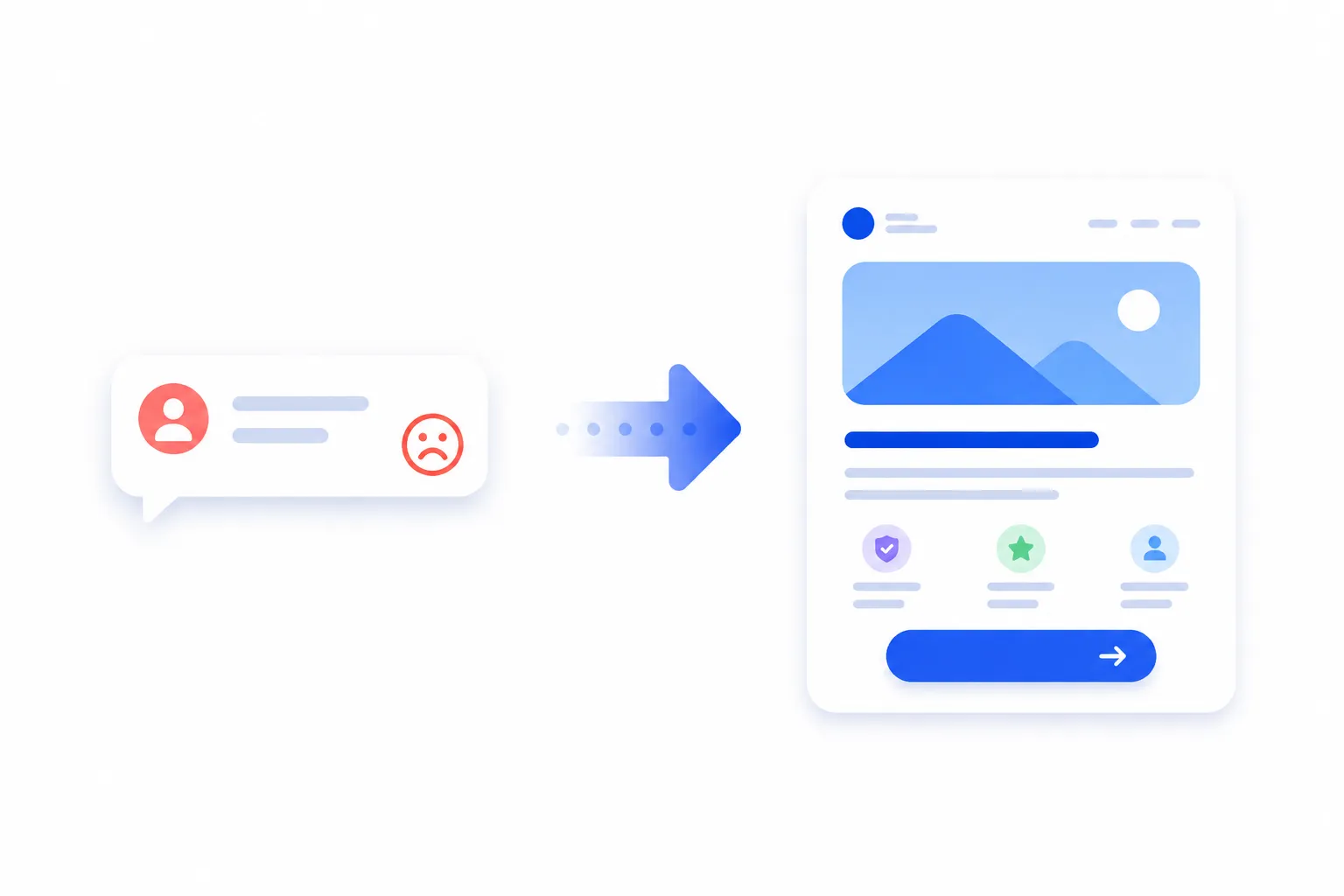
How to Turn Customer Complaints Into Landing Page Copy That Converts
Most landing pages fail because they sound nothing like the customer.
They talk about features, dashboards, automation, workflows, and “powerful solutions,” while the buyer is thinking something much simpler:
“I keep wasting time on this.”
“This is costing me leads.”
“I tried three tools and none of them solved the real problem.”
That gap is expensive. When your page does not match the frustration already in the buyer’s head, they skim, bounce, or decide you are “not for them” before they even understand your product.
The best landing page copy does not start inside your own product notes. It starts inside customer complaints.
Complaints show you the exact pain people care enough to say out loud. They reveal the language buyers use before they are ready to book a demo, buy software, or compare options. If you can collect those complaints, understand the pattern behind them, and turn them into clear copy, your landing page becomes much sharper.
This article will show you how to turn customer complaints from Reddit, X, reviews, support tickets, sales calls, and community threads into better landing page copy without sounding negative, spammy, or fake.
#Why customer complaints are better than generic marketing ideas
A complaint is not just a complaint.
It is a signal.
When someone posts, “I hate how long this takes,” they are not only venting. They are telling you there is a workflow problem. When someone says, “Every tool I tried is too complicated,” they are telling you the market has a trust problem. When someone says, “I wish there was a way to know sooner,” they are telling you timing matters.
That is copywriting gold.
Most businesses guess what customers care about. They write pages around internal assumptions:
-
“AI-powered platform”
-
“All-in-one solution”
-
“Save time and grow faster”
-
“Built for modern teams”
Those lines are not always wrong, but they are usually too clean. Real buyers are messier. They describe pain in plain words.
They say:
-
“I keep missing good opportunities.”
-
“I do not know which leads are worth replying to.”
-
“By the time I find the thread, someone else already answered.”
-
“I sound too salesy when I reply.”
-
“I spend hours searching and still find nothing useful.”
That kind of language gives your landing page weight because it feels recognized.
The reader thinks, “Yes, that is exactly my problem.”
That moment matters.
#The real job of landing page copy
Landing page copy is not there to impress the reader.
It is there to make the reader feel understood, reduce confusion, and show a clear next step.
Good copy answers four questions quickly:
-
What problem does this solve?
-
Why does that problem matter now?
-
How does this product make the situation better?
-
Why should I trust this enough to continue?
Customer complaints help with all four.
They show the pain. They show urgency. They show the broken current workflow. They also show the words your market already believes because those words came from people like them.
That is why complaint mining works so well for SaaS, agencies, service businesses, ecommerce brands, and founder-led sales teams.
You are not inventing pain.
You are organizing it.
#Where to find useful customer complaints
You do not need a huge research team to find better landing page copy.
You need better listening habits.
The best complaints usually appear in places where people are not trying to be polite. They show up in public threads, review sections, competitor discussions, and support conversations.
Here are strong places to look:
SourceWhat to look forHow it helps your landing pageReddit threadsFrustrations, tool complaints, “how do I solve this?” postsHelps you write pain-aware headlines and sectionsX postsQuick reactions, complaints, competitor mentionsHelps you spot urgent, emotional wordingReview sitesRepeated negatives and feature gapsHelps you position against existing alternativesSupport ticketsConfusion, objections, missing expectationsHelps you improve clarity and FAQ copySales callsBuyer priorities and hesitationsHelps you write stronger value sectionsCommunity discussionsWorkflow struggles and real use casesHelps you explain the product in plain EnglishFor Leadmatically-style social lead generation, Reddit is especially useful because people often explain their problem in detail. They ask for recommendations, compare tools, complain about current workflows, and describe what they already tried.
That is exactly the kind of language your landing page should learn from.
A helpful next step is to build a repeatable monitoring system instead of searching manually every time. This guide on /blog/how-to-monitor-reddit-for-customer-pain-points-without-wasting-hours fits naturally if you want to turn Reddit pain points into a steady research source.
#How to separate useful complaints from noise
Not every complaint deserves space on your landing page.
Some people complain because they are not the right customer. Some complaints are too specific. Some are emotional but not useful. Some point to a problem you do not actually solve.
You need to filter.
Ask these questions before using any complaint as copy input:
#Is this complaint repeated?
One person saying something is a clue.
Ten people saying the same thing in different words is a pattern.
Landing page copy should be built around patterns, not random one-off frustrations. If several people complain about the same issue, that issue probably deserves a headline, section, FAQ, or comparison point.
#Is the complaint connected to buying intent?
A useful complaint often comes with action energy.
The person is not just annoyed. They are looking for a fix, asking for tools, comparing options, or explaining why the current process is costing them time, money, leads, or trust.
For example:
Weak signal:
“This is annoying.”
Strong signal:
“We keep missing Reddit threads where people ask for tools like ours. Is there any way to get alerts before the thread gets crowded?”
The second complaint has a clear problem, urgency, and possible solution path.
#Does your product actually solve it?
This matters.
Do not turn every complaint into a promise. If your product does not solve the pain directly, do not pretend it does.
The strongest landing page copy connects real complaints to real product strengths.
For example, if people complain that they manually search Reddit for leads and still miss important threads, Leadmatically can connect naturally because it monitors Reddit and X, finds relevant discussions, and supports better replies.
That is a clean fit.
#Turn complaints into landing page sections
Once you have collected the complaints, do not just paste them into your page.
Translate them.
A complaint is raw material. Landing page copy is shaped material.
Here is a simple way to convert complaints into stronger page copy:
Customer complaintWhat it really meansLanding page angle“I never find these threads until they are already old.”Timing is the painFind high-intent conversations before the window closes“Most replies sound like spam.”Trust is the painReply with context, not generic outreach“I do not know which mentions are worth chasing.”Qualification is the painFocus on conversations that show real buyer intent“Manual searching takes forever.”Workflow cost is the painReplace random searching with a repeatable lead discovery system“People recommend competitors before we even see the thread.”Competitive visibility is the painCatch competitor conversations early and join while it still mattersThis is the core skill.
You are not copying complaints word for word. You are finding the business problem underneath the complaint and making it clear.
#Write headlines from pain, not features
A weak headline starts with the product.
A strong headline starts with the buyer’s problem.
Bad:
AI-powered social monitoring platform for modern businesses
Better:
Find Reddit conversations where buyers are already asking for a product like yours
The better version works because it is specific. It tells the reader what situation the product helps with. It also connects to a real complaint: “We are missing conversations where people are already looking.”
Here are a few complaint-based headline formulas you can use:
#Formula 1: Stop missing [specific opportunity]
Example:
Stop missing Reddit threads where buyers are already asking for help
#Formula 2: Turn [messy behavior] into [business outcome]
Example:
Turn scattered customer complaints into landing page copy that speaks to real buyers
#Formula 3: Find [high-intent signal] before [bad outcome]
Example:
Find competitor mentions before the buyer chooses someone else
#Formula 4: Replace [painful manual process] with [clean workflow]
Example:
Replace manual Reddit searching with a repeatable social lead workflow
These work because they are grounded in real frustration.
#Use complaints to improve your hero section
Your hero section has to do a lot of work fast.
It should tell the reader:
-
what you help them do
-
why it matters
-
why your approach is different
-
what they should do next
Customer complaints can improve each part.
Imagine your audience keeps saying:
“I want Reddit leads, but I do not want to spam people.”
That complaint should shape your hero.
Weak hero:
Grow your business with AI social selling
Better hero:
Find high-intent Reddit conversations and reply without sounding like spam
Now the page feels more accurate.
It speaks to both the desire and the fear.
That is important because buyers often have two thoughts at once. They want more leads, but they do not want to damage trust. They want automation, but they do not want to sound automated. They want to move faster, but they do not want to look desperate.
Your landing page should name those tensions.
#Use complaints to write better feature copy
Most feature sections are too product-centered.
They say what the product has, but not why the buyer should care.
Bad:
Keyword tracking AI scoring Reply suggestions Dashboard analytics
That list is technically clear, but emotionally flat.
Complaint-based feature copy gives each feature a job.
Better:
#Track the conversations you usually miss
Monitor keywords, competitor mentions, and buyer pain points so you are not relying on random manual searches.
#Prioritize replies by intent
See which conversations are worth your time instead of treating every mention like a lead.
#Reply with context
Use suggested replies that match the thread instead of dropping generic promotional comments.
#See what is working
Track discovered leads, read status, replies, and activity so Reddit lead generation becomes a workflow, not a guessing game.
Same features. Better framing.
The difference is that each feature now answers a pain the buyer already has.
#Use complaints to sharpen your FAQ
Your FAQ should not be a dumping ground.
It should handle real doubts.
Customer complaints and objections are perfect FAQ material because they show where people hesitate.
For example, if people complain about spammy Reddit outreach, your FAQ should address that directly.
If people worry about missing timing windows, explain how monitoring helps.
If people worry about reply quality, explain the difference between context-aware replies and generic promotion.
Good FAQ questions often sound like this:
-
“Will this make my brand look spammy?”
-
“How do I know which Reddit threads are worth replying to?”
-
“Can I reply myself instead of having someone else reply?”
-
“What if I only want to monitor a few keywords?”
-
“How fast do I need to reply for Reddit lead generation to work?”
These questions are much stronger than generic ones like:
-
“What is this platform?”
-
“Who is it for?”
-
“How does it work?”
Those are fine, but they are not enough. The best FAQs remove the exact friction that stops someone from taking the next step.
#A simple workflow for turning complaints into copy
Here is a practical process you can use.
#Step 1: Collect raw complaints
Start with Reddit threads, X posts, support tickets, reviews, sales notes, and competitor mentions.
Do not judge too early.
Copy the complaint, the source, the context, and the exact wording.
#Step 2: Group by pain type
Sort complaints into simple categories:
-
timing problems
-
trust problems
-
workflow problems
-
cost problems
-
confusion problems
-
competitor problems
-
reply quality problems
This helps you see patterns.
#Step 3: Translate each complaint into a business impact
Ask:
“What does this complaint cost the customer?”
Maybe it costs time. Maybe it costs leads. Maybe it costs trust. Maybe it costs visibility. Maybe it creates anxiety because competitors are showing up first.
The business impact is what makes the copy stronger.
#Step 4: Match each pain to a product capability
Now connect the pain to what your product actually does.
For Leadmatically, that might mean:
-
monitoring Reddit and X continuously
-
finding relevant discussions
-
organizing leads by business and keyword
-
helping users choose a reply style
-
supporting suggested replies or done-for-you human replies
-
tracking lead activity in the dashboard
Do not force the connection. Only use the strongest fits.
#Step 5: Rewrite the page section by section
Start with the highest-impact areas:
-
hero headline
-
hero subheadline
-
feature section
-
pain section
-
how-it-works section
-
FAQ
-
CTA
You do not need to rewrite the whole page at once. A better hero and sharper feature section can already improve clarity.
#A copy checklist before you publish
Before updating your landing page, run it through this checklist:
-
Does the hero mention a real problem your buyer already feels?
-
Does the copy sound like your customer, not your internal team?
-
Does each feature explain the pain it solves?
-
Have you removed vague claims like “grow faster” unless they are supported by specifics?
-
Does the page explain why timing matters?
-
Does it address trust concerns around outreach or automation?
-
Does the CTA feel like a natural next step?
-
Does the FAQ answer actual objections?
-
Can a new visitor understand the product in under 10 seconds?
-
Would your ideal customer say, “This is exactly what I have been dealing with”?
If the answer is no, go back to the complaints.
They will usually show you what is missing.
#Where Leadmatically fits into this workflow
The hard part is not knowing that customer complaints are useful.
The hard part is finding the right ones consistently.
Manually searching Reddit and X every few days is messy. You miss threads. You forget keywords. You find conversations after the useful window has already passed. And when you do find something, you still have to decide whether it is worth replying to and how to respond without sounding promotional.
That is where Leadmatically fits naturally.
Leadmatically helps businesses monitor Reddit and X for relevant conversations, find qualified leads, and choose how to reply. You can use those same conversations for more than outreach. They can also become a steady source of landing page insight.
The result is a cleaner loop:
You find real conversations.
You learn what buyers complain about.
You improve your landing page copy.
You reply to the right people with better context.
That is how social listening becomes more than research. It becomes part of your acquisition system.
#FAQ
#How many complaints do I need before changing my landing page?
You do not need hundreds. Start with 20 to 30 strong complaints from your target audience. Look for repeated patterns. If the same pain appears again and again, it is probably worth using in your copy.
#Should I use the exact words customers use?
Sometimes, but not always. Exact wording is useful when it is clear and natural. But your job is to turn raw complaints into polished, accurate copy. Keep the customer’s meaning. Improve the clarity.
#Can negative complaints make my landing page feel too harsh?
Only if you overdo it. The goal is not to make the page feel angry. The goal is to make the reader feel understood. Use the pain to create relevance, then move quickly into a better path forward.
#What if my product solves several different complaints?
Prioritize the complaints with the strongest buying intent. A landing page should not try to solve every possible problem. Lead with the pain that makes someone actively look for a solution.
#Is this only useful for SaaS landing pages?
No. This works for agencies, service businesses, ecommerce brands, consultants, and productized services too. Any business that needs clearer messaging can use customer complaints to write more relevant copy.
#Better copy starts with better listening
Your customers are already telling the market what they want.
They are doing it in Reddit threads, X posts, reviews, comments, support messages, and competitor discussions.
The question is whether you are listening closely enough to turn those complaints into better positioning.
Strong landing page copy does not come from sounding clever. It comes from making the buyer feel seen, naming the problem clearly, and showing a believable way forward.
If you want to build that kind of page, start with the complaints your market is already sharing. Then turn those complaints into sharper headlines, clearer feature sections, better FAQs, and more useful CTAs.
That is how your landing page stops sounding like a brochure and starts sounding like the answer to a problem your buyer already has.