
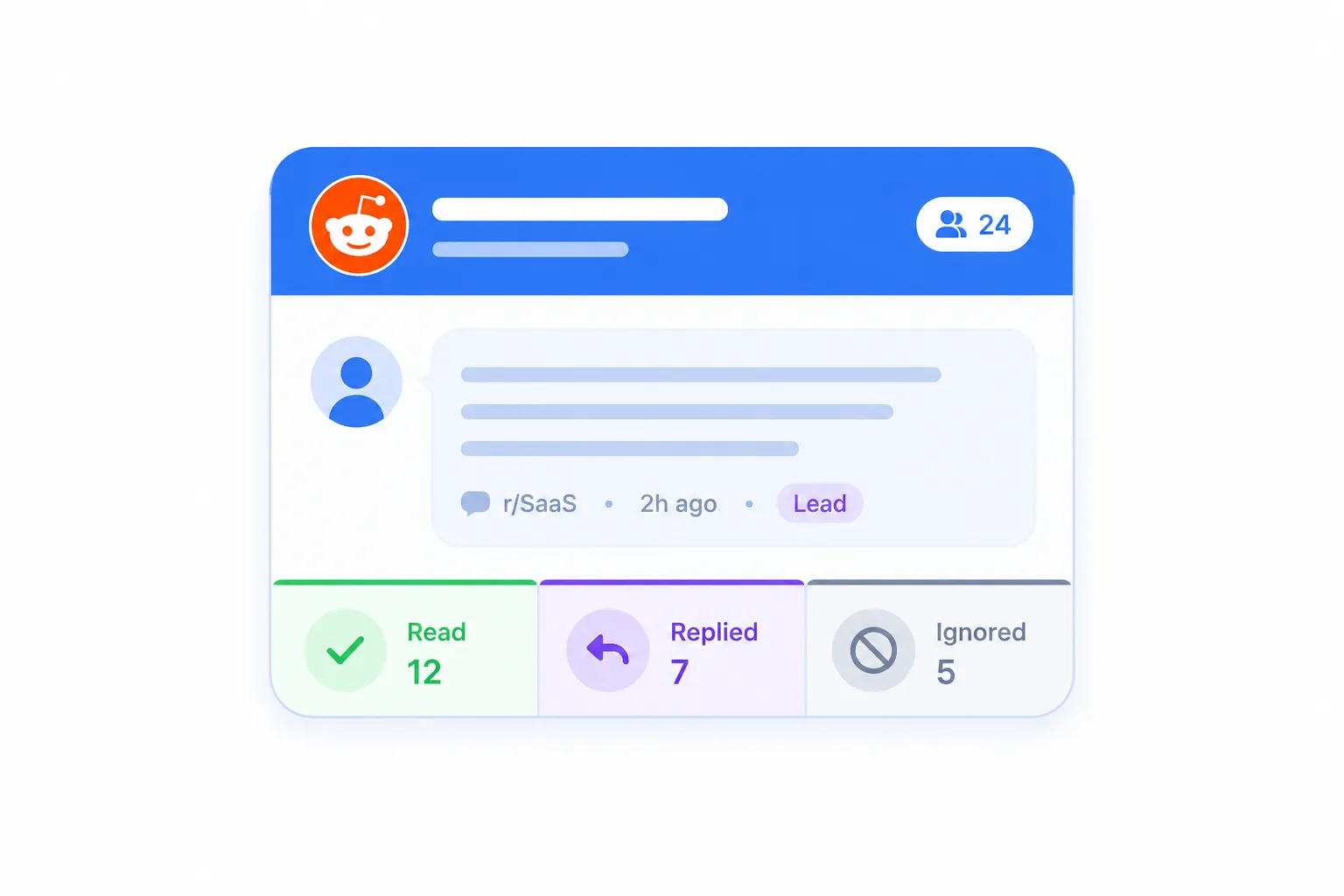
Social leads get messy faster than most teams expect.
At first, it feels simple. You find a Reddit thread. You reply to a few people. You save a couple of posts. Maybe someone on your team drops links into Slack or Notion. It feels like progress because conversations are happening and potential buyers are being discovered.
Then the cracks start showing.
Someone reads a good lead but forgets to reply. Another person replies to a thread that was already handled. A strong opportunity gets buried under weaker mentions. A founder assumes the marketing person followed up. The marketing person assumes the sales person ignored it on purpose. Three days later, the buyer has already chosen another tool.
That is where social lead generation quietly breaks.
The problem is not always discovery. Many teams can find conversations. The harder part is knowing what happened after the lead was found.
Was it reviewed?
Was it worth replying to?
Did someone actually reply?
Should it be ignored?
Does it need follow-up?
Without a simple status system, every social lead turns into a small guessing game. And when your lead workflow depends on guessing, good opportunities slip away.
This article explains a simple status system for social leads using three core labels: Read, Replied, and Ignored. You will learn how to use each status, how to avoid messy lead queues, how to improve reply timing, and how to build a cleaner workflow for Reddit and social lead generation.
#Why Social Lead Tracking Falls Apart
Social lead generation is different from cold email, paid ads, or traditional CRM outreach.
With cold email, you usually control the list. With paid ads, you control the campaign. With SEO, you control the page. But with Reddit, X, communities, forums, and public conversations, the buyer is already talking somewhere else.
You are not creating the conversation.
You are joining it.
That makes timing and context extremely important.
A person asking for a recommendation today may be ready to buy this week. A person complaining about a competitor may be open to switching. A founder asking “what tool do you use for this?” may be actively building a shortlist.
But that window does not stay open forever.
If your team finds the thread two days later, the best answer may already have won attention. If someone reads the lead but does not reply, the opportunity sits there until it goes cold. If your team cannot tell which leads were handled, you waste time checking the same conversations again.
The lead itself may be good.
The system around it is weak.
That is why status tracking matters.
#The Real Cost of Not Using Lead Statuses
A messy social lead workflow does not just make your dashboard ugly. It creates real business problems.
You lose speed.
You lose context.
You lose trust.
You lose good-fit buyers who were already showing intent.
Most teams notice the problem too late because the failure does not look dramatic. It looks like small daily misses.
A thread nobody replied to.
A question answered too late.
A comment that sounded rushed because nobody had time to understand the context.
A high-intent lead mixed into a pile of weak keyword matches.
A founder asking, “Did anyone handle this?” again and again.
These small problems compound.
If your team finds 100 social leads but only replies to 12 of them, discovery is not your only issue. The real issue is lead operations. You have attention coming in, but no clean process for turning that attention into conversations.
That is where a simple status system helps.
It does not need to be complicated.
It just needs to make the next action clear.
#The Simple Status System: Read, Replied, Ignored
You can manage most social leads with three core statuses:
StatusWhat It MeansBest Used WhenReadSomeone reviewed the lead but has not taken final action yetThe lead needs a decisionRepliedSomeone responded to the conversationThe team has taken actionIgnoredThe lead is not worth replying toThe lead is weak, irrelevant, risky, or coldThat is the foundation.
You can add more statuses later if your workflow grows, but most teams should start here. Too many labels create confusion before they create clarity.
The goal is not to build a perfect CRM.
The goal is to answer one simple question:
What should happen next with this lead?
A clean social lead flow usually looks like this:
New lead → Read → Replied or Ignored
That one workflow solves most of the confusion.
New means the lead has been discovered.
Read means someone reviewed it.
Replied means someone acted on it.
Ignored means the team decided not to spend time on it.
Simple.
Useful.
Easy to follow.
#Status 1: Read
“Read” means someone has looked at the lead and reviewed the context.
It does not mean the lead is good.
It does not mean someone replied.
It does not mean the opportunity is closed.
It only means the lead has been opened, checked, and understood enough for the team to know it is no longer untouched.
This matters because social leads need judgment.
A keyword match does not automatically mean buyer intent.
For example, imagine your product helps SaaS teams monitor Reddit for customer pain points. A lead appears because someone used the phrase “Reddit monitoring.” That could be a perfect buyer. But it could also be a student asking about moderation tools, a casual user discussing subreddit rules, or another marketer talking about brand tracking in a completely different context.
The system found a possible lead.
A human still needs to decide whether it is worth action.
That is what Read is for.
#When to Mark a Lead as Read
Use Read when:
-
The lead has been reviewed but not answered yet
-
The conversation looks potentially relevant
-
You need more time before replying
-
You want another person to approve the reply
-
The lead needs a custom response
-
The buyer intent is unclear but worth checking
-
The thread is important enough to keep visible
Read is a holding status.
It tells your team, “This is no longer untouched, but we have not made the final move yet.”
That is useful because many leads sit in the middle. They are not obvious wins, but they are not obvious rejects either.
#What Read Prevents
Read prevents repeated review.
Without it, the same thread may be opened by three different people. Everyone wastes a few minutes. Nobody knows who owns it. The lead still does not get a reply.
Read also prevents false confidence.
A team member may say, “I saw that one,” but seeing a lead is not the same as acting on it. The Read status keeps that difference visible.
#Example
Bad workflow:
A founder shares a Reddit thread in Slack. Someone opens it and thinks, “This looks relevant.” They get distracted and never reply. Everyone assumes it was handled.
Better workflow:
The lead is marked Read. The team can see it has been reviewed but still needs a reply decision.
That small difference can save a strong lead from disappearing.
#Status 2: Replied
“Replied” means someone has responded to the lead.
This is the action status.
A social lead only becomes useful when you enter the conversation in a relevant way. Finding the lead is not enough. Saving it is not enough. Reading it is not enough.
At some point, someone has to reply.
But the reply needs to fit the context.
That is where many teams get social selling wrong. They treat every lead like an excuse to pitch. They see a keyword match, jump into the thread, and force their product into the conversation.
That usually damages trust.
A good reply should feel like it belongs in the thread.
It should answer the person’s actual question. It should add something useful. It should sound like a person who understands the problem, not a brand trying to hijack attention.
#When to Mark a Lead as Replied
Use Replied when:
-
You posted a public Reddit comment
-
You replied on X
-
You answered the person’s question in the thread
-
You sent a helpful follow-up message
-
Your team responded using the right account
-
A done-for-you reply was posted
-
The conversation has been handled for now
Do not mark a lead as Replied just because a reply was drafted.
A draft is not action.
Replied should mean the response actually happened.
#Why Replied Is So Important
Replied shows execution.
Many teams love tracking lead volume because it feels impressive. But lead volume alone can hide the real problem.
You may have 300 discovered leads.
But how many were replied to?
How many received a thoughtful response?
How many were handled while the thread was still active?
How many turned into a conversation?
The Replied status helps you separate discovery from action.
That is important because a social lead system should not only answer:
“How many leads did we find?”
It should also answer:
“How many good leads did we actually engage?”
That second question is where pipeline starts.
#Status 3: Ignored
“Ignored” means the lead is not worth replying to.
This status may feel negative, but it is one of the healthiest labels in the whole workflow.
Why?
Because not every social lead deserves attention.
Some leads are bad fits. Some are too old. Some are from people who clearly are not buyers. Some threads are filled with arguments. Some posts mention your keyword but have nothing to do with your product. Some conversations would make your brand look desperate if you jumped in.
Ignoring these leads is not laziness.
It is discipline.
Good social lead generation is not about replying to everything.
It is about replying where your input is useful, relevant, and welcome.
#When to Mark a Lead as Ignored
Use Ignored when:
-
The lead is not relevant
-
The thread is too old
-
The person has no clear problem
-
The user is not close to your target audience
-
The conversation is mostly noise
-
The post is too broad to reply meaningfully
-
Your product would feel forced in the discussion
-
The thread is hostile or risky
-
The user is asking for something you do not offer
-
The lead came from a weak keyword match
Ignored keeps your active queue clean.
It also gives you useful feedback.
If you are ignoring too many leads, your targeting may be too broad. Your keywords may be too generic. Your monitoring may be catching mentions that sound relevant but do not show real intent.
That is not failure.
That is data.
#The Difference Between Ignoring and Missing a Lead
This distinction matters.
Ignoring a lead is intentional.
Missing a lead is accidental.
When you ignore a lead, you are saying:
“We reviewed this and decided it is not worth action.”
When you miss a lead, you are really saying:
“We never got to it in time.”
Those are completely different problems.
Ignored leads show judgment.
Missed leads show workflow failure.
You want more intentional decisions and fewer accidental misses.
A simple status system helps you see the difference.
#A Practical Decision Framework for Social Leads
Before replying to a social lead, ask a few simple questions.
QuestionWhy It MattersBest ActionIs the person describing a real problem?Pain is stronger than casual interestKeep reviewingIs the problem connected to what we sell?Relevance protects trustReply or keep reviewingIs the thread recent enough?Timing affects conversionPrioritize recent threadsCan we add useful advice?Value comes before promotionReply if usefulWould mentioning our product feel natural?Forced mentions hurt credibilityMention softly or avoidIs the user likely to be a buyer?Not every commenter is a prospectReply only if fit is strongIs the conversation respectful and safe?Some threads are not worth enteringIgnore if riskyThis framework keeps the team from replying based only on excitement.
It also prevents the opposite problem: overthinking every lead until the window closes.
The best lead workflows are fast, but not careless.
#How to Decide Between Replied and Ignored
The hardest part is not marking something Read.
The hard part is deciding what happens after that.
Here is a simple way to think about it.
#Reply When the Lead Has Clear Intent
Clear intent usually sounds like this:
-
“What tool should I use for this?”
-
“How are people solving this problem?”
-
“Is there a better alternative to this?”
-
“I’m struggling with this workflow.”
-
“Has anyone found a way to automate this?”
-
“We are wasting too much time doing this manually.”
These are good signals.
The person is not just mentioning a topic. They are expressing a problem, asking for help, comparing options, or looking for a better way.
That is when a useful reply can work.
#Ignore When the Context Is Weak
Weak context usually looks like this:
-
The thread is old and inactive
-
The user is not your target customer
-
The post is only a meme or casual mention
-
The discussion is unrelated after you read it
-
The keyword match is accidental
-
The person is asking for a free tool and your product is not a fit
-
The thread is full of negativity or bad-faith arguments
In those cases, replying often creates more risk than upside.
A clean status system gives your team permission to skip bad opportunities without guilt.
#Why Statuses Improve Reply Quality
Statuses do more than organize leads.
They improve the quality of your replies.
When a lead is clearly marked as New, Read, Replied, or Ignored, your team can slow down at the right moment and move fast at the right moment.
New leads need quick review.
Read leads need thoughtful decisions.
Strong leads need fast replies.
Weak leads need to be removed from the active queue.
That structure reduces panic.
Without it, people either rush bad replies or delay good ones.
Both are expensive.
A rushed reply can sound generic.
A delayed reply can miss the window.
A good status system helps you avoid both.
#A Simple Workflow for Managing Reddit Leads
Here is a practical workflow your team can use.
#Step 1: Capture New Leads Automatically
Start by collecting relevant social conversations in one place.
This may include Reddit posts, Reddit comments, X posts, competitor mentions, pain-point phrases, product category keywords, and direct questions from your target audience.
The goal is not to catch every mention on the internet.
The goal is to catch conversations where your team may be useful.
Leadmatically helps with this discovery layer by monitoring Reddit and social conversations so you are not manually searching every morning and hoping you find the right threads.
#Step 2: Review the Lead Context
Before replying, read the conversation.
Do not rely only on the keyword that triggered the lead.
Look at:
-
What the person is actually asking
-
Whether the thread is recent
-
Whether the replies are still active
-
Whether the person matches your target customer
-
Whether the problem connects to your product
-
Whether a reply would feel natural
This review step protects your brand.
It stops you from jumping into the wrong conversations.
#Step 3: Mark the Lead as Read
Once someone has reviewed it, mark it Read.
This prevents duplicate work and shows the lead is no longer untouched.
If you work alone, this still helps. It gives you a clean queue of leads that need a decision.
If you work with a team, it becomes even more important because everyone can see what has already been checked.
#Step 4: Write the Reply
If the lead is strong, write the reply around the person’s problem.
A good reply usually follows this structure:
-
Acknowledge the problem
-
Give useful advice
-
Share a practical recommendation
-
Mention your product only if it fits
-
Avoid sounding like a sales pitch
For example, instead of saying:
“Use our tool. It does exactly this.”
Say something more like:
“The main thing is catching these conversations early, because by the time a thread has 50 replies, the buyer has usually already formed an opinion. You can do it manually with saved searches, but a monitoring workflow is more reliable if this is part of your acquisition strategy.”
That kind of reply teaches first.
Then, if relevant, you can mention Leadmatically naturally as one way to manage that workflow.
#Step 5: Mark the Lead as Replied
After the reply is posted, update the status.
This matters because it gives the team a real record of action.
You can now track how many leads were found, how many were reviewed, and how many were actually replied to.
That is much more useful than only tracking discovery volume.
#Step 6: Mark Weak Leads as Ignored
If the lead is not worth action, mark it Ignored.
Do not leave it sitting in the queue.
An active queue should only contain leads that still need attention. If a lead is bad, remove it from the decision pile.
That keeps your workflow clean.
#Step 7: Review Patterns Weekly
Once a week, review your statuses.
Ask:
-
How many leads were discovered?
-
How many were Read?
-
How many were Replied to?
-
How many were Ignored?
-
Why were leads ignored?
-
Which replied leads created conversations?
-
Which keywords produced the best leads?
-
Which keywords produced noise?
This turns your status system into a feedback loop.
Now you are not just doing social lead generation. You are improving it.
#What Your Status Ratios Can Tell You
Your status data can show where the workflow is weak.
PatternWhat It May MeanWhat to FixMany New leads, few Read leadsReview process is too slowAssign ownership or check leads dailyMany Read leads, few Replied leadsTeam is unsure how to respondCreate reply guidelines or templatesMany Ignored leadsTargeting is too broadImprove keywords and filtersMany Replied leads, few conversationsReply quality may be weakImprove context and personalizationFew New leadsDiscovery is too narrowAdd better keywords or monitor more sourcesReplies happen lateTiming is brokenPrioritize fresh leads firstThis is where a simple system becomes powerful.
You are not guessing anymore.
You can see the bottleneck.
#Common Mistakes to Avoid
A status system only works if your team uses it clearly.
Here are the mistakes to avoid.
#Mistake 1: Marking Leads as Replied Too Early
Do not mark a lead as Replied when a response is only drafted.
That creates false reporting.
A reply only counts when it is actually posted or sent.
#Mistake 2: Leaving Bad Leads Unmarked
If a lead is bad, mark it Ignored.
Do not leave it in the active queue because you feel unsure. A cluttered queue makes good leads harder to spot.
#Mistake 3: Treating Read as a Final Status
Read is not the end.
It is a middle step.
Every Read lead should eventually become Replied or Ignored.
#Mistake 4: Replying Just Because the Keyword Matches
Keywords help you find possible leads.
They do not make the decision for you.
Always read the actual context before replying.
#Mistake 5: Using Too Many Statuses Too Early
More labels do not always create more clarity.
Start simple. Add more only when the team actually needs them.
#Should You Add More Statuses Later?
Maybe.
Once your workflow grows, you may want extra statuses like:
-
New
-
Read
-
Needs Approval
-
Drafted
-
Replied
-
Follow-Up Needed
-
Converted
-
Ignored
But do not start there unless you truly need it.
For most founders, indie hackers, agencies, and small SaaS teams, too many statuses create extra work. People spend more time managing the system than replying to good leads.
Start with Read, Replied, and Ignored.
Then add more only when a repeated problem appears.
For example, if many leads are reviewed but waiting on a founder’s approval, add “Needs Approval.”
If many replied leads require a second touch, add “Follow-Up Needed.”
Let the workflow earn its complexity.
#How Leadmatically Fits Into This Workflow
Leadmatically is useful because the hard part of social lead generation is not only finding mentions.
It is managing the full path from discovery to reply.
The platform helps businesses monitor Reddit and social conversations, find relevant leads, and keep the reply workflow organized. That matters because without a system, teams usually fall back into manual searching, scattered notes, and unclear ownership.
A clean lead queue helps you answer:
-
Which leads are new?
-
Which leads have been reviewed?
-
Which leads were replied to?
-
Which leads should be ignored?
-
Which conversations are worth prioritizing?
That visibility makes social lead generation feel less random.
It also helps teams avoid the two biggest mistakes: replying too late and replying where they do not belong.
For a deeper workflow on finding high-intent Reddit conversations without sounding spammy, this guide is a natural next step: /blog/how-to-find-leads-on-reddit-without-spamming-a-better-workflow-for-high-intent-social-selling
#A Simple Weekly Review Checklist
Use this checklist once a week to improve your social lead process.
#Weekly Social Lead Review
-
Check how many leads were discovered
-
Review how many were marked Read
-
Check how many received replies
-
Look at how many were Ignored
-
Identify the top reasons leads were ignored
-
Find which keywords created the best leads
-
Find which keywords created noisy leads
-
Review the replies that got responses
-
Improve one reply template or guideline
-
Remove or adjust one weak keyword
-
Prioritize faster review for high-intent conversations
This should not take hours.
The point is to improve the system a little every week.
Social lead generation gets better when your team learns from the leads it already found.
#The Best Mental Model: A Lead Queue, Not a Content Feed
Many teams treat Reddit and social discovery like a content feed.
They scroll.
They skim.
They save links.
They reply when they feel like it.
That is why the process feels random.
A better way to think about it is as a lead queue.
A queue has order.
A queue has status.
A queue has next actions.
A queue shows what needs attention and what has already been handled.
That shift changes everything.
You stop asking, “Did anyone see this?”
You start asking, “What status is this lead in?”
That is a much better question.
#FAQ
#What is a social lead status system?
A social lead status system is a simple way to track what happened to each lead found from Reddit, X, forums, or other social conversations. It helps you know whether a lead is new, reviewed, replied to, or ignored.
#What does Read mean in lead tracking?
Read means someone reviewed the lead but has not taken final action yet. It is useful for leads that need a decision before replying or ignoring.
#What does Replied mean for social leads?
Replied means someone has responded to the conversation. This could be a Reddit comment, X reply, or another context-aware response.
#What does Ignored mean?
Ignored means the lead is not worth replying to. This may be because the conversation is irrelevant, too old, too risky, or not connected to your product.
#Should every Reddit lead get a reply?
No. Replying to every Reddit lead is a bad strategy. You should only reply when the conversation is relevant, timely, and you can add something useful.
#Why do teams miss good social leads?
Teams usually miss good leads because they do not monitor consistently, review too slowly, or lack a clear ownership system. A lead may be found, but if nobody knows who should reply, the opportunity goes cold.
#How can I improve Reddit lead follow-up?
Use a clear queue, review leads daily, mark each lead with a status, prioritize fresh high-intent threads, and track which replies create real conversations.
#Is a CRM required for social lead tracking?
Not always. A full CRM can help later, but most teams can start with a simple status system. The important thing is knowing which leads need action and which ones are already handled.
#When should I ignore a social lead?
Ignore a lead when the person is not your target customer, the thread is too old, the context is weak, or your reply would feel forced. Ignoring weak leads protects your time and credibility.
#How does Leadmatically help with this?
Leadmatically helps businesses find relevant Reddit and social conversations, manage discovered leads, and organize the reply workflow so teams can act faster and avoid missing high-intent opportunities.
#Final Thought
Social lead generation does not fail only because teams cannot find leads.
It often fails because they cannot manage what happens after the lead is found.
That is the hidden problem.
A good conversation appears. Someone sees it. Nobody replies. Or someone replies too late. Or the team wastes time on weak leads while strong ones go cold.
A simple status system fixes the basics.
Read means reviewed.
Replied means handled.
Ignored means skipped on purpose.
Those three statuses create a cleaner workflow, faster decisions, and better team visibility. They help you focus on the conversations that deserve attention and stop wasting energy on the ones that do not.
That is how social lead generation becomes more reliable.
Not by spamming more.
Not by chasing every mention.
But by finding the right conversations, reviewing them quickly, replying where you can actually help, and building a process your team can repeat.