
Managing social replies for clients sounds simple until the volume starts growing.
At first, you are checking Reddit threads manually, saving a few posts, writing replies one by one, and reporting wins in a spreadsheet. Then you add another client. Then another niche. Then more keywords. Suddenly, your team is trying to monitor dozens of communities, respond before conversations go cold, avoid sounding promotional, and prove that the work is actually producing pipeline.
That is where most agency social lead workflows break.
The problem is not just “not enough time.” The real problem is that social reply work has too many moving parts: discovery, qualification, timing, tone, approval, reply tracking, and reporting. If any part is weak, the whole system feels messy.
This guide will show you how to manage social replies at scale without turning your agency into a spam machine. You will learn what to track, how to structure the workflow, how to protect reply quality, and where a tool like Leadmatically fits when manual monitoring stops being reliable.
#Why Social Replies Get Messy for Agencies
Social replies are different from cold email, paid ads, or simple social posting.
You are not pushing a message into a fixed channel. You are entering live conversations where people already have context, opinions, questions, frustrations, and trust filters.
That makes the work powerful.
It also makes it easy to mess up.
When an agency manages social replies badly, a few things usually happen:
-
The team replies too late, after the buyer has already chosen another option.
-
Replies sound generic because the person responding did not understand the thread.
-
Junior team members copy the same structure across every comment.
-
Clients ask what results came from the activity, and the agency has weak reporting.
-
Good opportunities are missed because nobody was watching the right keywords at the right time.
The agency thinks the issue is volume.
But volume only exposes the real issue: there is no repeatable system.
#The Goal Is Not More Replies. It Is Better Conversation Coverage.
A lot of teams approach social selling with the wrong target.
They think scale means replying to more threads.
That is dangerous.
If your agency replies to more conversations but the replies are late, irrelevant, or obviously promotional, you are not scaling lead generation. You are scaling trust damage.
A better goal is conversation coverage.
That means your agency has a clear system for finding the right conversations, deciding which ones deserve attention, responding quickly, and matching the reply to the situation.
Think of it like support tickets.
A good support team does not treat every ticket the same. They triage. They assign urgency. They route to the right person. They track status. They measure resolution.
Social replies need the same discipline.
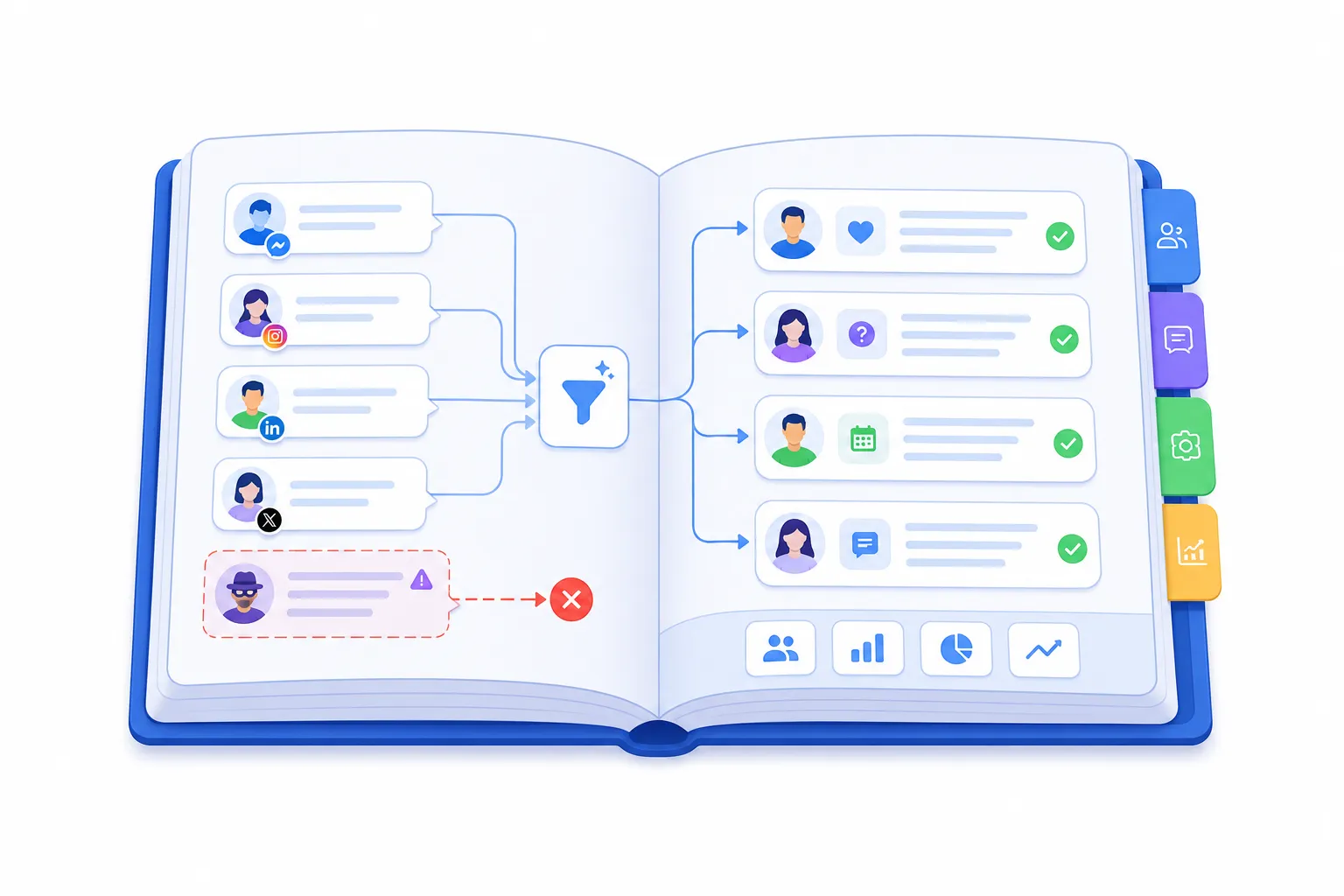
#The Core Agency Workflow: Find, Score, Reply, Track
A scalable social reply system has four parts.
Not twenty. Not some huge internal process that nobody follows.
Just four.
#1. Find the Right Conversations
This is where most agencies lose money quietly.
They rely on manual searches, random subreddit browsing, or client-provided keywords that are too broad.
For example, if your client sells project management software, searching only for “project management tool” is not enough. Buyers may be saying:
-
“Trello is getting messy”
-
“Need something better than Asana”
-
“How do you manage client tasks?”
-
“Agency workflow is becoming a nightmare”
-
“Looking for a tool for remote team handoffs”
The best conversations are often not clean keyword matches. They are pain signals.
Your system should monitor keywords, competitor mentions, problem phrases, category terms, and buying-intent language.
A useful bridge here is this guide on how to find leads on Reddit without spamming, because the first step is always finding conversations where a helpful reply actually belongs.
#2. Score the Opportunity Before Replying
Not every mention deserves a reply.
This is a hard lesson for agencies, because clients often want “activity.” They want to see movement. They want more comments, more links, more replies.
But not every thread is worth touching.
A good opportunity usually has at least one of these signals:
SignalWhat It MeansReply PriorityClear painThe person explains a real problemHighTool searchThey ask for recommendations or alternativesHighCompetitor mentionThey mention a competing productMedium to highRecent threadThe conversation is still activeHighStrong fitYour client genuinely solves the issueHighLow contextThe post is vague or broadLowNegative toneThe thread is hostile or not open to adviceLowOff-topic matchKeyword appears but intent is wrongSkipThis step protects your team from wasting time.
It also protects your client’s reputation.
A reply should only happen when your client can add value without forcing the product into the conversation.
#3. Write Replies That Fit the Thread
The best social replies do not sound like ads.
They sound like someone understood the problem.
Bad reply:
“You should check out our platform. It helps businesses automate this process and save time.”
Better reply:
“This usually gets messy when the team is tracking conversations manually. I’d separate discovery from replying first. Track the phrases people use when they describe the problem, then only reply when there is clear buying intent. Otherwise it starts feeling like random outreach.”
See the difference?
The better reply teaches first. It gives the reader something useful even if they never click anything.
That is the standard your agency needs.
A strong reply usually does three things:
-
Acknowledges the person’s exact situation
-
Offers one useful thought, warning, or next step
-
Mentions the client only if it naturally fits
The product should feel like part of the answer, not the reason the reply exists.
#4. Track Every Reply Like Pipeline
If you are managing replies for clients, you need tracking.
Not just “we replied to 40 comments this month.”
That is activity reporting. Clients eventually get tired of it.
You need pipeline reporting.
Track:
-
source platform
-
subreddit or channel
-
thread URL
-
client/business
-
keyword or trigger
-
reply status
-
reply date
-
lead quality
-
response outcome
-
whether the conversation moved forward
This lets you answer the questions clients actually care about:
Did we find relevant conversations?
Did we reply fast enough?
Which keywords produced the best opportunities?
Which replies created engagement?
Which clients or offers are converting from social?
Without this, your agency is just doing busy work with screenshots.
#What Breaks When Agencies Try to Scale Manually
Manual work can be fine for one client.
It becomes painful with five.
It becomes unreliable with ten.
Here is what usually breaks first.
#Monitoring Becomes Inconsistent
One team member checks Reddit in the morning. Another checks at night. Someone forgets a keyword. Another person searches the wrong variation.
Good conversations disappear in the gaps.
The best social leads often have a short window. If someone asks for a recommendation and ten people reply before your team sees it, your client is now late.
Late replies are not always useless, but they are weaker.
In social conversations, timing creates trust.
#Reply Quality Gets Uneven
When more people start writing replies, quality becomes harder to control.
One person writes helpful, natural comments.
Another person sounds like they are copy-pasting from a landing page.
Another person overmentions the client.
Another person avoids mentioning the client at all.
This creates an inconsistent brand voice.
The fix is not to force everyone into one robotic template. The fix is to build reply principles.
For example:
-
Start with the user’s problem, not the client’s product.
-
Never lead with a link.
-
Mention the client only after giving useful context.
-
Match the tone of the thread.
-
Avoid hype words.
-
Do not reply when the fit is weak.
That gives your team structure without killing the human feel.
#Approval Slows Everything Down
Agencies often create approval workflows to protect quality.
That makes sense.
But if every reply needs three reviews, the opportunity may be cold by the time it goes live.
You need different approval levels.
High-trust, low-risk replies can move fast. Sensitive replies, competitor comparison replies, pricing replies, or technical claims may need review.
Not every comment deserves the same process.
#Reporting Becomes Too Manual
If your team is copying links into spreadsheets and manually tagging outcomes, reporting will eventually fall behind.
Then the client call becomes vague.
You say:
“We found some good conversations this month.”
The client hears:
“We are not sure what this is doing.”
That is a problem.
At scale, reporting needs to be built into the workflow, not added at the end.
#A Practical Social Reply System for Agencies
Here is a simple operating system you can use.
#Step 1: Build a Client Conversation Map
Before replying anywhere, define what a good conversation looks like for each client.
Create a simple map:
-
What pain points does the client solve?
-
What words do buyers use before they know the product category?
-
Which competitors come up often?
-
Which subreddits or communities matter?
-
Which questions show high intent?
-
Which topics should the agency avoid?
-
What claims are allowed?
-
What claims need approval?
This prevents broad, messy targeting.
It also helps junior team members understand what to look for.
#Step 2: Separate Discovery From Replying
Do not make one person responsible for everything.
Discovery and replying are different jobs.
Discovery is about finding and qualifying opportunities.
Replying is about writing something useful, accurate, and natural.
When one person does both at scale, they usually rush one side.
A cleaner setup:
-
Lead finder monitors and qualifies conversations.
-
Reply writer drafts the response.
-
Reviewer checks sensitive replies.
-
Account owner reviews performance and client fit.
For smaller teams, one person can hold multiple roles. But the workflow should still be clear.
#Step 3: Use Reply Tiers
Not every opportunity needs the same response.
Use tiers.
TierUse CaseReply StyleTier 1Strong buying intent, perfect fitHelpful answer plus soft product mentionTier 2Pain is clear, but buyer is earlyEducational reply, no hard mentionTier 3Brand or competitor mentionContextual reply, careful positioningTier 4Weak fit or vague threadSkip or save for laterTier 5Risky, hostile, or sensitive topicDo not reply without approvalThis keeps your agency from treating every keyword match like a lead.
That alone can improve reply quality.
#Step 4: Create a Reply Quality Checklist
Before any reply goes live, it should pass a quick check.
Use this:
-
Does the reply clearly connect to the original post or comment?
-
Does it help before it promotes?
-
Would it still be useful if the product mention was removed?
-
Is the tone natural for the community?
-
Is the product mention relevant and light?
-
Is there any claim the client would need to approve?
-
Is the reply too long for the thread?
-
Does it sound like a real person wrote it?
If the reply fails more than two of these, rewrite it.
Simple rule:
If it sounds like marketing, it probably should not be posted.
#Where Leadmatically Fits Into the Agency Workflow
At some point, manual monitoring becomes the bottleneck.
That is where Leadmatically fits naturally.
Leadmatically helps agencies find relevant conversations on Reddit and X, track leads by business, manage keywords, and work from a lead queue instead of manually searching platform by platform.
For an agency, this matters because your team needs consistency.
You do not want client results depending on whether someone remembered to search Reddit that morning. You want a repeatable system where conversations are discovered, scored, organized, and ready for action.
Leadmatically also supports the two reply models agencies often need:
-
Your team can reply manually using suggested replies.
-
Leadmatically can help with human-crafted replies using established Reddit accounts, depending on the plan and workflow.
That gives agencies more flexibility.
Some clients may want full control. Others may want done-for-you execution. The important thing is that discovery, qualification, and reply management are not scattered across browser tabs and spreadsheets.
#How to Keep Replies Human at Scale
This is the part agencies cannot ignore.
The more you scale, the easier it is to sound fake.
And Reddit users are very good at spotting fake.
So your system needs guardrails.
#Do Not Use One Template Everywhere
Templates are useful for structure.
They are dangerous when copied word for word.
Instead of writing fixed replies, create reply patterns.
Example pattern:
-
Reflect the problem.
-
Explain the likely cause.
-
Give one practical suggestion.
-
Mention the client only if clearly relevant.
That creates consistency without making every reply identical.
#Do Not Force a Product Mention
Some of the best replies should not mention the client at all.
That might feel strange at first.
But social trust works differently from ads. Sometimes the goal is to become useful in the conversation, not to convert instantly.
If every reply includes a product mention, the account starts looking like it has an agenda.
Use product mentions when they fit.
Skip them when they do not.
#Match the Community’s Tone
A Reddit reply in a technical subreddit should not sound like a LinkedIn post.
A founder community may tolerate direct tool suggestions.
A niche hobby subreddit may hate anything that feels promotional.
Train your team to read the room.
Before replying, look at:
-
how people speak in the thread
-
whether recommendations are welcome
-
whether links are common or disliked
-
whether the user asked for tools, advice, or opinions
-
whether the community has strict rules
Good replies fit the room they enter.
#A Simple Weekly Operating Rhythm for Agencies
Scaling social replies is easier when the week has a rhythm.
Here is a practical one.
#Monday: Review Client Targets
Check each client’s keywords, competitors, positioning, and priority offers.
Ask:
-
Are we monitoring the right pain points?
-
Are any keywords too broad?
-
Are we missing competitor terms?
-
Did last week’s replies reveal new phrases buyers use?
Update the targeting before the week gets busy.
#Daily: Triage New Conversations
Review discovered conversations every day.
Sort by:
-
relevance
-
recency
-
intent
-
risk
-
client priority
Do not let strong opportunities sit for days.
A reply that would have been strong on Tuesday may feel late by Friday.
#Daily: Draft and Publish Replies
For each qualified opportunity, write the reply based on context.
Use the reply checklist.
Escalate only when needed.
Do not create a heavy approval process for simple, helpful replies.
#Friday: Report What Mattered
Do not just count replies.
Report useful signals:
-
best conversations found
-
strongest keywords
-
replies published
-
engagement or responses
-
leads moved forward
-
lessons from missed opportunities
-
changes planned for next week
This makes your agency look strategic, not just busy.
#What Good Looks Like Before and After
Here is the difference between a messy workflow and a scalable one.
#Before
The team manually searches Reddit when they remember.
A few posts are saved in Slack.
Replies are written quickly with loose context.
Some include links too early.
Some are too vague.
Reporting is a spreadsheet with URLs and rough notes.
The client asks, “Is this working?”
The answer is unclear.
#After
The agency monitors specific keywords, pain phrases, and competitor mentions.
Leads are scored and organized by client.
Replies are written based on the thread’s actual context.
Sensitive comments get reviewed.
Low-fit threads are skipped.
Reports show which conversations were found, which replies went live, what got engagement, and what should change next.
That is the difference between social activity and a real acquisition workflow.
#Common Mistakes Agencies Should Avoid
#Replying Just Because a Keyword Matched
A keyword match is not the same as intent.
Someone may mention “CRM” because they hate software in general, not because they want a recommendation.
Always read the context before replying.
#Leading With the Client’s Product
This is one of the fastest ways to lose trust.
Start with the problem.
Then explain.
Then mention the product only if it helps.
#Ignoring Timing
Social conversations move quickly.
A late reply can still be useful, but it is rarely as strong as an early one.
If your agency wants better results, speed matters.
#Treating Reddit Like LinkedIn
Reddit is more skeptical.
People do not want polished brand language.
They want direct, useful, specific replies.
Strip out the marketing tone.
#Reporting Only Activity
Clients do not only care how many replies you posted.
They care whether you found the right conversations and created useful opportunities.
Track quality, not just volume.
#FAQ
#How many social replies should an agency post per day?
There is no perfect number. A small number of relevant, helpful replies is better than a large number of weak ones. Start with quality, then increase volume only when your discovery and review process is stable.
#Should every reply mention the client’s product?
No. Some replies should simply help. If the product does not fit naturally, do not force it. Trust is more valuable than squeezing a mention into every thread.
#How do agencies avoid sounding like spam on Reddit?
Read the full context, avoid generic templates, do not lead with links, and reply like a person who understands the problem. The reply should be useful even before the product is mentioned.
#What should agencies track for social reply campaigns?
Track the source, thread URL, client, keyword trigger, lead quality, reply status, reply timing, engagement, and whether the conversation created a real opportunity.
#Can this workflow work for multiple clients?
Yes, but only if each client has separate targeting, lead queues, reply rules, and reporting. If everything is mixed together, quality drops fast.
#Final Thought
Managing social replies at scale is not about posting more comments.
It is about building a system that finds the right conversations, helps your team respond while the window is still open, protects trust, and gives clients proof that the work is creating real opportunities.
Manual searching can work in the beginning.
But once your agency is handling multiple clients, you need a cleaner workflow.
Leadmatically gives agencies a more organized way to discover relevant Reddit and X conversations, manage lead queues, and turn social replies into a repeatable acquisition process instead of a scattered daily task.