
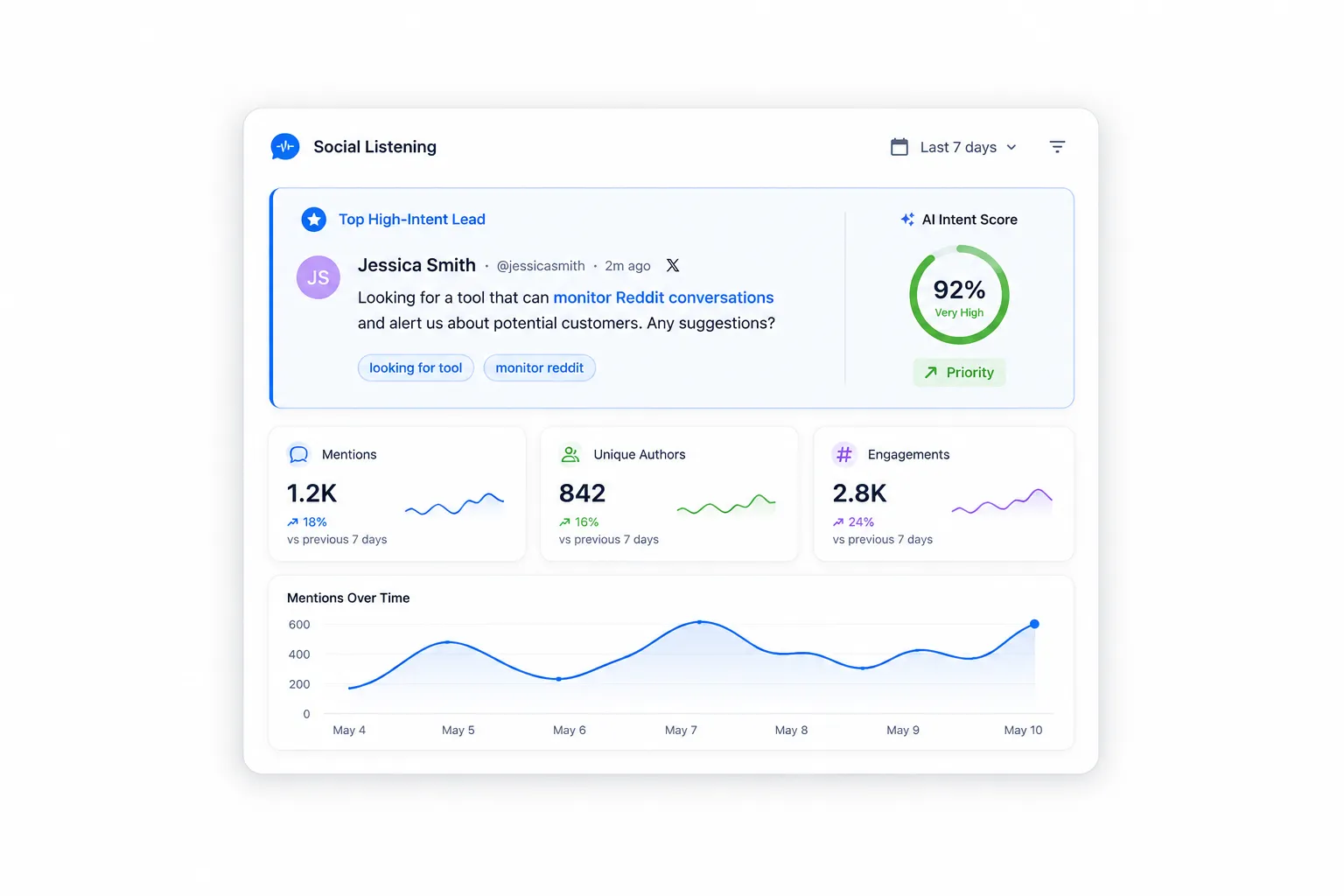
Most social listening dashboards make the same mistake.
They show you too much.
A wall of mentions. A pile of keywords. Charts that look impressive. Sentiment graphs that feel useful until you ask the real question: which conversation should I reply to right now?
That is where social listening becomes expensive.
Not because the tool costs too much, but because your team burns time reading low-value mentions, misses high-intent threads, replies too late, or jumps into the wrong conversations with the wrong message.
The best dashboard does not start with vanity data.
It starts with priority.
A good social listening dashboard should help you quickly understand where the real opportunity is, why it matters, how urgent it is, and what to do next.
This article breaks down what your dashboard should show first if you want social listening to become a lead generation workflow, not just a reporting screen.
#The First Screen Should Answer One Question
The first screen of your social listening dashboard should answer this:
“Where should I spend my attention right now?”
That sounds simple, but most dashboards do the opposite.
They show activity before importance.
They show volume before intent.
They show mentions before context.
Imagine opening your dashboard in the morning and seeing 200 Reddit mentions, 40 X posts, 12 competitor mentions, and a nice line chart showing “conversation growth.”
That might be interesting.
But it does not tell you what to do.
Now imagine opening your dashboard and seeing this instead:
-
7 high-intent conversations need review
-
3 competitor comparison threads are active
-
2 complaints mention your category
-
5 leads are new and unreplied
-
4 threads are already getting old
That is useful.
Because now the dashboard is not just showing data. It is guiding action.
#Why Priority Matters More Than Volume
Social listening can quickly become a noise machine.
A keyword match is not the same as a buyer signal.
Someone mentioning “CRM” does not mean they want to buy a CRM. Someone saying “I am tired of manually tracking leads from Reddit” is much closer to intent.
That difference matters because your time is limited.
You cannot reply to every mention. You should not try.
A good dashboard helps you separate:
Dashboard SignalWeak VersionBetter VersionMentionsEvery keyword matchMentions ranked by intentTimingNewest first onlyUrgent, active, and still worth replying toSourcePlatform nameSubreddit, thread type, audience fitContextSnippet onlyProblem, pain, competitor, and reply angleStatusSeen/unseenPending, read, replied, ignoredQualityRaw mention countAI score or lead relevance scoreThe goal is not to collect more conversations.
The goal is to find the few conversations where a helpful reply could actually create trust, traffic, or pipeline.
#Start With High-Intent Conversations
The first block in your dashboard should show high-intent conversations.
Not all mentions.
Not all posts.
Not all comments.
Just the conversations most likely to matter.
A high-intent conversation usually has one or more of these signals:
-
The person is asking for a recommendation
-
They are comparing tools
-
They are complaining about a painful manual workflow
-
They mention a competitor
-
They describe a problem your product solves
-
Other people in the thread are also discussing solutions
-
The conversation is recent enough that a reply still has value
This is especially important on Reddit.
Reddit conversations move fast. If someone asks for a tool recommendation and you find the thread three days later, you may still be able to help, but the best window is usually gone.
Speed matters.
But only after relevance.
A fast reply to the wrong thread is still a waste.
#Show Lead Quality Before Raw Activity
A dashboard that leads with “1,000 mentions found” can make you feel productive.
But it can also hide the truth.
Maybe 950 of those mentions are irrelevant. Maybe 40 are useful. Maybe 10 are worth replying to today.
That is why lead quality should come before raw activity.
For example, a better dashboard might show:
-
High-priority leads
-
Medium-priority leads
-
Low-priority mentions
-
Ignored or archived noise
This gives your team a simple mental model.
You are not “checking mentions.”
You are working a queue.
That changes how you behave.
A queue creates focus. A feed creates scrolling.
Leadmatically uses this kind of workflow by turning Reddit discovery into an operational lead queue. Instead of forcing users to manually search Reddit all day, it helps surface relevant opportunities, score them, and organize them so the next action is clearer.
#Show Status Clearly
Every useful social listening dashboard needs a clean status system.
Without status, your team will repeat work.
One person reads a lead. Another person replies without knowing the context. A third person forgets which threads were already handled.
That gets messy fast.
At minimum, your dashboard should show:
-
Pending — not reviewed yet
-
Read — reviewed but not replied to
-
Replied — action taken
-
Ignored — not relevant or not worth engaging
-
Needs follow-up — reply happened, but conversation may continue
This matters because social lead generation is not only about finding conversations.
It is about managing them.
A dashboard should make it obvious what has happened and what still needs attention.
#Show the Original Context, Not Just a Snippet
Bad dashboards show a tiny mention preview and expect you to figure everything out.
Good dashboards show enough context to make a smart decision.
Before replying, you need to know:
-
What is the person actually asking?
-
Are they venting, buying, comparing, or researching?
-
Is the thread friendly to product suggestions?
-
Has someone already recommended a competitor?
-
Would a direct product mention help, or would it feel pushy?
-
What tone is the conversation using?
This is where many teams damage trust.
They see a keyword match and rush into the thread.
The reply sounds generic because they did not understand the conversation.
A better workflow is slower at the wrong moment and faster at the right moment.
Slow down before you reply.
Speed up the discovery and prioritization.
#Show Reply Opportunity, Not Just Mention Data
A useful social listening dashboard should help you decide whether a reply makes sense.
Some conversations are good to monitor but bad to enter.
For example:
-
A user is just venting and does not want advice
-
A community is discussing a sensitive topic
-
A thread has strict self-promotion rules
-
The conversation is too old
-
Your product is only loosely related
-
The best reply is educational, not promotional
This is why your dashboard should include some kind of reply guidance.
Not a fake one-click spam button.
Real guidance.
Something like:
-
Suggested reply angle
-
Why this lead is relevant
-
What pain point was detected
-
Whether to mention the product directly or stay educational
-
Suggested next step
-
Risk level for sounding promotional
That last point matters.
A lot.
Social lead generation works when the reply feels like it belongs in the conversation.
It fails when it sounds like a sales script dropped into a human thread.
#Show Timing and Freshness
Freshness should be visible immediately.
A thread from 12 minutes ago and a thread from 4 days ago should not feel the same in your dashboard.
They require different action.
Here is a simple way to think about timing:
Conversation AgeWhat It Usually MeansBest Action0–2 hoursFresh and activeReview quickly if intent is strongSame dayStill usefulReply if the thread has momentum1–3 daysMaybe usefulReply only if context is still active4+ daysLower urgencySave for research unless still activeThis is not a hard rule.
Some Reddit threads stay active for weeks.
But your dashboard should make timing obvious, because late replies often feel less useful and less natural.
The best social listening workflows help you show up before the thread goes cold.
#Show Source Quality
Not every subreddit, X thread, or community has the same value.
A mention in a broad, noisy subreddit may matter less than one comment in a niche community full of your exact buyers.
Your dashboard should show source quality clearly.
For Reddit, useful source details include:
-
Subreddit
-
Thread type
-
Number of comments
-
Upvotes
-
Posting time
-
Original post or comment source
-
Whether the community usually allows tool recommendations
-
Whether the audience matches your ICP
For X, useful source details may include:
-
Account relevance
-
Conversation topic
-
Reply activity
-
Audience fit
-
Whether the post is asking for help or just broadcasting an opinion
The point is simple.
Your dashboard should not treat every mention equally.
A small thread with the perfect buyer can be more valuable than a viral post full of people who will never buy.
#Show Competitor Mentions Separately
Competitor mentions deserve their own section.
They are often some of the highest-intent signals in social listening.
When someone says:
“Has anyone used Tool A? Looking for alternatives.”
That is not a random mention.
That is a buying moment.
But competitor threads need careful handling.
You should not jump in with:
“Use our tool instead.”
That usually feels desperate.
A better reply might be:
“I’d compare them based on how fast they surface useful conversations, how much context they show, and whether they help you reply naturally instead of just sending alerts. Some tools are better for monitoring, others are better for turning conversations into a workflow.”
Then, if relevant, you can mention your product naturally.
The dashboard should help you identify these moments, but the reply still needs judgment.
#Show Team Workflow, Not Just Personal Notes
If more than one person touches social replies, your dashboard needs workflow features.
Otherwise, things break.
One person replies twice. Another person misses a lead. Someone marks something as handled but nobody knows what was said.
A useful dashboard should show:
-
Assigned owner
-
Current status
-
Reply history
-
Internal notes
-
Reply prompt or style used
-
Last updated time
-
Follow-up needed or not
Even for a small team, this helps.
Social selling feels casual from the outside, but internally it needs structure.
You are turning messy public conversations into a repeatable acquisition channel.
That requires more than alerts.
#A Simple Dashboard Priority Order
If you are designing or evaluating a social listening dashboard, use this order.
Do not start with charts.
Start with action.
#1. High-priority conversations
Show the best opportunities first.
These are the conversations with strong intent, recent activity, and clear relevance.
#2. Unreplied leads
Show what still needs action.
This keeps good leads from slipping through the cracks.
#3. Competitor and category mentions
Separate these because they often require a different reply strategy.
#4. Conversation freshness
Make age and urgency obvious.
A good lead that is too old may not deserve the same attention.
#5. Reply context
Show why the lead matters and what kind of reply would make sense.
#6. Analytics
Only after the action queue is clear should you show charts.
Analytics are useful, but they should not block the main workflow.
#Practical Checklist: What Your Dashboard Should Show First
Use this checklist when reviewing your current setup.
Must-HaveWhy It MattersHigh-intent lead queueKeeps attention on conversations that can become pipelineAI or manual relevance scoreHelps sort signal from noiseConversation sourceShows where the opportunity came fromFreshness indicatorHelps you reply before the thread goes coldStatus trackingPrevents duplicate work and missed repliesFull context previewHelps avoid generic or off-topic repliesReply guidanceMakes responses more useful and less promotionalCompetitor mention sectionSurfaces strong buying signalsBusiness or campaign filterKeeps workflows organized across productsAnalytics after the queueLets you measure performance without losing focusIf your dashboard does not help you decide what to do next, it is not really a lead generation dashboard.
It is just a monitoring feed.
#Where Leadmatically Fits
Leadmatically is built around the idea that social listening should not stop at finding mentions.
The useful part is the workflow after discovery.
You need to know which Reddit conversations matter, which ones are worth replying to, which ones are still fresh, and how to respond without sounding like a marketer forcing a pitch into the thread.
That is the difference between social listening as “research” and social listening as a real acquisition system.
For a deeper workflow around finding customer pain points without wasting hours, this guide is a useful next read: how to monitor Reddit for customer pain points without wasting hours.
#FAQ
#What is the most important thing in a social listening dashboard?
The most important thing is a prioritized action queue. Your dashboard should show which conversations deserve attention first, not just how many mentions were found.
#Should a dashboard show all mentions?
It can, but all mentions should not be the first thing you see. Start with high-intent, fresh, relevant conversations. Keep the full mention feed available for research.
#Why are raw mention counts misleading?
Raw mention counts measure activity, not opportunity. A dashboard can show hundreds of mentions while only a few are useful for sales, support, or reputation management.
#Should social listening dashboards include AI scores?
Yes, if the score helps explain relevance. A score is useful when it helps you prioritize leads, but it should be paired with context so users understand why the conversation matters.
#What should teams track after replying?
Track reply status, response quality, follow-up needs, and whether the conversation produced a useful outcome. The goal is not just to reply more. The goal is to build trust and create qualified pipeline.
#Final Thought
A good social listening dashboard should not make you feel busy.
It should make you sharper.
The first screen should show where the real opportunities are, why they matter, and what action should happen next.
Because the businesses that win from Reddit and social conversations are not the ones monitoring the most keywords.
They are the ones finding the right conversations early, understanding the context, and replying in a way that feels useful before anyone asks for the sale.