
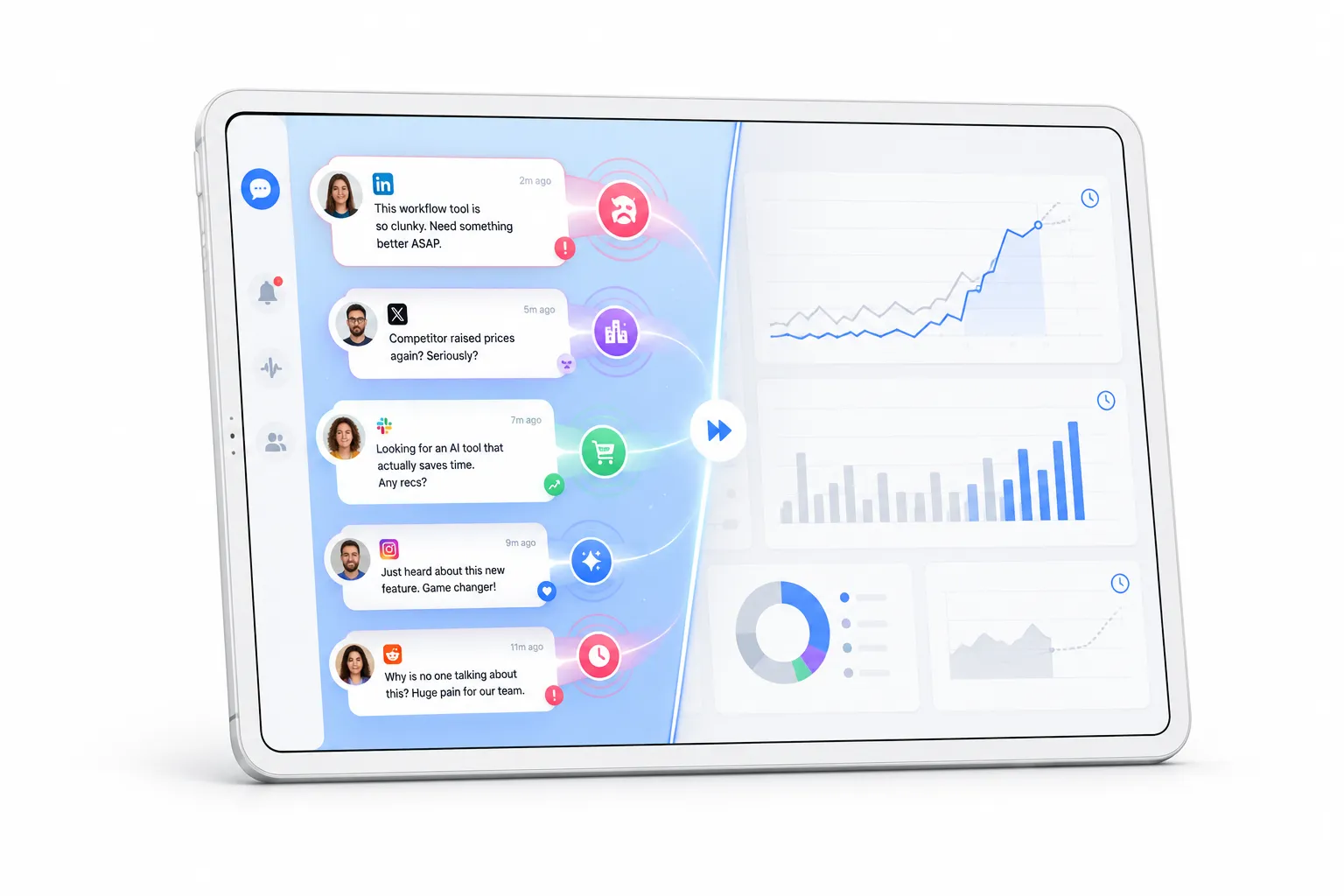
What Social Mentions Reveal Before Analytics Tools Catch Up
Most analytics tools tell you what already happened.
A visitor landed on your site. A lead filled out a form. A user clicked a button. A customer churned.
That data matters, but it usually arrives after the buyer has already made a move. By the time your dashboard shows the pattern, the conversation may have already happened somewhere else. A founder complained in a Reddit thread. A buyer asked for alternatives. A frustrated user described the exact problem your product solves. And nobody on your team saw it.
That is the gap social mentions fill.
Social mentions are not just brand alerts. They are early signals. They show what people are confused about, what they dislike about existing tools, what they are trying to buy, and what language they use before they ever touch your website.
In this article, you will learn what social mentions can reveal before analytics tools do, why those signals matter for lead generation, and how to build a simple workflow for turning public conversations into better timing, better replies, and stronger pipeline.
#Analytics Tells You the Result. Social Mentions Tell You the Reason.
Analytics is useful, but it mostly measures owned behavior.
It shows what people do on your website, product, landing page, checkout, or email flow. That helps you improve conversion paths. But it does not always explain what pushed the person there in the first place.
Social mentions happen earlier.
They show the messy thinking stage.
Someone might write:
“Has anyone found a decent alternative to this tool? It is too expensive now.”
Or:
“We are trying to solve this manually, but it is becoming painful.”
Or:
“I looked at three options and still cannot tell which one fits a small team.”
That is not just a casual mention. That is context.
The person is not filling out your form yet, but they are showing intent. They are describing a problem, comparing options, asking for help, or reacting to a bad experience.
Analytics may show the signup later.
Social mentions show the pressure that created the signup.
#Why Social Mentions Matter More Than Most Teams Think
A lot of teams treat social mentions as reputation monitoring.
That is too narrow.
Yes, you should know when people mention your brand. But the bigger opportunity is in the conversations around your category, competitors, pain points, and buying triggers.
Most buyers do not start by searching your brand name.
They start by describing the problem.
They ask questions like:
-
“How do I find customers from Reddit without spamming?”
-
“What are people using instead of cold email?”
-
“Is there a tool that monitors Reddit comments for leads?”
-
“How do small SaaS teams find buying intent on social?”
-
“Any alternative to [competitor] for social listening?”
These conversations often happen before the person searches Google, compares pricing pages, or books a demo.
That is why they are valuable.
You are seeing demand while it is still forming.
#The Problem With Waiting for Dashboard Data
Imagine you run a SaaS product for agencies.
Your analytics dashboard shows that traffic from Reddit went up last week. Nice. You check the source, see a spike, and maybe try to find where it came from.
But the real opportunity may already be gone.
A Reddit thread from four days ago mentioned your category. Several people asked for recommendations. A competitor was suggested three times. A few people complained that the existing options were too expensive.
By the time you notice traffic in analytics, the thread is cold.
People have already read the replies. They have already clicked competitors. They may have already chosen a tool.
This is the timing problem.
Traditional analytics helps you understand performance after attention arrives. Social mention tracking helps you notice the attention while it is still active.
That difference matters a lot.
#What Social Mentions Can Tell You Early
Social mentions can reveal several things that analytics tools usually miss or show too late.
#1. Buyer Pain Before Search Intent Appears
People often describe pain before they know what solution to search for.
They may not type “Reddit lead generation software” into Google yet. But they might say, “I spend too much time searching Reddit for people who might need our product.”
That is a buying signal.
The person has not named the category, but the pain is clear.
This is where good social monitoring becomes powerful. You are not only tracking keywords. You are watching for problem language.
Bad signal tracking only catches exact matches.
Better signal tracking catches the situation behind the words.
#2. Competitor Frustration Before Churn Happens
Analytics tools can show when your users churn.
Social mentions can show why people are getting ready to switch before they become your users.
A competitor’s customer might complain about pricing, poor support, missing features, confusing setup, or weak results.
That does not mean you should jump in with a pitch.
But it does mean there is a market signal.
If ten people in your category are complaining about the same issue, that is not random noise. That is positioning insight, product insight, and sales insight at the same time.
You can use it to sharpen your messaging.
You can also respond helpfully when the thread makes sense.
#3. The Exact Words Buyers Use
Your landing page might say:
“AI-powered social intent discovery.”
But your buyers might say:
“I just want to know when someone on Reddit is asking for a tool like mine.”
That gap is important.
Social mentions show real customer language. Not polished marketing language. Not internal team language. Real wording from people who are confused, annoyed, curious, or actively comparing options.
This helps with:
-
landing page copy
-
blog titles
-
paid ad angles
-
sales replies
-
onboarding language
-
product positioning
-
FAQ sections
The closer your copy gets to how buyers already describe the problem, the easier it is for them to trust that you understand it.
#4. Objections Before Sales Calls
Some objections never reach your sales calls because the buyer disqualifies you earlier.
They might ask publicly:
“Does this kind of tool make replies sound spammy?”
Or:
“Can this work if I do not want to use my own Reddit account?”
Or:
“Is Reddit lead generation even worth it for B2B?”
Those are objections.
If you notice them early, you can answer them in content, product pages, docs, onboarding, and replies.
Analytics might show that people visited your pricing page and left.
Social mentions might show the concern that made them hesitate.
#5. Demand Patterns Before They Become Reports
One mention can be random.
Repeated mentions are a pattern.
If people keep asking about the same problem across Reddit and X, that is useful market feedback. It shows that the pain is not only in your head.
Maybe founders are tired of cold outreach. Maybe agencies want warmer leads. Maybe SaaS teams want to monitor competitor mentions. Maybe ecommerce brands want to track customer complaints before they spread.
A good mention workflow helps you notice these patterns early, long before they become obvious in analytics reports.
#Social Mentions vs Analytics: What Each One Is Good For
You do not need to choose one.
You need to understand the job of each.
Signal TypeWhat It ShowsWhen It Helps MostMain WeaknessWebsite analyticsWhat visitors do on your siteImproving pages, funnels, conversion paths, and traffic qualityUsually shows behavior after interest already existsProduct analyticsWhat users do inside your productImproving activation, retention, usage, and feature adoptionDoes not show what non-users are saying elsewhereCRM dataWhat sales conversations turn into pipelineTracking deals, follow-ups, and revenue stagesMisses people who never entered your funnelSocial mentionsWhat buyers say in public before they convertFinding pain, intent, objections, competitor gaps, and timing windowsNeeds filtering so you do not chase noisy conversationsThe simple version:
Analytics shows behavior. Social mentions show motivation.
You need both.
#The Real Value Is Not the Mention. It Is the Timing.
A mention by itself is not magic.
The value comes from seeing the right mention early enough to act on it.
A Reddit thread has a short attention window. The first few helpful replies often shape the conversation. Late replies can still help, but they usually have less impact.
That is why speed matters.
Not spammy speed. Not “rush in and pitch your product” speed.
Helpful speed.
There is a big difference.
Bad response:
“Try our tool. It does exactly this. Sign up here.”
Better response:
“I have seen this problem a lot with teams trying to monitor Reddit manually. The hard part is usually not finding one thread. It is catching the right thread before it goes cold and replying in a way that fits the discussion. I would start by tracking pain phrases, competitor names, and alternative requests separately.”
The second reply builds trust.
It gives value before asking for anything.
That is the kind of timing social mentions make possible.
#What Bad Social Mention Monitoring Looks Like
A weak workflow usually looks like this:
You search Reddit when you remember. You track a few obvious keywords. You open ten irrelevant threads. You reply to one, but it is already old. You sound slightly promotional because you are trying to make the effort worth it. Then you stop doing it consistently.
That is not a strategy.
That is manual hunting.
It feels busy, but it does not create a repeatable acquisition channel.
The problem is not that Reddit or social conversations do not work. The problem is that the workflow is too random.
#What a Better Workflow Looks Like
A better workflow starts with signal quality.
You are not trying to monitor everything. You are trying to catch conversations that suggest real need.
Here is a simple framework.
#Step 1: Track Pain, Not Just Keywords
Do not only track your product category.
Track phrases people use when they are struggling.
For example:
-
“looking for an alternative”
-
“too expensive”
-
“does anyone know a tool”
-
“how do I find”
-
“manual process”
-
“wasting time”
-
“not scalable”
-
“recommendations for”
-
“what are you using for”
These phrases reveal intent better than broad keywords.
A keyword tells you the topic.
Pain language tells you why the topic matters.
#Step 2: Separate Mention Types
Not every mention deserves the same response.
Group mentions into buckets:
Mention TypeWhat It MeansBest ResponsePain mentionSomeone describes a problemExplain the problem clearly and offer a practical next stepCompetitor complaintSomeone is frustrated with another toolBe helpful, avoid attacking the competitor, explain what to compareAlternative requestSomeone asks for optionsGive a balanced recommendation and mention your product only if it fitsCategory questionSomeone is learning the spaceTeach first, then show what a good workflow looks likeBrand mentionSomeone mentions your product directlyRespond quickly, clearly, and with useful contextObjection mentionSomeone worries about risk, spam, cost, or trustAddress the concern honestlyThis keeps your replies from sounding forced.
It also helps you avoid treating every mention like a sales opportunity.
#Step 3: Score Conversation Quality
A good mention workflow should not send every thread to your team.
Some conversations are too vague. Some are too old. Some are from people who are not your buyer. Some are just general discussion.
Score mentions based on:
-
relevance to your product
-
urgency of the problem
-
freshness of the thread
-
buyer fit
-
reply opportunity
-
competitor involvement
-
clarity of pain
-
likelihood of trust-building
This is where tools like Leadmatically fit naturally.
Leadmatically monitors Reddit and X for relevant conversations, helps surface qualified leads, and supports reply workflows so you are not manually searching, guessing, and replying late. For teams trying to turn Reddit into a real acquisition channel, that solves the discovery and timing problem at the same time.
For a more tactical setup, this guide on how to monitor Reddit for customer pain points without wasting hours is a useful next read.
#Step 4: Reply Like a Person, Not a Campaign
A social mention is not a landing page visit.
The person did not ask to be sold to.
They joined a conversation.
So your reply has to match the room.
A good reply usually does three things:
-
Acknowledges the exact problem
-
Adds something useful
-
Mentions a next step only if it genuinely fits
The order matters.
Help first. Context second. Product last, if at all.
That is how you avoid sounding automated, desperate, or off-topic.
#A Practical Checklist for Acting on Social Mentions
Use this before replying to a mention.
QuestionWhy It MattersIs the thread recent enough to matter?Late replies often get ignored, especially on fast-moving discussionsIs the person describing a real problem?Pain is stronger than a broad topic mentionDoes the person match your target customer?Not every interested person is worth pursuingIs the conversation asking for help, options, or advice?These are better openings than random mentionsCan you add value without pitching?If not, do not reply yetWould your reply feel natural if your brand name was removed?This is a strong test for trustIs there a clear next step?Good replies should reduce confusion, not create more noiseThis checklist protects your reputation.
It also improves conversion because your replies feel more relevant.
#The Mistake: Treating Mentions Like Leads Too Early
A social mention can become a lead.
But it is not always a lead yet.
This is where many teams get too aggressive.
They see someone mention a pain point and immediately try to move them into a sales motion. That often backfires because the person may still be exploring, venting, or asking peers for advice.
You need to match the stage.
If someone says:
“I hate manually searching Reddit for potential customers.”
Do not immediately say:
“Book a demo.”
Say something useful first.
Explain what makes manual Reddit prospecting hard. Mention the difference between keyword tracking and intent tracking. Suggest a small workflow. Then, if relevant, mention that tools like Leadmatically can automate discovery and help teams catch these threads earlier.
That feels natural because it follows the conversation.
#The Better Mental Model: Public Conversations Are Pre-Funnel Data
Most teams think the funnel starts when someone reaches their website.
It starts earlier.
It starts when the buyer feels the pain strongly enough to talk about it.
That could happen in:
-
a Reddit thread
-
an X post
-
a comment under a competitor announcement
-
a community discussion
-
a comparison request
-
a complaint about pricing
-
a question about workflows
-
a recommendation thread
These are pre-funnel signals.
They help you understand demand before it becomes measurable traffic.
This is also why social mentions are useful beyond sales.
They can improve your whole go-to-market motion.
#How Social Mentions Improve Your Content Strategy
If you write content only from keyword tools, your articles may miss the emotional reason people search.
Social mentions fix that.
They show the exact problems people are trying to solve.
For example, a keyword tool might tell you:
“reddit monitoring tool”
But social mentions might show people asking:
“How do I know when someone talks about my product on Reddit before the thread blows up?”
That second version is sharper. It has pain, timing, and urgency.
You can turn that into a better blog angle, landing page section, or comparison page.
Good content does not just target keywords.
It answers the conversation already happening in the market.
#How Social Mentions Improve Product Positioning
Social mentions also reveal what buyers actually care about.
Maybe you think your best feature is AI scoring.
But buyers keep asking about response timing.
Maybe you think the main problem is finding leads.
But buyers keep complaining that replies sound spammy.
Maybe you think teams want more volume.
But the market is telling you they want fewer, better conversations.
That is positioning gold.
It helps you stop selling the feature your team likes and start explaining the outcome buyers already want.
For Leadmatically, that outcome is not “more social noise.”
It is a cleaner workflow for finding relevant Reddit and X conversations, responding at the right time, and building trust before asking for anything.
#How Social Mentions Improve Sales Replies
Sales replies often fail because they answer the wrong question.
The buyer may ask about features, but underneath they are worried about effort, timing, trust, or risk.
Social mentions help you see those worries earlier.
If people in your market keep saying, “I do not want to sound spammy on Reddit,” then your replies should not just say, “We monitor Reddit.”
They should explain how to find relevant conversations and respond in a way that fits the context.
That is a better sales angle.
It speaks to the real fear.
#A Simple Weekly Social Mention Workflow
You do not need a huge team to start.
Use this simple weekly process.
#Monday: Review New Signals
Look at the strongest mentions from the past week.
Separate them into:
-
pain points
-
competitor mentions
-
alternative requests
-
product questions
-
objections
-
brand mentions
Do not chase everything.
Look for patterns.
#Tuesday: Turn Patterns Into Content Ideas
Pick two or three repeated problems and turn them into useful content.
That could be:
-
a blog post
-
a comparison guide
-
a landing page FAQ
-
a short LinkedIn post
-
a Reddit reply template
-
a support article
The goal is to make your content match the market’s actual language.
#Wednesday: Improve Reply Playbooks
Look at replies that felt natural and replies that felt forced.
Build better templates, but do not make them robotic.
A good reply playbook should guide tone and structure, not copy-paste the same pitch everywhere.
#Thursday: Update Positioning
Ask:
-
What problems are buyers repeating?
-
What competitors are they comparing?
-
What objections keep appearing?
-
What words do they use?
-
What outcomes do they actually want?
Use those answers to improve your homepage, pricing page, and product messaging.
#Friday: Follow Up on Active Conversations
Some threads deserve follow-up.
Not with pressure.
With useful extra context.
If someone asked for options and you replied helpfully, check whether they had another question. If a discussion expanded, add something useful. If the conversation is done, leave it alone.
This is how social selling stays human.
#What to Avoid When Using Social Mentions
Social mentions can become a bad channel fast if you use them poorly.
Avoid these mistakes:
-
replying to every mention
-
using the same pitch repeatedly
-
pretending to be neutral when you are not
-
attacking competitors
-
dropping links without context
-
replying too late with a forced sales message
-
tracking broad keywords that create noisy alerts
-
ignoring the tone of the thread
-
treating Reddit like a cold email inbox
Trust is fragile in public communities.
One bad reply can do more harm than ten missed opportunities.
#FAQ
#Are social mentions the same as brand mentions?
Not exactly. Brand mentions are when people mention your company or product directly. Social mentions are broader. They can include category keywords, competitor names, pain points, alternative requests, and buying signals related to your market.
#Why are social mentions useful if I already have analytics?
Analytics shows what happens on your owned channels. Social mentions show what buyers are saying before they reach those channels. You need both because they answer different questions.
#Should I reply to every relevant mention?
No. Reply only when you can add value and the conversation is recent, relevant, and appropriate. A quiet mention is sometimes better used as research for content or positioning.
#What makes a social mention high intent?
A high-intent mention usually includes pain, urgency, comparison, frustration, or a request for recommendations. For example, “What tool should I use for this?” is stronger than a general mention of a topic.
#Can social mentions help with SEO?
Yes, but indirectly. They reveal real buyer language, pain points, objections, and content ideas. That can help you write more useful pages that match what people actually care about.
#Final Thought
Analytics tools are still important.
But they are not enough.
They show you the numbers after people move. Social mentions show you the thinking before they move.
That is where the advantage is.
When you can spot the right conversations early, understand the pain behind them, and reply with context instead of promotion, social channels become less random. They become a real demand signal.
Leadmatically helps make that workflow repeatable by monitoring Reddit and X, surfacing relevant conversations, and supporting human-style replies that fit the context.
Not more noise.
Better timing. Better signals. Better conversations.